
Cerebras ($CBRS) Trading Plan: Next $NVDA Killer or Cathie Wood Trap?
Is $CBRS the next $NVDA? Dive into our Cerebras Systems trading plan after Cathie Wood's $46M ARK buy. Precise entry zones, targets, & bear risks exposed.
STOCK ANALYSISMOMENTUM STOCKSINSTITUTIONAL FLOWAI & TECH
Headline: Cathie Wood’s New Bet? Why Cerebras Systems ($CBRS) is Dominating the AI Conversation
The semiconductor landscape is experiencing a massive structural shift, and Cerebras Systems Inc. (NASDAQ: $CBRS) has taken absolute center stage. If you’ve been watching the tickers lately, you’ve likely noticed the explosive buzz—and the intense volatility—surrounding this newly public AI hardware player. After its blockbusting debut on May 14, the stock has quickly become a battleground for retail momentum chasers, institutional giants, and short-term traders alike.
The immediate catalyst driving today's massive spike in Google searches is clear: Cathie Wood’s ARK Invest is aggressively accumulating the stock. According to recent daily trade disclosures, ARK has been systematically trimming stakes in legacy players like $AMD to fund multi-million-dollar buys into $CBRS for both the ARK Innovation ETF ($ARKK) and the ARK Next Generation Internet ETF (ARKW). When ARK makes a concentrated rotation like this, retail money notices.
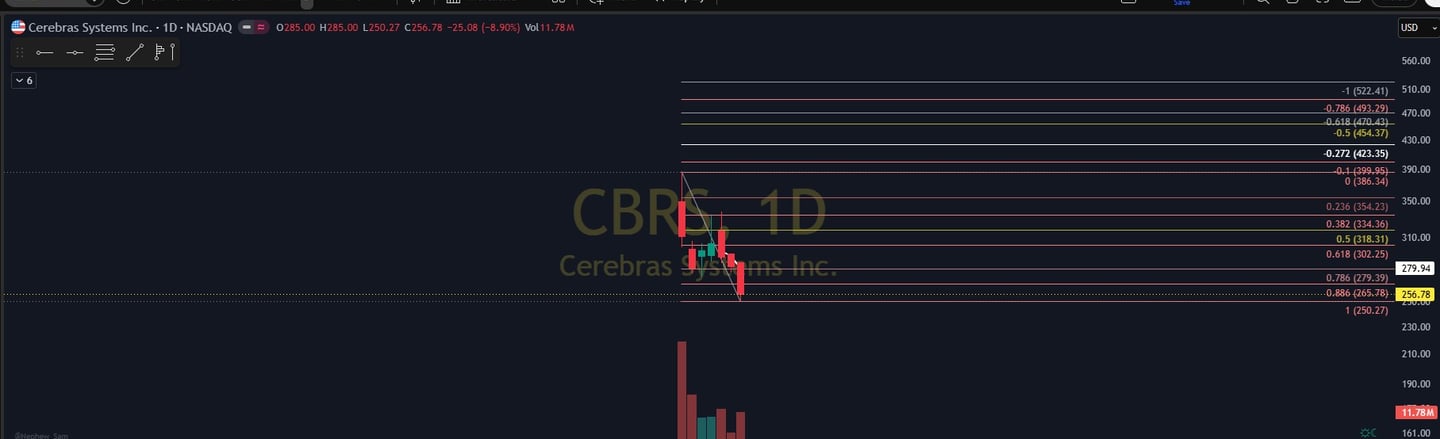
On Friday, May 22, $CBRS closed down roughly 8.9% to finish at $256.78. For active traders, a sharp post-IPO cooling period like this isn't a reason to panic—it’s an invitation to map out an institutional-grade game plan.
The Technology: What Makes Cerebras Different?
To understand why Cathie Wood is willing to sell off liquid giants to chase a recent IPO, you have to look at the hardware architecture. Traditional AI infrastructure relies on clustering thousands of individual, relatively small graphics processing units (GPUs) manufactured by companies like $NVDA or $AMD. The massive engineering challenge in that model is data latency; moving information between thousands of tiny, separate chips creates communication bottlenecks.
Cerebras takes the exact opposite approach with its proprietary "Wafer-Scale Engine" (WSE-3). Instead of cutting a silicon wafer into hundreds of small chips, Cerebras uses the entire undivided wafer to build one singular, giant processor—roughly the size of a dinner plate.
By keeping 44 gigabytes of on-chip SRAM on a single piece of silicon, data never has to leave the processor during heavy AI inference or training workloads. Cerebras publicly claims this architectural edge allows its infrastructure to deliver processing speeds up to 15 to 20 times faster than standard GPU clusters for specific AI workloads. For an asset manager like Wood, who builds portfolios entirely around high R&D spend and disruptive engineering, this is the textbook definition of a frontier technology pla
The Bull Case: Hidden Profitability Potential
From a fundamental perspective, there is a compelling narrative forming under the surface of Cerebras' financial statements. While the company is young and currently operates with negative GAAP operating income, it boasts a remarkably high net profit margin structure of 46.63% on its core unit economics.
This suggests that the business model is highly scalable. Cerebras is currently building on a trailing revenue base of approximately $509 million. If the company can successfully scale production and fulfill its growing enterprise pipeline, those high underlying margins mean it has the potential to convert future revenue into an absolute cash-flow machine.
Furthermore, management isn't running on financial fumes. With a healthy current ratio of 2.39, the balance sheet has a solid short-term liquidity buffer. This financial cushion gives them the runway needed to fund its aggressive research and development pipeline—which recently clocked in at $243 million—without being forced into immediate, dilutive capital raises.
The Bear Case: High Burn and Extreme Valuation
However, clean technical charts and structural innovations don't mean you should blindly buy the hype. The bear case for $CBRS is rooted in a very steep valuation and aggressive capital consumption.
Trading at a price-to-earnings (P/E) ratio of approximately 156.67, the market has already priced a staggering amount of flawless execution into the current stock price. At 156x earnings, any future delay in chip shipments, component shortages, or missed quarterly guidance could trigger an immediate, punishing correction.
Additionally, pioneering an entirely new manufacturing process for plate-sized chips is an incredibly capital-intensive endeavor. Cerebras recently reported a levered free cash flow of -$622.9 million. They are burning significant cash to sustain their competitive technological lead and scale up manufacturing facilities.
Combine that cash burn with severe short-term volatility—where the stock plunged from its post-debut high of $311 down to $256 in just over a week—and it becomes obvious that this asset requires strict risk management parameters.
The Actionable Trading Plan for CBRS
For disciplined traders, high volatility simply means high opportunity, provided you use precise price levels rather than raw emotion. Given the stock's recent 8.9% decline down to $256.78, the asset is rapidly approaching a highly attractive technical inflection point.
Here is how to structure a risk-defined trading setup based on current market data:
The Entry Zone ($240.00 – $250.00): Do not chase the stock on sudden morning spikes. Instead, look to build or scale into a position if price pulls back into the $240.00 to $250.00 range. This area aligns closely with newly established post-IPO technical support and offers a highly favorable risk-to-reward ratio.
Short-Term Price Target ($280.00): If support holds in the entry zone, the initial structural target is $280.00. This level represents a natural resistance point near the May 21 closing print and serves as an ideal spot to take partial profits or lock in gains on short-term swing trading positions.
Mid-Term Price Target ($310.00): For a larger macro move, the secondary target is $310.00. A break above short-term resistance sets up a clean retest of the historical post-IPO highs established on May 14.
The Stop Loss (Below $230.00): Capital preservation is paramount on high-beta tech stocks. A daily close below $230.00 signals a definitive breakdown of the current support structure and invalidates the b
The Bottom Line
Whether you view Cerebras Systems as a revolutionary hardware giant capable of taking market share from Nvidia, or an overhyped, high-multiple IPO destined to cool off, one thing is certain: it is going to remain a primary driver of volume in the AI sector for the foreseeable future.
Chasing the "Cathie Wood Bump" without a clear strategy is a fast way to get caught on the wrong side of a momentum shift. Keep your position sizing conservative, stick strictly to your defined entry zones, and let the market structure dictate your execution.
TL;DR: $CBRS Action Plan
Cerebras Systems (NASDAQ: $CBRS) is giving us a textbook high-beta trading setup. After an absolute moonshot of an IPO, the stock has undergone a massive structural flush, closing at $256.78. With a print hovering right above its post-IPO lows and a 14-day RSI sitting in deep oversold territory at 23.42, the rubber band is stretched incredibly tight.
Whether you are looking to buy the blood on a reversal or short a weak relief rally, here is exactly how to structure your risk on both sides of the tape.
Setup 1: The Bullish "Cathie Wood" Reversal
The Strategy: Catching the knife on a high-probability risk-to-reward bounce off structural support.
The Entry Zone: $250.00 – $257.00. You want to accumulate shares as close to the post-IPO floor ($250.27) as possible.
First Target (The Gap Fill): $281.86. This is your immediate spot to take partial profits and move your stops to break even.
Second Target (The Macro Test): $311.00. Looking for a full retest of the prior May resistance levels.
The Hard Stop: $245.00. Keep the risk tight. If the $250 psychological floor snaps, a massive trap door opens underneath. Cut the loss and walk away.
Setup 2: The Bearish "Growth Flush" Continuation
The Strategy: Shorting into a failed relief rally to ride the broader downward momentum.
The Entry Zone: $280.00 – $290.00. Do not short the lows. Wait for a dead-cat bounce to exhaust itself near the overhead resistance and moving averages.
First Target (The Base Test): $250.00. Looking for a retest and potential breakdown of the recent lows.
Second Target (The Macro Flush): $209.25. The next major historical support level if the valuation completely deflates.
The Hard Stop: $305.00. If the price reclaims the psychological $300 level, the bears are trapped. Cover immediately.
Cheat Sheet: CBRS Levels To Watch
Metric / LevelPriceTrading ContextCurrent Price$256.78Hovering just above the post-IPO baseline.Primary Support $250.27. The ultimate line in the sand that bulls must defend. Primary Resistance $288.63 Overhead supply zone; key moving average resistance.14-Day RSI $23.42 Deeply washed out. Expect high intraday volatility.