Market News: Fed Minutes, PCE Inflation & Tech Rotation (Feb 16-20)
Weekly Market Pulse for Feb 16-20, 2026. We breakdown the 5 mega-themes driving stocks, including the FOMC Minutes, PCE Inflation, Walmart earnings, and the growing AI tech rotation.
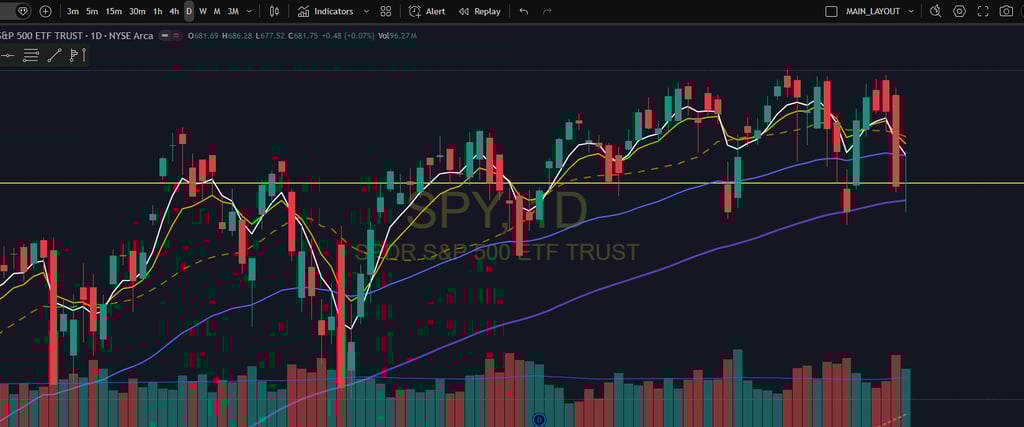
WEEKLY STOCK MARKET OUTLOOKSPY
Weekly Market Pulse: The 5 “Mega-Themes” Driving Stocks This Week (Feb 16–Feb 20)
Date: February 16, 2026
The Setup: A Collision of Macro and Micro
This is one of those weeks where “the market” won’t trade on one headline — it’ll trade on the interaction between macro data, Federal Reserve messaging, and a few key earnings that act like economic seismographs.
The big narrative shift:
Last week’s question wasn’t just “how high can tech go?” — it was “is the market broadening, or is leadership cracking?” That matters because broad participation usually supports sustained uptrends, while narrow leadership tends to create fragile rallies and violent reversals.
Below is the playbook for the week — what matters, why it matters, and what to watch so you’re reacting to information instead of headlines.
1) The Fed Focus: FOMC Minutes & the Rate-Cut Narrative
The FOMC minutes are the “behind the scenes” of the last Fed meeting — and traders read them for one reason: to handicap the next policy move before it’s obvious.
What the market is really hunting for:
- Confirmation (or denial) that cuts are getting closer
- How concerned the Fed is about inflation re-accelerating
- Whether the Fed thinks financial conditions are “too loose” (markets rallying too hard, too fast)
The “tells” to watch in the minutes:
- Language that suggests inflation progress is “stalled” vs. “continuing”
- Any emphasis on services inflation, wages, or housing
- Discussion about “restrictive policy” needing to remain in place longer than markets expect
- Concerns about risk assets rallying and undoing the Fed’s work (this can be a volatility trigger)
Market impact cheat sheet:
- Hawkish tilt (less dovish than expected): yields up, USD firmer, growth multiples compress → pressure on QQQ and high-multiple tech
- Dovish tilt (more comfortable with disinflation): yields down, risk assets catch a bid → growth and small caps can pop
2) The Inflation Spotlight: PCE Data (The Fed’s Favorite Number)
The Personal Consumption Expenditures report matters because it’s the inflation gauge the Fed tends to lean on when shaping policy.
But traders don’t just watch the headline number — they focus on:
- Core PCE (strips food/energy)
- Month-over-month trend (the “momentum”)
- Whether inflation is sticky in services vs. easing across categories
Why PCE can “change the tape” fast:
PCE influences the path of interest rates, and interest rates influence equity valuations — especially in growth stocks. If rates spike, growth often pays the price first.
Market impact cheat sheet:
- Hot PCE: yields up → growth underperforms; defensive/value may hold up better
- Cool PCE: yields down → tech/growth relief; risk appetite improves
- “Mixed” PCE: whipsaw risk increases (initial spike then reversal is common)
3) Sector-Moving Earnings: The Consumer vs. The Enterprise
Earnings season isn’t just about beats and misses — it’s about forward guidance. This week has two reports that can influence multiple sectors because they represent two pillars of the economy: consumers and corporations.
A) Walmart (WMT): The U.S. Consumer Proxy
WMT is a read-through on household behavior — especially as consumers adjust to inflation, interest rates, and shifting job conditions.
What matters more than EPS:
- Same-store sales trends
- Margins (cost pressures and pricing power)
- Inventory levels (clean inventory = healthy demand; bloated inventory = discounting)
- Guidance that signals trade-down behavior (consumers buying cheaper items, smaller basket sizes)
How it can ripple:
- Strong guidance → retail and staples sentiment improves (and it supports “soft landing” confidence)
- Weak guidance → “consumer slowdown” fears resurface, and cyclicals can feel it
B) Palo Alto Networks (PANW): Enterprise Spend + Cybersecurity Signal
PANW often acts like a pulse check on corporate IT budgets and cybersecurity priorities.
What to watch:
- Billings and remaining performance obligations (forward demand signals)
- Guidance on enterprise deal cycles (are deals taking longer to close?)
- Commentary on budget scrutiny and discretionary software spend
- Any talk that suggests security remains “non-negotiable” even if spending slows elsewhere
How it can ripple:
- Strong demand signal → boosts confidence across cybersecurity/software
- Weak demand signal → can pressure software broadly (risk-off for IGV-style names)
4) The “Tech Rotation” & AI Volatility: A Market That’s Becoming Pickier
One of the most important developments isn’t a single event — it’s the market’s changing personality.
What “rotation” really means:
Money moves from the most crowded winners (often mega-cap growth) into other areas that were left behind. This is not automatically bearish — it can be bullish if the market is broadening. But it can also be a warning if leadership is failing and buyers are getting selective.
What to watch to confirm rotation vs. breakdown:
- Does the equal-weighted market outperform the cap-weighted market?
- Do financials/industrials/energy hold bids on red tech days?
- Do dips get bought broadly, or only in a handful of names?
AI volatility angle:
AI is still a tailwind — but it also creates disruption risk. New tools can change winners and losers quickly, especially in software. That means traders may start rewarding “proof” (earnings + guidance) instead of stories.
Translation: this can become a stock-picker’s environment where:
- strong fundamentals get rewarded
- weak guidance gets punished harder than usual
- indexes can chop even while individual names trend sharply
5) The Macro Data Cluster: The Daily “Risk-On / Risk-Off” Fuel
Beyond the big marquee catalysts, the week includes the typical macro cluster — growth reads, housing data, and PMI-style business activity.
Why this matters:
Macro prints influence bond yields and recession/soft-landing odds — and those odds influence sector leadership.
Interpretation framework:
- Resilient housing + solid PMIs → supports “soft landing,” helps cyclicals and small caps
- Weak housing + falling PMIs → recession fears creep in, defensives and quality often lead
- Mixed macro → chop and range trading becomes more likely
In these weeks, the best traders aren’t predicting — they’re mapping scenarios and reacting.
Your Daily Watchlist Summary (Quick Reference)
Theme: FOMC Minutes
Why it matters: Signals the Fed’s comfort level with inflation progress and rate-cut timing.
Typically moves: SPY, QQQ, bond yields, USD, high-multiple tech.
Theme: PCE Inflation
Why it matters: Major inflation input to Fed expectations; impacts yields and valuation multiples.
Typically moves: bond yields first, then growth vs. value leadership.
Theme: WMT Earnings
Why it matters: Proxy for U.S. consumer strength and pricing power.
Typically moves: retail (XRT), staples, and broader “soft landing” sentiment.
Theme: PANW Earnings
Why it matters: Proxy for enterprise tech budgets and cybersecurity demand.
Typically moves: cybersecurity/software complex, sentiment across growth tech.
Theme: Macro Data Cluster (housing, PMI, growth reads)
Why it matters: Daily risk-on/risk-off fuel; influences recession vs. soft landing narrative.
Typically moves: sector rotation, IWM sensitivity, overall volatility.
How to Use This Post (Simple Trading Mindset)
- Don’t overtrade the headline: watch the reaction in yields and index breadth.
- Let the market pick the theme: the strongest theme becomes the dominant driver for that session.
- Track confirmation: broad participation = healthier trend; narrow leadership = fragile tape.
Disclaimer: This analysis is for educational purposes only. Trading stocks involves risk, and past performance does not guarantee future results.