$SPX Key Levels — 6520 Line in the Sand | Trade Plan, Targets & Pre‑Market Checklist
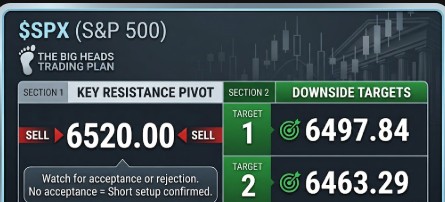
S&P 500 ($SPX) key intraday level at 6520 — targets 6497.84 and 6463.29. Practical pre‑market checklist, intraday setups (gap & fade, breakout), watchlist, and risk rules for traders. Educational content only.
SPYSPX
$SPX Key Levels — 6520: The Line in the Sand
Intro: 6520.00 on $SPX is the level of the day — the line in the sand. If price rejects here, the precise downside targets to watch are 6497.84 and 6463.29. Use these levels as your roadmap for pre‑market sizing, intraday entries, stops, and profit targets. This page is written to be practical, repeatable, and easy to act on in tomorrow’s session.
Why these levels matter:
6520 — decision pivot: acceptance above = bullish continuation; rejection = short‑term bearish edge.
6497.84 — first precise downside target; common first support objective for gap fills or measured moves.
6463.29 — secondary support / next structural target; useful for swing traders if early momentum continues.
Context: event catalysts, macro headlines, and overnight futures gaps will change how price reacts to these levels — always confirm with price action and volume.
Quick signals to watch (pre‑open and early open):
Futures gap size on ES/NQ: quantify % gap vs prior close; >0.5% to 1% increases the odds of a tradable move.
Crude oil (CL) and sector leadership: energy and defensive rotations affect SPX flow.
Pre‑market strength/weakness in $SPY, $QQQ, $IWM; note which ETF leads.
Volume confirmation: use rising volume on breakouts and low/declining volume on failed attempts.
Pre‑market checklist (do this before market open):
Note overnight ES gap % and CL direction.
Mark 6520, 6497.84, 6463.29 on your chart for $SPX / $SPY / $IWM.
Scan pre‑market movers for energy/defense/financials leadership.
Check option IV and liquidity for any option trades you plan (prefer defined‑risk spreads if IV elevated).
Set maximum risk per trade (percent of account or $ cap) and stick to it.
Concrete intraday setups (templates you can apply) A. Gap & Fade (mean reversion)
Use when SPX gaps sharply (up or down) but shows early exhaustion.
Entry: fade into the gap on rejection candles or wick prints within first 30–60 minutes.
Stop: a little beyond recent swing high/low or fixed % (ETF context: 0.5–1.5%).
Target: VWAP, mid‑gap, or first target 6497.84 then 6463.29 if momentum continues.
B. Breakout Continuation (momentum)
Use when price accepts above 6520 with rising volume and futures confirm.
Entry: on clean breakout above the pre‑market / morning high with follow‑through.
Stop: below breakout candle low or a percentage band.
Target: measured move; trail stops to capture extended trend.
C. Defined‑Risk Option Plays
Directional debit verticals on SPY/QQQ/IWM when you have a clear bias and IV is high.
Avoid naked short premium into event-driven volatility; consider verticals instead.
For scalpers using 0DTE: trade tight spreads, watch bid/ask, and set strict time stops.
Sector plays tied to tone:
De‑escalation / dovish tone → oil likely softens; consider energy short/bear spreads or rotate to cyclicals.
Escalation / hawkish tone → oil rallies and defense names outperform; consider energy/defense long plays.
Example morning plan (step‑by‑step)
Pre‑open: note CL and ES moves; if CL down >1% and ES flat/up, bias risk‑on.
Open (first 15–30 min): observe whether SPX accepts above 6520 (bull bias) or rejects (fade setups).
Execute: trade either gap fade into VWAP or clean breakout above 6520 with volume confirmation.
Manage risk: fixed stop + profit target (1–2R) and trailing stop once position in profit.
If first target hits and price accelerates, consider scaling out and letting a portion run with a trailing stop toward 6463.29 or further.
Watchlist (primary)
SPY, QQQ, IWM (index ETF flow)
XOM, CVX, OXY (energy sensitivity)
LMT, RTX, GD (defense sensitivity)
GLD, TLT (safe haven indicators)
VIX (volatility gauge)