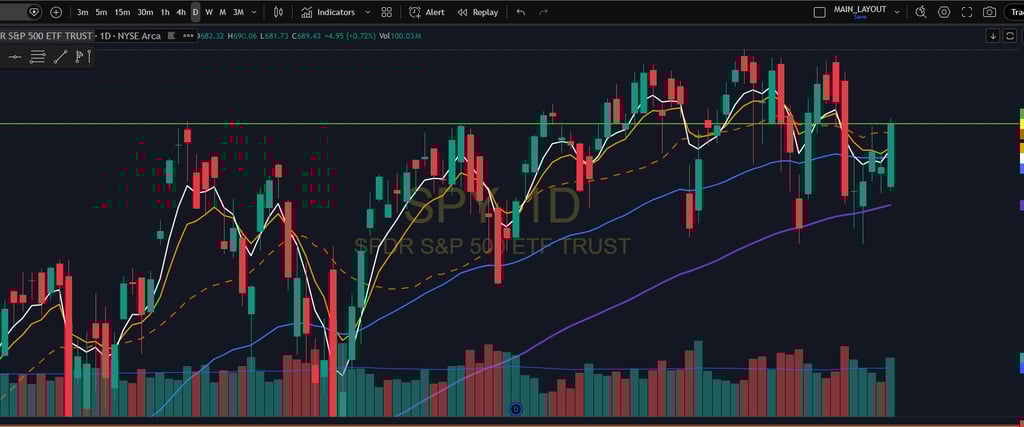
SPY Weekly Outlook: Tariff Whipsaw Week (Feb 23–27, 2026)
SPY weekly outlook for Feb 23–27, 2026: markets are headline-driven after the Supreme Court struck down IEEPA-based tariffs and a new time-limited global tariff was announced under Section 122 (with follow-on talk of raising the rate). This playbook shows how to trade SPY, QQQ, and IWM using VWAP, prior day high/low, and 15-minute confirmation—plus risk-on, risk-off, and chop scenarios with clear triggers, stops, and targets.
WEEKLY WATCHLISTSPY
The Tariff Whipsaw Week
📉 Executive Summary:
Market Pulse: 🟠 HEADLINE-DRIVEN / VOLATILE-BIAS
This week is a “policy headline repricing” week. The U.S. Supreme Court struck down a large swath of IEEPA-based tariffs, and the administration responded with a time-limited global tariff under Section 122 authority (reported up to 150 days) with follow-on messaging about raising the rate (10% to 15%). Net effect: uncertainty remains elevated, and that uncertainty itself is tradable through confirmation (VWAP, PDH/PDL, and clean 15-minute closes). Expect fast rotations between QQQ leadership (rates/multiple sensitivity) and IWM leadership (growth/margin sensitivity).
❓ What is the SPY Outlook for This Week?
The SPY outlook for the week is “conditional and headline-driven.” Bullish only if SPY holds VWAP and QQQ confirms strength; bearish if SPY rejects VWAP and QQQ leads downside. The highest-probability plan is to stop trading the headline and start trading the reaction: reclaim-and-hold for longs, retest-and-fail for shorts. In chop conditions (VWAP ping-pong + QQQ/IWM divergence), the correct trade is patience.
🌍 The Macro "Why": The Tariff Whipsaw (And Why It Matters For SPY/QQQ/IWM)
Before you execute, understand the why. This is the type of week where narrative drives risk premium.
1) SCOTUS Shock + Fast Policy Response
The Supreme Court struck down a large swath of tariffs tied to IEEPA authority. The administration moved quickly to impose a global tariff under a different statute (Section 122), reported as time-limited (up to 150 days), and the rate has been discussed/raised from 10% to 15% in follow-on messaging. This preserves uncertainty: corporates can’t confidently model costs, and institutions can’t confidently price the terminal policy path.
2) Why QQQ Can Overreact
QQQ is the most sensitive to the “rates + risk premium” channel. If tariffs are perceived as inflationary or margin-negative, the market can price higher yields or a higher equity risk premium, which pressures long-duration growth multiples first.
3) Why IWM Can Get Choppy
Small caps feel cost pressure and financing pressure faster. Tariff uncertainty can mean input costs up, margins down, and credit sensitivity up. IWM can either confirm risk-off or diverge—divergence is your warning flag.
📊 Technical Analysis: The Weekly Operating Framework (No Guessing)
This week is not about predicting. It’s about confirmation at levels.
Core Levels To Plot Every Morning (Non-Negotiable):
1) Prior Day High (PDH)
2) Prior Day Low (PDL)
3) Prior Day Close (PDC)
4) Premarket High (PMH)
5) Premarket Low (PML)
6) VWAP (intraday)
7) Opening Range High/Low (first 5 or 15 minutes)
The Weekly Truth:
If price is chopping VWAP, you are in the headline blender. Do not force trades. Wait for control.
🧠 The SmartTradesZone Weekly Playbook: “Don’t Trade Headlines, Trade Confirmation”
There are 3 market modes this week. Your job is to identify the mode, then execute the matching plan.
MODE 1: Relief / Risk-On
What it looks like:
- SPY holds VWAP and trends
- QQQ leads green (stronger than SPY)
- Dips get bought quickly; pullbacks are shallow
How to trade it:
- Buy pullbacks to VWAP
- Buy reclaim-and-hold of PDH
- Avoid chasing the first spike candle; wait for the retest
MODE 2: Inflation Scare / Risk-Off
What it looks like:
- SPY rejects VWAP and fails reclaim attempts
- QQQ leads lower (weaker than SPY)
- Pop-and-drop action; failed bounces into VWAP
How to trade it:
- Short failed VWAP reclaim
- Short retest-and-fail of broken support (PDL/Opening Range Low)
- Take partials at support because headline reversals happen
MODE 3: Chop / Uncertainty (Most common this week)
What it looks like:
- SPY ping-pongs VWAP
- QQQ and IWM disagree (divergence)
- Fake breakdowns and fake breakouts; overlapping candles
How to trade it:
- Stand down until directional control returns
Directional control signal:
- 2 consecutive 15-minute closes above VWAP = bullish control
- 2 consecutive 15-minute closes below VWAP = bearish control
🎯 The Trade Terminal: Weekly Execution Plans (SPY / QQQ / IWM)
SETUP A: Bullish Continuation (Risk-On Confirmation)
📈 Direction | LONG (Calls or Long Shares)
🚀 Trigger | SPY above VWAP + QQQ leading green + reclaim PDH or hold VWAP pullback
📍 Entry Zone | VWAP reclaim/hold OR first pullback after PDH break
🛑 Stop Loss | Close back below VWAP OR below most recent 15-min swing low
🎯 Target 1 | Prior intraday high (take partials)
🎯 Target 2 | Next daily resistance zone
⚖️ Risk/Reward | Minimum 1 : 2
⏳ Timeframe | Intraday to 1-3 days
SETUP B: Bearish Breakdown (Risk-Off Confirmation)
📉 Direction | SHORT (Puts or Short Shares)
🚀 Trigger | SPY rejects VWAP + QQQ leading red + break of Opening Range Low or PDL
📍 Entry Zone | VWAP rejection candle close OR retest fail into VWAP
🛑 Stop Loss | Reclaim VWAP and hold (2 candles) OR above rejection high
🎯 Target 1 | PDL / first support (cover 50%)
🎯 Target 2 | Next daily demand zone
⚖️ Risk/Reward | Minimum 1 : 2.5
⏳ Timeframe | Intraday to 2-5 days
SETUP C: The “No Trade Until Clean” Rule (Chop Filter)
🧊 Direction | FLAT / WAIT
🚀 Trigger | SPY chopping VWAP + QQQ/IWM divergence + overlapping candles
📍 Action | Wait for 2 consecutive 15-min closes above/below VWAP
🛑 Risk Control | Reduce size even after confirmation (headline reversals happen)
🎯 Goal | Preserve capital and mental capital
💡 Execution Notes (The Stuff That Saves You Money)
1) The best entry this week is usually the SECOND move, not the first.
The first move is often a headline spike. The second move (retest-and-fail or reclaim-and-hold) is where your stop can be tight and your R:R becomes real.
2) QQQ is your “risk meter.”
If QQQ is leading down, be careful longing SPY. If QQQ is leading up, shorts get dangerous.
3) IWM divergence is a warning.
If SPY/QQQ are up but IWM is weak, rallies can be narrow and fragile. If IWM is strong while QQQ lags, you may be seeing rotation/breadth expansion.
4) Confirmation beats conviction.
You don’t need to be right about tariffs. You need to be right about what institutions are doing after the headline.
Wild Cards & Risk Management (Mandatory This Week)
⚠️ Policy headline risk (any day, any hour):
- The Risk: tariff messaging can shift rapidly; futures can whip overnight.
- The Contingency: smaller size, tighter rules, demand confirmation.
⚠️ Gap risk:
- The Risk: you can be right and still lose if you’re oversized into gaps.
- The Contingency: if the open gaps beyond your invalidation level, do not “hope.” Re-assess after the first 15 minutes.
⚠️ Liquidity traps:
- The Risk: thin premarket liquidity prints fake levels.
- The Contingency: trust cash-session closes; confirm with 15-minute candles.
📝 Educational Corner: Why VWAP Is The Anchor This Week
VWAP acts like a live “fair price” reference. In headline weeks, price can overshoot then snap back hard. VWAP gives a binary framework:
- Above VWAP and holding = buyers in control
- Below VWAP and rejecting = sellers in control
- Chopping VWAP = no control, no trade
✅ Final Pre-Trade Checklist (Run Daily)
1) [ ] Identify the mode: Risk-On, Risk-Off, or Chop
2) [ ] Plot PDH/PDL/PDC + PMH/PML
3) [ ] Wait for VWAP confirmation (hold/reject)
4) [ ] Confirm leadership (QQQ vs IWM)
5) [ ] Define invalidation BEFORE entry
6) [ ] Size down if headlines are active