
Trump’s Prime-Time Address Tonight (9 PM ET): What He’ll Say, Market Signals to Watch, and How to Trade It Tomorrow
President Trump speaks tonight at 9 PM ET with an update on Iran. Here’s what markets may do, the sectors to watch (oil, defense, USD, bonds), and a practical trade plan for pre-market and tomorrow’s session — with exact setups, risk rules, and option strategies.
SPYTRUMPIRAN
President Trump will deliver a prime-time address tonight at 9:00 PM ET to provide an important update on Iran. The White House announced the timing and major networks will carry the speech live. Markets are already sensitive to any sign of de-escalation or escalation. Oil, defense stocks, safe-haven assets, and the broad market will be the primary beneficiaries or victims of whatever tone he sets.
What to expect:
Time and topic: 9:00 PM ET — an update on Iran.
Broadcast: Major networks and streaming outlets will carry the address.
Market context: Headlines about a possible end to military involvement have pushed oil down in recent sessions; traders will watch for confirmation or changes in tone tomorrow morning.
Why this matters to traders:
The speech is after market close, so the immediate market reaction will be priced overnight in futures and show up in pre-market and tomorrow’s open. Geopolitical updates move commodity markets like crude oil, defense contractors, safe-haven assets such as gold and treasuries, and broad risk indices like $SPY, $QQQ, and $IWM. Expect higher volatility in the overnight session and early morning.
Background and timing:
The White House announced that President Trump will address the nation at 9:00 PM ET with an update on the Iran situation. The address is expected to be carried live across major networks and streaming platforms.
Market Backdrop:
Recent headlines have shown markets moving on optimism that U.S. involvement could wind down. That dynamic has pressured oil and lifted broad risk at times. Traders should treat tonight’s address as an overnight headline risk event with price discovery concentrated in pre-market and tomorrow’s open.
How to trade it tomorrow:
High-level plan:
Observe: Do not trade during the speech while markets are closed. Monitor futures and international markets overnight.
Plan: Build a pre-market game plan based on the futures gap, pre-market leadership, and overnight headlines.
Execute: Use defined-risk setups in the open including gap fills, VWAP reversion, breakout continuation, or directional option debit spreads.
Size: Size positions for event risk and use stop rules. Treat anything held overnight into the speech as a high-risk hold unless you are explicit about the risk.
Pre-market preparation checklist:
Track overnight futures: ES (S&P E-mini), NQ (Nasdaq futures), and CL (crude oil futures). Note the gap direction and magnitude.
Watch pre-market movers and news feeds for company-specific headlines in energy stocks and defense names.
Update your watchlist: $SPY, $QQQ, $IWM, $XOM, $CVX, $OXY, $LMT, $RTX, $GD, $GLD, $TLT, $USO, $VIX, and $CL futures.
Compute overnight gap percentage by comparing today’s pre-market price versus yesterday’s close. Flag gaps greater than 0.5 to 1.5 percent as potentially tradable.
Check option IV Rank and IV Percentile for the tickers you plan to trade. Event risk raises IV; prefer spreads if IV is expensive.
Trade ideas and setups:
$SPY Key Levels:
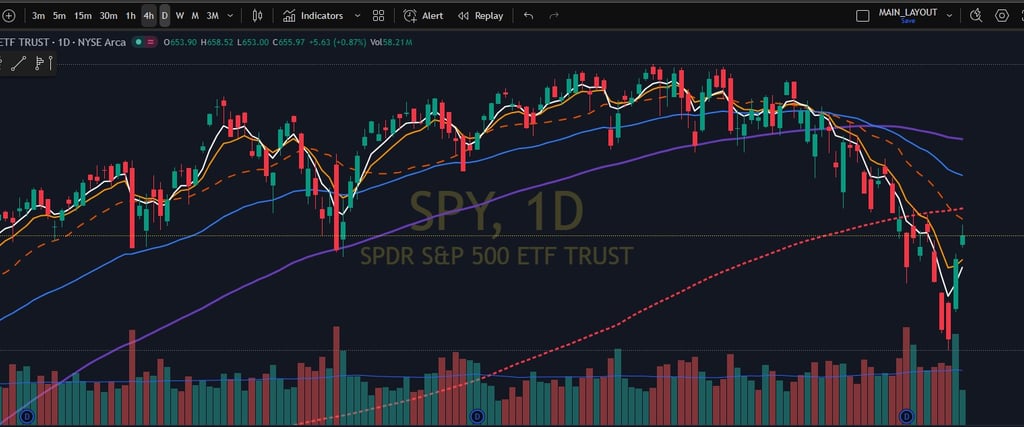
Watch key level of $656.87 tomorrow. If price acts as resistance then short it back down to $653 area. However this all depends on any gap up or gap down scnearios. Will update levels tomorrow.
$IWM Key Levels:
Watch for $$251.86 to act as support or resistance tomorrow.
$QQQ Key Levels:
Keep eyes on $586.81 level tomorrow.
A. Gap and fade (mean reversion)
When to use: Market gaps sharply in one direction in pre-market by more than 0.5 to 1.0 percent.
Signal: Price begins to retrace toward the prior close with volume confirming the fade.
Entry: Enter on a pullback into the gap once price shows rejection, such as a bearish wick on a gap up or a bullish wick on a gap down.
Stop: 0.5 to 1 percent beyond entry for ETFs or an ATR-based stop; use tighter stops for scalps.
Target: VWAP, prior close, or 50 to 75 percent of the gap fill.
Example: If IWM gaps up 1.2 percent pre-market, wait for a pullback toward VWAP or the previous close. Buy a rejection bounce and exit fast.
B. Breakout continuation (momentum)
When to use: Pre-market gap is followed by sustained futures momentum and sector leadership.
Signal: Break of pre-market high with increasing volume.
Entry: On a breakout candle close above the pre-market high with follow-through.
Stop: Under the breakout candle low or 0.7 to 1.5 percent depending on the ETF.
Target: A measured move equal to the initial move or use intraday levels like R1 and R2.
C. Volatility and option plays
Directional debit verticals: If you have a directional bias and IV is elevated, buy a vertical call or put spread for tight, defined risk.
Long straddle or strangle: Use only if you expect a very large move and IV is not prohibitive. Premiums can be expensive; this is favorable only if you expect a move greater than 10 to 20 percent in option value.
Iron condor or short premium: Not recommended immediately after major geopolitical events. IV can spike or unwind quickly and produce whipsaw. If used, do so only after IV collapses and you see range-bound behavior the next day.
Position-sizing: Treat options as defined-risk instruments. Size so the maximum possible loss fits your plan.
D. Sector-specific plays
Oil down on de-escalation: Short oil producers or trade energy ETFs like XLE and USO while looking at long positions for airlines and consumer cyclicals.
War de-escalation: Defense names like LMT and RTX may lag. If Trump signals a drawdown, defense contractors can pull back.
Risk-on tone: Equities broadly up.
Risk-off tone: Treasuries (TLT) and gold (GLD) bid.
Morning execution example
Step 1: Note overnight futures gap for ES and CL. If CL is down more than 1 percent and ES is flat-to-up, bias risk-on.
Step 2: If the SPY gap is greater than 0.8 percent and price refuses to close the gap, play the breakout long. If SPY gaps up but quickly stalls and forms a reversal wick, look for a fade into VWAP.
Risk control: For ETFs, risk 0.5 to 1.5 percent of trade value as stop distance. For options, risk no more than a pre-set dollar amount per trade depending on account size.
Exit rules: Predefine a profit target and use a trailing stop to lock in gains.
For $IWM scalpers:
Use the same setups but be extra strict on spread width and liquidity. Only trade strikes with tight bid/ask spreads and good open interest.
0DTE tactic: Buy contracts on momentum after a breakout or sell quick credit spreads only if you can manage risk intraday.
Quick rule: If the pre-market gap is greater than 1.5 percent and vega is high, prefer buying a directional 0DTE debit spread instead of naked options to limit downside.
Risk management
This is event-driven trading where volatility and whipsaw are expected. Use defined risk.
Position sizing: Never risk more than a small portion of your trading capital on any single intraday trade, such as 1 to 2 percent of account equity. If using more aggressive sizing, document the trade as higher-risk and reduce the number of simultaneous positions.
Stops: Place hard stops or option hedges. Do not hope the news works in your favor.
Avoid holding large directional positions overnight into unknown geopolitical sequels.te your text here...
Get real-time $TSLA & $IWM updates and other Tickers during the market open—Follow @smarttradeszone on X. 🚀