
$BRAI Stock Price Today: Why This PropTech Penny Stock Is Surging
$BRAI is trending after a massive stock split and European expansion. Read our full technical analysis, bull vs bear case, and the ultimate trading plan.
STOCK ANALYSISMOMENTUM STOCKSAI & TECH
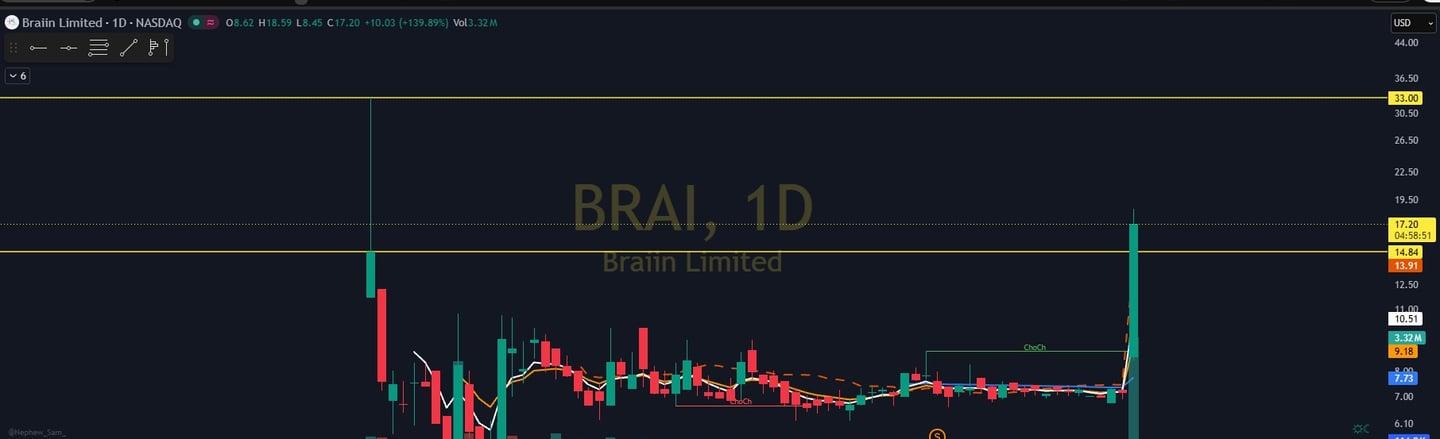
Table of Contents:
The Parabolic Surge of $BRAI Stock: Is the PropTech Pioneer Ready for $33?
Penny stocks and micro-cap equities are famous for explosive moves, but few have captured the market's attention recently quite like Braiin Limited. Trading under the ticker symbol $BRAI, this company has recently evolved from a relatively quiet tech player into a high-volume trading vehicle. For day traders and swing traders alike, the massive volume spike and rapid price expansion have turned this ticker into a premier watch-list candidate. If you look at the daily charts, the equity has recently broken out of a tight consolidation range, sparking intense debate across financial forums. The core question dominating trading desks right now is whether this massive upward momentum is a sustainable breakout or a temporary liquidity flush.
The Catalysts Behind the Massive Trend
Understanding why $BRAI is trending requires looking at a rapid succession of major corporate catalysts that have completely reshaped the company’s fundamental profile. First, the stock recently underwent a highly anticipated three-for-one forward stock split. This corporate action effectively lowered the per-share price, immediately boosting liquidity and making the equity far more accessible to retail momentum traders. Following the split, the company signed a massive non-binding term sheet to acquire a majority stake in Home.cc for approximately seventy-three million Australian dollars. This acquisition instantly expands their digital footprint into the lucrative European residential lifecycle and "Living Infrastructure" markets. To top it off, the company just announced a major commercial partnership with Switchcraft to embed white-labeled utility and telecom switching directly into its UK platform, targeting a multi-billion dollar residential services market
The Bull Case: A Trillion-Dollar Addressable Market
The bullish thesis for $BRAI relies heavily on the explosive growth potential of its artificial intelligence-native "LivTech" platform. By integrating automated utility, telecom, and broadband switching into tenant onboarding and residential property management, the company is positioning itself as an essential infrastructure layer for European real estate. Bulls argue that the commission-sharing revenue model with major utility providers creates a highly scalable, high-margin, recurring revenue stream. From a technical perspective, the stock has completely broken out of its multi-month accumulation base, registering a powerful Change of Character on the daily chart. With massive buying volume backing the move, optimistic investors believe the stock is fundamentally undervalued given its aggressive global expansion strategy.
The Bear Case: Dilution Risks and Non-Binding Agreements
On the flip side, skeptical market participants urge extreme caution when chasing a parabolic move of this magnitude. The bear case centers on the execution risk of the company's aggressive expansion strategy. Critics are quick to point out that the massive seventy-three million dollar deal was signed as a non-binding term sheet, meaning the transaction is not yet finalized and could still fall apart. Furthermore, rapidly scaling an international platform requires an immense amount of capital, which raises the distinct probability of future equity dilution that would hurt current shareholders. Bears also argue that the recent vertical price action is driven purely by momentum chasers and retail hype surrounding the stock split, leaving the stock highly vulnerable to a severe profit-taking flush once the initial excitement cools down.
The Bulls vs. Bears Trading Plan: Critical Levels to Watch
For active traders looking to participate in this high-beta environment, managing risk around key structural levels is absolutely paramount. The daily chart has established two definitive zones that dictate the current trading framework: a major overhead macro resistance target at the thirty-three dollar mark, which aligns with previous historical peaks, and a critical downside support floor at the fourteen dollars and eighty-five cents level.
The Momentum Bull Strategy
Traders looking to play the long side should monitor the fourteen dollars and eighty-five cents level closely on any corrective pullbacks. This zone represents an ideal risk-to-reward entry point, assuming the stock can establish a clear higher low on heavy volume. A confirmed bounce off this fourteen dollars and eighty-five cents support line allows bulls to set tight stop-losses just below the structural floor while targeting a primary upside move toward twenty dollars, followed by a macro run to the thirty-three dollar target. Alternatively, a high-volume breakout and hold above the psychological twenty dollar psychological barrier can be used as a momentum trigger to ride the wave back up toward the thirty-three dollar historical highs.
The Counter-Trend Bear Strategy
Traders looking to short the stock or protect existing profits will want to watch for signs of momentum exhaustion as the price approaches overhead resistance zones. If the price fails to sustain its hold over recent local highs, bears will look for a technical breakdown back toward the fourteen dollars and eighty-five cents support level. A clean break below fourteen dollars and eighty-five cents would completely shift the short-term market structure back to the downside, opening the door for a deeper correction into the single digits. Whether you lean bullish or bearish on $BRAI, the massive daily trading volume guarantees plenty of volatility, making strict position sizing and disciplined risk management mandatory for anyone stepping into this ticker.