
$SPY Key Levels: Will the S&P 500 Hold the 50-Day SMA?
S&P 500 ($SPY) drops 2.58% following hot payroll data. Lock in our professional trading plan mapping out critical long setups and the 50-day SMA short targets.
SPY TRADINGDAY TRADINGMARKET INSIGHTS
Why is $SPY Trending Today?
The broad-market exchange-traded fund $SPY is dominating institutional order flow following a violent Friday liquidation event that drove the index down 2.58% to close at $737.55 on massive volume. This systemic shift in market structure was catalyzed by the U.S. Bureau of Labor Statistics' May nonfarm payrolls report, which printed a red-hot headline addition of 172,000 new jobs—vividly outperforming Wall Street consensus expectations of roughly 85,000 to 88,000.
Core Macro Catalyst Matrix:
May Nonfarm Payrolls Surge: The headline labor market print added 172,000 new jobs, dramatically outperforming Wall Street consensus expectations of roughly 85,000 to 88,000, signaling persistent economic heat.
Hawkish Prior-Month Revisions: Net job gains for March and April were quietly adjusted upward by a combined 93,000, compounding macro strength and disrupting the near-term economic cooling narrative.
Bond Market Volatility Spike: The 10-year U.S. Treasury yield surged rapidly to 4.54%, forcing institutional fixed-income traders to aggressively reprice the Federal Reserve's terminal interest rate trajectory.
$SPY High-Volume Distribution: The broader market index plunged 2.58% to close at $737.55, as systematic multi-sector liquidations pierced through primary intraday support shelves.
This unexpected labor market resilience immediately re-ignited Federal Reserve monetary hawkishness, forcing fixed-income traders to reprice the terminal interest rate trajectory and sending the 10-year U.S. Treasury yield surging up to 4.54%. In accordance with traditional macro-to-micro asset allocation models, this sudden spike in the risk-free rate triggered an aggressive risk-off mean-reversion move, punishing highly leveraged, high-multiple growth equities.
The macroeconomic "good news is bad news" selloff left a severe institutional footprint across the technology complex, turning what began as a routine macro reaction into a cascading sector-wide rout. Passive index funds and programmatic execution algorithms were forced to liquidate tech exposure due to $SPY's top-heavy market capitalization weighting. This triggered an unprecedented $1 trillion semiconductor drawdown that clawed back months of aggressive, speculative expansion among artificial intelligence market leaders. The structural cascade was amplified by massive distribution in core components:
$NVDA (the index's primary AI engine) plunged 4.3%, puncturing short-term moving averages.
$AVGO suffered a brutal 5.6% supply rejection.
$AMD and $MU tumbled 7.1% and 6.7% respectively, as systematic momentum strategies unwound their long exposure simultaneously.
Systematic Order Flow Note: This multi-sector liquidation event pushed the index below critical short-term options defensive walls. As $SPY breached key intraday put-wall strikes between $745 and $740, options market makers were forced into a structural "short gamma" position. To maintain delta-neutral portfolio parameters, these institutional desks were forced to programmatically short underlying S&P 500 equity futures into the afternoon weakness, rapidly accelerating the downward velocity and driving the price action straight into the primary weekly liquidity pocket near the close.
$SPY Long Setup & Breakout Levels:
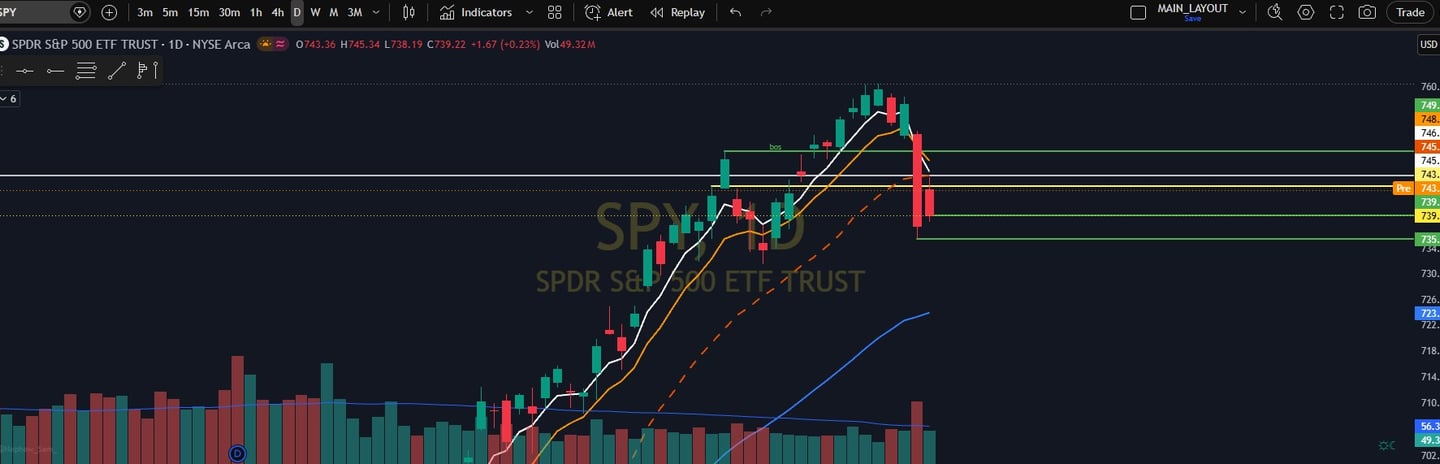
For a viable bullish reversal to materialize, market participants must see an immediate halt to the tech-centric distribution and a decisive reclamation of Friday's broken intraday value areas. The primary tactical trigger for a long entry requires a high-volume breakout and sustained consolidation above the $739.00 pivot zone. Reclaiming this structural shelf would indicate localized supply rejections and confirm that large-scale institutional buyers are stepping in to absorb the macro-driven panic, positioning the index for a powerful mean-reversion squeeze.
Once this intraday level shifts from resistance to verified support, the first major upside objective sits at $743.90, which aligns with a significant volume profile gap-fill area. If momentum algorithms chase this squeeze and tech sectors begin to stabilize, the secondary upside target rests at $749.53. Should broad-market risk-on sentiment fully return to the tape, the ultimate swing target for this long campaign is the local structural ceiling at $754.70. Risk management must remain incredibly tight; the long thesis is completely invalidated if price prints a structural breakdown below the immediate liquidity pocket at $734.00.
$SPY Short Setup & Technical Bear Case:
The technical bear case for $SPY is highly compelling given the severe structural damage inflicted during the high-volume breakdown beneath short-term moving averages. The primary short trigger is established on a clean breakdown below the immediate liquidity shelf at $736.50, proving that sellers are retaining macro control over the weekend overhang. With the broader market exhibiting a clear shift toward a distribution phase, any weak intraday bounces that fail to establish higher highs should be viewed as institutional fading opportunities.
The initial downside objective for short positions rests at $731.53, a prominent historical demand node. Breaking below this level clears the path through a notable low-volume zone, accelerating bearish expansion toward the secondary target at $728.16 and the tertiary target at $725.04. If interest rate anxieties intensify ahead of upcoming central bank commentary, the ultimate technical magnet for this short swing is the heavily defended 50-day Simple Moving Average (SMA) at $723.23. This macro bear thesis becomes entirely invalidated if $SPY prints a daily closing session back above the $740.00 psychological resistance barrier, forcing a rapid cover of short commitments.
$SPY Full Trading Plan & Execution Matrix (TL;DR):
The Long Execution Matrix:
Tactical Entry Trigger: Clean breakout and 1-hour consolidation above the $739.00 structural pivot zone on expanding volume.
Upside Profit Targets: Scale out initial risk at $743.90 (Target 1), lock in remaining core gains at $749.53 (Target 2), and completely exit the swing at $754.70 (Target 3).
Risk Management / Invalidation Point: Hard stop-loss triggered on a sustained structural violation below $734.00.
The Short Execution Matrix:
Tactical Entry Trigger: Sustained breakdown or clean retest rejection under the $736.50 liquidity shelf.
Downside Profit Targets: Secure partial profits at $731.53 (Target 1), scale out further down at $728.16 (Target 2) and $725.04 (Target 3), and take final profit at the 50-day SMA floor of $723.23 (Target 4).
Risk Management / Invalidation Point: Close out short positions immediately if price action prints a daily close back above $740.00.
Strategic Bottom Line
The core rule for managing $SPY in this macro window is to strictly respect the directional breakout or breakdown boundaries between $739.00 and $736.50. Do not commit heavy capital while the index chops sideways within this tight distribution pocket; wait for institutional order flow to confirm a clean exit from this range before deploying size.