
Stagflation vs Inflation: 2026 Macro Trading Playbook
Understand stagflation vs inflation and protect your capital. Get the definitive 2026 macro trading playbook to hedge risk with energy, gold, and options.
RISK MANAGEMENT
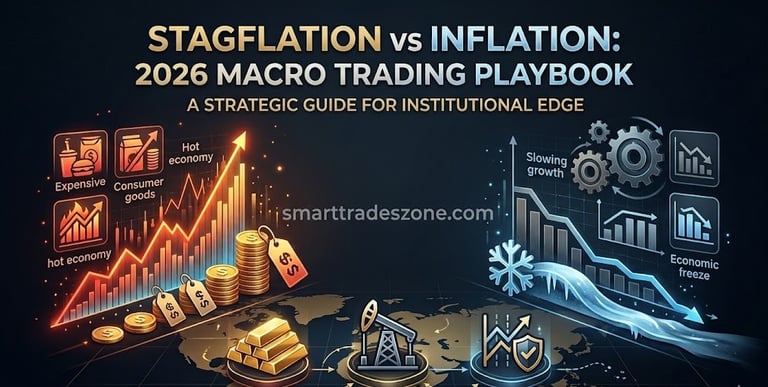
Stagflation is the ultimate market anomaly because it breaks the traditional economic playbook and completely upends the foundational rules of asset correlation. In a normal economic cycle, slowing growth naturally forces inflation down as consumer demand cools. This drop in demand prompts central banks to confidently lower interest rates, injecting liquidity into the system to spark an economic recovery.
Conversely, when an economy overheats, rising inflation is typically accompanied by robust employment and high productivity, allowing the Federal Reserve to raise rates without immediately crushing the consumer.
In a stagflationary environment, this entire balancing act shatters. The system faces sticky, rising inflation paired directly with stagnant economic growth and elevated macro pressures. This creates a severe policy dilemma for central banks: raising interest rates to combat rampant inflation further suffocates slowing business productivity, while cutting rates to stimulate growth risks triggering a runaway inflationary spiral.
The Catastrophic Breakdown of the 60/40 Paradigm
This toxic macroeconomic combination completely invalidates standard diversified portfolios like the traditional 60/40 stock-to-bond allocation. For over four decades, the 60/40 model was revered as a reliable safety net because it relied on an inverse correlation between equities and fixed income: when stocks went down, defensive bonds went up, serving as a natural portfolio hedge.
However, that relationship only functions in a low-inflation, steady-growth environment. During stagflation, the historic inverse correlation flips completely positive. Rising inflation and aggressive rate hikes strike both asset classes at the exact same time.
Because interest rates and bond prices move in opposite directions, surging yields rapidly crush the price of existing fixed-income bonds. The longer the duration of the bond, the more severe the price drop.
Instead of acting as a reliable ballast to absorb stock market volatility, fixed income turns into a direct drag on capital, destroying wealth at the exact moment investors expect to be protected.
Corporate Earnings Squeeze and Multiple Compression
While fixed income is eroded by duration risk, the 60% equity side of the portfolio is attacked from two distinct angles: margin compression and multiple contraction.
Slowing macroeconomic activity heavily deflates consumer purchasing power, meaning broad market sales and revenue pipelines dry up. Concurrently, sticky cost-push inflation drives up the raw expense of commodities, labor, and logistics.
Most broad-market corporations cannot pass these rising input costs down to a cash-strapped consumer fast enough, resulting in rapid margin deterioration and downward earnings revisions.
Simultaneously, high interest rates force a severe contraction in equity valuations. When discount rates rise to keep pace with inflation, the net present value of all future corporate cash flows shrinks dramatically.
Growth stocks and broad index funds trading at high price-to-earnings multiples face sudden, aggressive repricing.
When both core asset classes drop in tandem, static buy-and-hold strategies fail entirely. To survive, traders must abandon passive broad market indexes and aggressively pivot toward a regime-aware, tactical playbook focused entirely on pricing power, real tangible assets, and systematic cash flow generation.
The Mechanics of Stagflation: Why Traditional Portfolios Fail
When economic growth stalls, broad market multiples compress rapidly, forcing institutional capital out of high-beta risk assets and directly into defensive segments characterized by inelastic demand. The core defense against a stagflationary regime rests within tactical asset plays like energy, gold, and consumer staples. These unique safe havens thrive primarily due to the structural presence of "pricing power"—the rare capability of an enterprise or asset class to absorb rising input and raw material costs and pass them directly down to the end consumer without triggering a major drop in purchase volume. While cyclical growth companies suffer massive margin collapse during stagflation, companies anchored by physical scarcity and non-discretionary utilization retain their core asset value and continue spinning off real cash flow.
1. Energy and Commodities: The Structural Inflation Vectors:
Physical tangible assets, led by crude oil, natural gas, uranium, and key industrial metals like copper, do not merely survive inflation—they actively drive it. In a stagflationary environment driven by cost-push dynamics, supply chain constraints, regional trade tensions, and geopolitical friction serve as persistent tailwinds for the commodities complex. When production caps or shipping bottlenecks choke global supply channels, the baseline price of raw inputs escalates rapidly regardless of broader macroeconomic softness.
For tactical traders, this sector provides an immediate structural hedge. Energy extraction and commodity production companies capture instant margin expansion during these supply shocks because their cost of extraction remains relatively fixed while their selling spot price surges. Furthermore, the emerging landscape shows massive new baseline demand drivers—such as the enormous electricity and grid load required to power modern data centers, artificial intelligence infrastructure, and next-generation sovereign defense industrial frameworks. This structural demand floor keeps energy and industrial commodity prices elevated, converting real resources into highly effective cross-asset correlation breaks for a traditional portfolio.
2. Gold and Precious Metals: Hard Money and Sovereign Insurance:
Gold serves as the ultimate historical store of objective value when underlying confidence in paper currencies, sovereign bond yields, and central bank policy breaks down. During stagflation, when real inflation-adjusted yields remain deeply compressed or negative, paper money actively loses purchasing power daily. Gold holds absolute zero counterparty risk and cannot be artificially printed or diluted by fiscal authorities, making it a critical strategic macro anchor.
The macro setup reflects unprecedented structural forces keeping a firm floor under precious metals. Massive, structural over-the-counter purchases and continuous gold accumulation by global central banks—most notably across major emerging market economies like China—signal a permanent macro shift toward alternative reserve assets. Institutional macro research emphasizes that even during brief periods of sideways price action or technical consolidation, the long-term target trajectory remains heavily skewed to the upside. Because equities are inherently claims on highly volatile future corporate earnings and bonds are merely claims on depreciating nominal cash flows, hard money assets effectively capture a permanent geopolitical and inflationary risk premium. This premium expands violently whenever market participants realize that monetary policy tools are fundamentally stuck.
3. Consumer Staples: Monetizing Inelastic Demand and Defending Margins:
When household budgets face a relentless double-squeeze from stagnant real wage growth and rising baseline living costs, consumer behavior undergoes a dramatic, non-negotiable optimization. Consumers completely eliminate discretionary expenditures—such as upgrading consumer electronics, purchasing luxury goods, or financing new automobiles—and ruthlessly redirect their remaining capital toward survival priorities. This creates a powerful defensive rotation into the Consumer Staples sector.
Companies tracking within this ecosystem produce everyday essentials, including packaged foods, household cleaners, hygiene products, and basic medical goods. This product mix guarantees highly predictable, steady revenue lines even during a major macroeconomic deflation of the consumer wallet. Because the demand curve for these items is exceptionally steep and inelastic, dominant market-share brands can consistently adjust their retail pricing upward to match raw wholesale input inflation without destroying their baseline sales volume. This capacity preserves corporate profit margins and ensures stable, recurring cash flows. Furthermore, these mature corporate entities traditionally function as high-quality dividend payers, providing stock traders with a reliable income cushion that offsets capital drawdowns across the rest of their trading canvas.
Safe Haven Allocations: Capitalizing on Pricing Power and Hard Assets
When the broader indexes like the S&P 500 flatline or enter extended corrective phases, relying purely on static long positions or hoping for long-term capital appreciation will severely drain a portfolio's net asset value. In flat or downward-trending macro regimes, traditional buy-and-hold approaches expose investors to negative real returns due to the compounding drag of inflation. To combat this, tactical traders utilize derivatives and structured income vehicles to systematically harvest cash flow out of range-bound or declining markets. This active strategy converts ambient market volatility and sideways price action into a reliable, consistent revenue stream that acts as a structural cushion for the total portfolio.
1. Volatility Harvesting and the Covered Call Framework
Implementing a structured covered call framework allows traders to effectively monetize the equity assets they already own by selling upside call options to speculative buyers looking to chase breakouts. In a choppy, slow-growth market, buying momentum rarely sustains itself, causing breakouts to fail and equity prices to mean-revert back into localized trading ranges. Because these upside options frequently expire completely out-of-the-money, sellers keep the collected premium as pure profit while retaining their underlying shares.
To optimize this strategy in an uneven market, advanced execution relies on monitoring the spread between Implied Volatility (IV) and Realized Volatility (RV). When macroeconomic uncertainty spikes, option premiums swell due to elevated IV, presenting an ideal environment to sell premium at overvalued rates. By carefully selecting short-duration contracts—such as 30-to-45 days to expiration (DTE)—and target deltas between 0.20 and 0.30, traders maximize the acceleration of time decay (theta) while maintaining a sufficient buffer against being prematurely assigned or having their shares called away during temporary market rallies.
2. Single-Stock Option Income Vehicles and Covered Call ETFs
For core sectors where directly managing individual option chains across multiple positions becomes capital-intensive or operationally inefficient, modern single-stock option income ETFs and covered call products present a highly effective alternative. These specialized income instruments utilize sophisticated derivative structures—such as synthetic covered calls or actively managed call vertical spreads—to generate high yield profiles tied directly to high-liquidity underlying assets.
By shifting from basic covered calls to enhanced options strategies like credit call spreads, these specialized funds sell short-term, near-the-money call options to capture substantial premium income while simultaneously purchasing higher-strike long calls. This tactical architecture limits the risk of capped upside if an underlying security experiences a sudden structural breakout, allowing the fund to participate in meaningful price extensions while maintaining a substantial annualized distribution rate. Utilizing these option income wrappers on highly volatile equities provides a distinct advantage: the inherent volatility of the underlying reference stock inflates the options pricing, resulting in large monthly distributions that can be aggressively reinvested to compound equity shares at a deep discount during market drawdowns.
3. Establishing the Tactical Income Buffer
Integrating a dedicated allocation to these option-income vehicles establishes a robust, systematic cash flow layer that insulates a portfolio against downside risk. The significant yield extracted from these strategies provides an immediate cash buffer, lowering the overall breakeven cost basis of your core equity positions and serving as a synthetic hedge against ambient capital erosion.
In a low-growth or corrective market environment, generating an independent cash-flow stream means your total return is no longer dependent on the market making new all-time highs. Instead, the steady influx of option premiums and distributions can be dynamically redeployed—either routed into hard defensive assets like precious metals and energy producers, or used to build up cash reserves to deploy when long-term valuations finally hit major macro floors. This shifts the trading operation away from speculative beta reliance and establishes a self-sustaining income factory tailored for difficult market cycles.
Advanced Hedges: Using Options and Income Vehicles in Flat Markets
Navigating a stagflationary environment requires knowing what to cut or short just as much as knowing what to buy. When growth stalls while inflation remains sticky, broad-market index strategies hide underlying rot. Capital preservation relies on aggressively steering clear of equities that are hyper-vulnerable to rising debt service costs, compression of consumer spending, and valuation multiple contraction. If a company's business model relies on cheap credit or unpredictable consumer whim, it is a structural trap in this macro regime.
1. Long-Duration Growth and Tech Over-Valuations
High-flying growth companies, specifically within technology and software sectors, trade at elevated price-to-earnings (P/E) ratios because their valuations are fundamentally built on the promise of massive cash flows generated far into the future. In equity analysis, these are known as "long-duration assets." When sticky inflation forces long-term bond yields and discount rates higher, the math behind these valuations shifts aggressively. Future earnings are heavily discounted back to the present day, causing the net present value of the stock to contract sharply, triggering severe multiple compression even if the company's current operation remains steady.
Furthermore, the technology landscape faces intense capital expenditure (capex) fatigue. Massive corporate investments into artificial intelligence infrastructure and data centers are running into stiff wall-street skepticism regarding actual near-term return on investment (ROI). Software providers relying on per-seat licensing models are experiencing contract compression as corporate clients trim headcounts to save margins. When sky-high growth expectations collide with elevated capital costs and lengthening sales cycles, these over-extended equities face sudden, aggressive institutional de-risking, resulting in violent downside adjustments.
2. Highly Leveraged Consumer Discretionary
The consumer discretionary sector stands directly in the crosshairs of a stagflationary squeeze. As real inflation-adjusted wages fall and baseline living costs—such as energy, rent, and insurance—consume a larger share of household income, the consumer wallet undergoes a severe defensive optimization. Non-essential spending is instantly slashed to prioritize basic survival goods. This leaves mid-tier retail chains, apparel brands, travel operators, and casual dining restaurant groups highly vulnerable to top-line revenue deterioration.
The risk multiplies exponentially for consumer companies carrying heavy debt loads on their balance sheets. Tightening credit markets and prolonged higher interest rates mean that refinancing corporate debt or carrying variable-rate credit facilities becomes unsustainably expensive. These businesses face a lethal combination: dropping foot traffic and sales volumes occurring at the exact same time their debt service costs spike. The result is an immediate squeeze on free cash flow, credit rating downgrades, and an elevated risk of structural liquidity crises, making them ideal targets for tactical short positions rather than dip-buying.
3. Margin-Squeezed Manufacturing and Commodity-Dependent Processors
A common mistake is assuming that any company selling a physical product is an inflation hedge. Packed food processors, consumer goods manufacturers, and commercial agricultural brands that sit in the middle of the supply chain face extreme margin destruction during cost-push inflationary cycles. These industries are highly sensitive to sudden spikes in raw materials, packaging inputs, industrial fertilizers, and transport logistics costs.
The fundamental flaw in these businesses is the "Input-Output Lag" combined with a lack of absolute pricing power. While their raw wholesale costs escalate instantly, these manufacturers sell their finished goods to massive global retail conglomerates and supermarkets under rigid, long-term supply contracts. They cannot raise their wholesale prices at will without risking losing shelf space to cheaper generic white-label alternatives. Because they are forced to absorb soaring input costs for months before they can successfully renegotiate retail pricing, their operating margins collapse rapidly. This dynamic triggers severe earnings misses, inventory write-downs, and sudden downward guidance revisions that catch passive investors completely off guard.