
The 200-Day Line in the Sand: Is $ASTS a Generational Space Monopoly or the Ultimate Bear Trap?
Is AST SpaceMobile ($ASTS) a generational tech monopoly or a high-risk cash burn? Discover the direct-to-cell fundamentals and massive telco moats driving this space race.
STOCK ANALYSISMOMENTUM STOCKSMARKET INSIGHTS
The Space Monopoly: Why the Smart Money is Obsessed with AST SpaceMobile ($ASTS)
The global telecommunications sector is facing an existential bottleneck: billions of cellular devices regularly drop calls, hit dead zones, or completely lose access to terrestrial towers. For years, the market assumed connecting an unmodified, off-the-shelf smartphone directly to a satellite in low Earth orbit (LEO) was a physical impossibility.
AST SpaceMobile ($ASTS) is proving that theory wrong. Here is the foundational, evergreen breakdown of why this ticker is commanding the undivided attention of growth investors and institutional capital alike.
The Core Technology: Solving Physics at Scale:
To understand the long-term value proposition of $ASTS, you have to understand the sheer size of the hardware. Traditional satellite internet, like SpaceX’s Starlink, historically required a proprietary ground dish to capture high-speed data. Reconnecting standard smartphones requires an entirely different approach because a cell phone’s internal antenna is incredibly small and weak.
AST SpaceMobile solved this physics constraint by launching the largest commercial communication arrays ever deployed in low Earth orbit.
The Blueprint: Their next-generation Block 2 "BlueBird" satellites feature massive phased array antennas measuring roughly 2,400 square feet.
The Power Advantage: These gigantic arrays act like a massive space-based magnifying glass, generating intense beam-forming capabilities that link directly to standard, unmodified 4G and 5G smartphones.
Data Speeds: While competitors primarily chase narrowband text messaging, ASTS’s architecture is built for true cellular broadband. The latest Block 2 hardware is designed to deliver peak data speeds approaching 200 Mbps—allowing users to stream high-definition video, make voice over LTE (VoLTE) calls, and browse the web from the middle of the ocean or the deepest valleys.
The Commercial Moat: The "Toll Booth" Business Model
Building a space constellation is incredibly expensive, but AST SpaceMobile's genius lies in its go-to-market strategy. They are not trying to compete with existing mobile network operators (MNOs); they are partnering with them.
Instead of spending billions of dollars acquiring customers, building retail stores, and fighting for market share against giants like AT&T and Verizon, ASTS operates as a wholesale space-based network extension.
Hardware Required: Unlike legacy satellite models that require expensive, proprietary ground terminals or dishes, $ASTS connects directly to an unmodified, standard everyday smartphone.
Customer Acquisition: Legacy space internet providers face extremely high direct-to-consumer marketing costs. In contrast, AST SpaceMobile's acquisition cost is effectively zero because it instantly taps into billions of active subscribers from its partner telcos.
Regulatory Hurdles: While competitors spend years fighting for global wireless spectrum approvals, ASTS bypasses this massive bottleneck entirely by operating on its partners' existing, approved spectrum.
Strategic Partners: Instead of operating solo, AST SpaceMobile is backed by a formidable global coalition, including AT&T, Verizon, Vodafone, Rakuten, Google, and stc Group.
This creates a formidable regulatory and commercial moat. By integrating deeply with MNO core networks, ASTS secures premium cellular spectrum without paying billions in auction fees. When a subscriber steps into a dead zone, they will simply receive a text message asking if they want to turn on space-based coverage for a monthly add-on or daily pass. The revenue is split between the carrier and ASTS, turning the satellite network into a pure software-like toll booth with high operating margins.
The Path to Profitability: Scaling the Constellation
From an investment perspective, $ASTS is transitioning away from a speculative "science project" into a pure industrial execution and manufacturing story.
The path to global continuous coverage scales iteratively with the satellite count. The long-term financial thesis rests on a highly predictable, three-stage operational ramp:
Manufacturing Cadence: Operating out of their vertically integrated half-a-million square foot facilities, the company has heavily scaled its assembly capacity. The production pipeline is built to continuously pump out advanced phased arrays, shifting from single bespoke builds to automated, factory-line scaling.
The Capital Inflection Point: Early phases require massive capital expenditure (CapEx) to build, test, and launch the initial batches of satellites. However, once the baseline constellation of approximately 45 satellites is securely in orbit to unlock initial continuous regional services, the financial model radically flips.
Software-Like Margins: With the initial infrastructure paid for and deployed, adding more subscribers across the globe incurs virtually zero incremental costs. Additional satellite launches simply add capacity, data throughput, and redundancy, allowing the company's operating leverage to expand dramatically.
Disclaimer: This article is for informational and educational purposes only and is not financial advice. Always do your own research and manage risk carefully.
The Tactical Trading Plan: Key Levels for Bulls and Bears
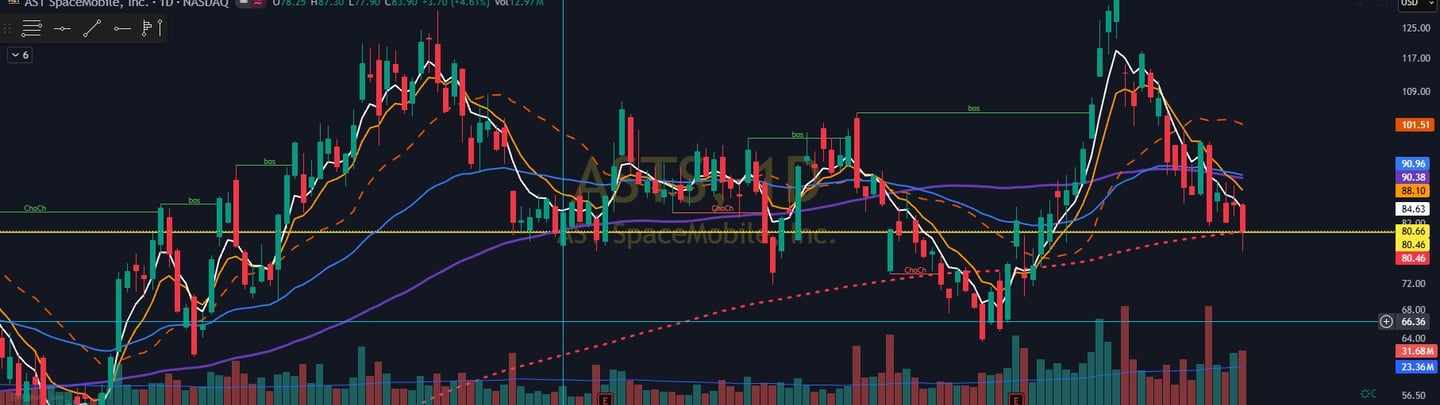
While the long-term fundamental story is compelling, maximizing returns on $ASTS requires strict technical execution. As the stock digests major supply and demand shifts following its recent Block 2 satellite launches, price action is consolidating around a definitive line in the sand.
Here is the exact blueprint for trading the current structure cleanly.
The Line in the Sand: $80.46:
The absolute pivotal pivot point for this entire structure is $80.46, which aligns precisely with the 200-day Moving Average (MA). How price reacts here dictates the macro trend over the coming weeks.
The Bull Case: Defending the 200-Day MA:
If the bulls can successfully defend $80.46 on a daily closing basis, it confirms institutional accumulation is stepping in to protect the long-term trend. Look for a clean bounce or a consolidation pattern right above this area to confirm structural strength before executing long positions.
Should the bounce confirm, map out the following upside targets to scale out of the position:
Target 1: $84.63 (Initial overhead resistance and short-term liquidity pool)
Target 2: $88.10 (Major structural supply zone)
Target 3: $90.35 (Psychological barrier and breakdown point replication)
The Bear Case: Breaking the Trend:
If $80.46 fails to hold and the stock closes decisively below the 200-day MA, the technical narrative flips to short-term bearish control. A failure here signifies that the post-launch momentum has fully exhausted, opening the door for a deeper correction.
If this key support breaches, look for short setups or put options to target downstream liquidity pockets:
Short Target 1: $77.15 (Immediate volume shelf support)
Short Target 2: $76.00 (Intermediate consolidation floor)
Short Target 3: $73.50 (Major downside value area and gap-fill zone)
Risk Management Note:
Due to high implied volatility on $ASTS options contracts, maintain strict position sizing. Always let the daily close confirm the bias at the $80.46 level before committing size to either a breakout swing or a macro breakdown slide.