
Best AI Stocks for 2026: Why $GOOGL Stock Is the Ultimate Catalyst Play
Looking for the best AI stocks for 2026? Dive into our full $GOOGL stock trading plan, key breakdown levels, and how macro AI tech earnings catalysts will impact your next trade.
MARKET INSIGHTS

The Intellectual Capital Moat: How AI Talent Brain Drain Destroys (or Builds) Long-Term Shareholder ValueThe Intellectual Capital Moat: How AI Talent Brain Drain Destroys (or Builds) Long-Term Shareholder Value
The sudden drop in $GOOGL stock following reports that a Nobel-Winning AI Researcher left Google for Anthropic highlights a critical vulnerability for modern hyperscalers: intellectual capital risk. For long-term investors and momentum traders alike, a company’s technical moat is only as strong as the engineers anchoring it. When pioneering talent migrates to agile, venture-backed competitors like Anthropic, it alters the projected timeline for proprietary AI breakthroughs.
To capitalize on these talent shifts, smart traders utilize a structural checklist to evaluate whether a "talent drain" headline is a temporary buying opportunity or a structural warning sign:
The Key-Man Risk Assessment: Evaluate if the departing talent is tied to a core monetization engine (like Search or Google Cloud) or an exploratory research arm (like DeepMind). Exploratory departures cause short-term narrative damage, while core engine departures disrupt near-term revenue.
The Innovation Replacement Rate: High-dwell organizations maintain a deep bench of elite researchers. Traders must monitor institutional continuity—if a departure is followed by a cascade of team defections, the moat is actively deteriorating.
The Capex vs. Brain Utility Divergence: Building massive data centers is a capital expenditure game, but optimizing those models requires elite minds. If capital expenditures rise while top-tier talent exits, capital efficiency drops, compressing forward enterprise value-to-EBITDA (EV/EBITDA) multiples.
Evaluating Non-Core Monetization Catalysts: The Enterprise AI Partnership Framework
When macro sentiment turns bearish, analyzing a hyperscaler's secondary ecosystem expansion provides key clues regarding its long-term financial health. Recent market data from image_8f7dde.png highlights Alphabet’s multi-pronged capital deployment strategy: a $75 million partnership with entertainment studio A24 for AI integration, alongside an expanded enterprise telecom infrastructure footprint via Nokia to deploy Gemini AI agents.
To understand how these headlines translate into future cash flows, traders should categorize Alphabet's investments into two distinct strategic buckets:
Vertical Narrative Expansion (e.g., Google's $75M Investment in A24 Studio)
Strategic Objective: Proving AI utility in creative media and defending against intellectual property moat erosion.
Time-to-Monetization: Slow (estimated 24–48 months).
Trader's Execution Action: Treat this strictly as a long-term brand equity play. Expect minimal near-term impact on next quarter's EPS, meaning it should not be traded as an immediate fundamental catalyst.
Horizontal Enterprise Integration (e.g., Nokia Infrastructure Deal for Gemini AI Agents)
Strategic Objective: Rapidly scaling B2B cloud revenue and securing high-margin recurring SaaS/PaaS model market share.
Time-to-Monetization: Fast (estimated 6–12 months).
Trader's Execution Action: Actively monitor Google Cloud margin expansion in upcoming quarterly earnings calls. This represents a high-immediate-impact fundamental catalyst that can justify near-term swing long entries.
By tracking whether $GOOGL is investing in long-tail narrative plays or immediate enterprise scaling, traders can accurately gauge whether capital expenditures will yield near-term revenue acceleration or long-term ecosystem lock-in.
The "Hyperscaler Dip-Buying" Playbook: Technical Support Rules During Major Market Tumbles
With prominent macro voices turning structurally bearish on hyperscalers, large-scale tumbles become frequent. When $GOOGL undergoes its largest percentage decreases, emotion-driven retail traders panic-sell, while institutional algorithms look for structural liquidity pockets.
To avoid catching a falling knife when hyperscalers experience steep intraday drops, execute using this three-step technical playbook:
Identify the Volume Control Point (POC): During a steep sell-off, ignore arbitrary moving averages. Look at the volume profile over the last 180 days. Identify the price level where the highest volume of shares changed hands. This is the institutional baseline where major market makers will step in to absorb sell orders.
The Two-Day Confirmation Rule: Never buy a large-cap stock on the first day of an aggressive, high-volume news-driven decline. Wait for the second trading session to establish a clear daily candle close. If the second day holds the prior day's low on lower relative volume, the selling exhaustion signal is confirmed.
The Relative Strength Index (RSI) Divergence Filter: When $GOOGL probes new multi-week lows on headlines of talent loss or analyst downgrades, look at the 4-hour RSI chart. If the price prints a lower low but the RSI prints a higher low, it indicates that internal selling momentum is slowing down despite the scary headlines, offering a high-probability, low-risk entry point for a reversion-to-the-mean swing trade.
Disclaimer: This article is for informational and educational purposes only and is not financial advice. Always do your own research and manage risk carefully.
The Complete $GOOGL Trading Plan: Core Execution Levels and Short Targets
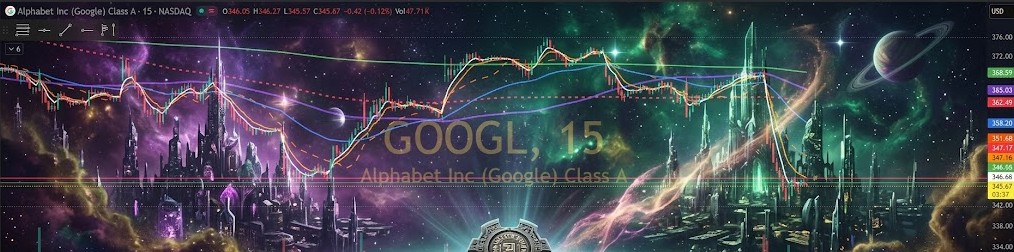
As structural and macroeconomic shifts inject volatility into the mega-cap tech landscape, Alphabet ($GOOGL) presents a highly technical, high-probability setup for disciplined traders. Following its recent sharp decline, the equity is displaying a clear path of least resistance to the downside. However, maximum execution edge relies on identifying precise reaction zones rather than chasing a falling market.
This comprehensive trading plan outlines the invalidation levels, macro targets, and key price milestones required to manage risk effectively over the coming sessions.
The Macro Trajectory: Room to the 100-Day Moving Average:
From a structural perspective, $GOOGL has broken key near-term support frameworks and possesses substantial downside room before finding a major institutional floor.
The Ultimate Downside Target: Technical analysis points to a logical downside magnet at $338.40.
The Significance of the Level: This price perfectly aligns with the 100-day Moving Average (MA). Institutional volume typically clusters around this major moving average, making it the primary objective for swing shorts and the baseline for any potential long-term trend stabilization.
The Invalidation Zone: The $355.00 Retest Pivot:
A direct, vertical sell-off is rarely clean. Active traders must anticipate intraday bounce attempts driven by short-covering or algorithmic noise. The entire structural short thesis hinges on how price behaves during these temporary relief rallies.
The Line in the Sand: The absolute key level to watch on any bounce attempt is $355.00.
The Execution Blueprint:
If a relief rally pushes toward $355.00 and faces clear selling volume or a candlestick rejection (such as a shooting star or bearish engulfing pattern on the 15-minute or 1-hour chart), the short position is validated with an exceptional risk-to-reward ratio.
A clean daily close above $355.00 invalidates the immediate bearish momentum and serves as a hard stop-loss for short positions.
Step-by-Step Short Targets and Profit-Taking Milestones:
If the $355.00 level gets denied, it confirms institutional distribution. Traders should scale out of short contracts or equity positions systematically using the following downstream price targets:
Target 1: $350.00
Psychological Support: This represents a major psychological whole number where initial retail dip-buyers will likely attempt to stall the decline. Take partial profits here to reduce initial risk.
Target 2: $345.00
Structural Liquidity Pocket: A key intraday inflection point where historical buying pressure has previously emerged. Scaling out another portion of the position protects capital against sudden intraday reversals.
Target 3: $340.00
Acceleration Zone: Breaking below $345.00 likely triggers automated stop-losses from trapped longs, causing a rapid flush straight to the $340.00 round number.
Target 4: $338.35
The Final Destination: This level sits just a few cents ahead of the exact 100-day moving average. Cover the remainder of the short position entirely at this target to maximize gains before institutional algorithms step in to defend the macro trend.