
$AAPL: Your Next iPhone 18 Is About to Cost $300 More—And You Can Blame AI
Your next iPhone 18 could cost $300 more. Discover how the AI memory shortage is forcing Tim Cook to raise prices—and what it means for your wallet
STOCK ANALYSISMOMENTUM STOCKSMARKET INSIGHTS
RAMageddon Metrics: Dissecting the 272% Component Cost Spike
When Apple CEO Tim Cook—a man who built his entire reputation on mastering global logistics—publicly labels a component shortage a "hundred-year flood," the market has to stop and look at the math. The consumer tech sector is currently locked in a brutal, structural supply-side crisis. The metrics driving this smartphone component squeeze aren't just a minor blip; they represent a fundamental realignment of hardware economics.
At the heart of this pricing crisis is a basic shift in how the world's leading semiconductor foundries allocate their production capacity. The global scramble to build out Artificial Intelligence infrastructure has completely broken the traditional consumer supply chain.
The Data: Why Memory Has Quadrupled:
The core issue isn't that memory manufacturers like Micron, Samsung, and SK Hynix have stopped producing. The issue is that AI hyperscalers are simply outbidding consumer electronics. Cloud giants are pouring hundreds of billions of dollars into AI data center infrastructure, aggressively locking up high-bandwidth memory and enterprise storage solutions under massive premium contracts.
As foundries shift their assembly lines to feed high-margin server demands, the remaining supply of consumer-grade DRAM and NAND flash has evaporated. Data from TechInsights reveals exactly how damaging this shift is to the bill of materials (BOM) for next-generation premium devices:
12GB LPDDR5X RAM: Skyrocketed from $39 to $145 per unit.
256GB NAND Storage: Surged from $13 to $51 per unit.
The Core Shift: A massive 272% to 292% price increase for the basic memory and storage architecture alone.
The Structural Wall for Apple ($AAPL):
Historically, Apple has used its massive cash stockpile and dominant volume leverage to dictate terms to suppliers, effectively shielding its bottom line from short-term market spikes. But even the world's most sophisticated supply chain has its breaking point. When the foundational manufacturing cost of a single premium smartphone jumps from roughly $582 to $726, the margin erosion becomes too severe for any corporation to absorb internally.
For decades, technology investing operated under a predictable rule: hardware components get cheaper and more efficient over time. The AI infrastructure boom has officially inverted that law. Consumer tech companies are no longer just competing against each other; they are now forced to outbid the virtually bottomless corporate budgets of cloud computing networks.
The $726 iPhone 18 Reality Check: Breaking Down the TechInsights Data
To understand why a retail price shock is imminent, you have to look past Apple's marketing and dive directly into the raw Bill of Materials (BOM). A joint data analysis by The Wall Street Journal and research firm TechInsights has laid bare the exact manufacturing costs for the upcoming iPhone 18 Pro. The findings are a sobering reality check for both tech consumers and equity traders.
For the current-generation iPhone 17 Pro, Apple managed a highly efficient manufacturing and assembly layout. Non-memory parts and baseline manufacturing costs sit at roughly $530. When you added last year's standard raw component pricing—$39 for the 12GB LPDDR5X RAM package and $13 for the 256GB NAND flash storage—Apple’s total cost to build a baseline Pro model hovered at an estimated $582.
For the iPhone 18 Pro, that baseline math completely breaks down.
The Bill of Materials (BOM) Comparison:
When the data is laid out side-by-side, it becomes clear that Apple isn't raising prices out of greed—they are doing it to defend their structural corporate model.
Core Components & Manufacturing: $530 (iPhone 17 Pro) vs. $530 (iPhone 18 Pro) — 0% Change
12GB LPDDR5X DRAM: $39 (iPhone 17 Pro) vs. $145 (iPhone 18 Pro) — +271.8% Surge
256GB Flash Storage: $13 (iPhone 17 Pro) vs. $51 (iPhone 18 Pro) — +292.3% Surge
TOTAL ESTIMATED BUILD COST (BOM): $582 (iPhone 17 Pro) vs. $726 (iPhone 18 Pro) — +24.7% Total Overhead Spike
This $144 surge in raw factory costs represents an immediate 25% overhead spike. In the world of high-volume hardware manufacturing, a 25% jump in production costs is a catastrophic margin killer.
The 47% Margin Wall:
Apple historically guards its product gross margins with absolute ferocity. TechInsights data reveals that Apple enjoyed a clean 47% profit margin on the $1,099 iPhone 17 Pro.
If Tim Cook and the executive team choose to maintain that exact 47% margin against a new $726 manufacturing cost, mathematics dictates that the base iPhone 18 Pro would have to retail at $1,371.
Because Apple fiercely favors standardized, clean pricing structures (ending in $99), they are forced into a difficult game of corporate chess. Absorbing the hit entirely drops their margins to an unacceptable 44% at a $1,299 retail price.
The Upgraded Camera Wildcard:
Compounding the memory crisis is a critical structural upgrade slated for the premium lineup. Supply chain data indicates that the new variable-aperture camera system headed to the Pro models will cost Apple roughly 50% more than previous camera modules.
When you layer a more expensive optical stack on top of the already bloated $726 memory bill, a $1,399 starting price tag transitions from a worst-case rumor into a baseline financial necessity. Apple has spent a decade training consumers to accept incremental cost increases, but a structural pivot from $1,099 to $1,399 will test the exact limits of consumer price elasticity.
The Balance Sheet Play: Can Apple’s Cash Stack Solve the Supply Crisis?
Whenever a major tech company faces a supply-side headwind, retail investors point to the exact same corporate safety net: Apple’s legendary balance sheet. With cash and cash equivalents sitting at a staggering $68.5 billion—and total liquid reserves and short-term marketable securities climbing above $162 billion—Apple technically holds enough raw capital to buy out entire segments of the global tech supply chain outright.
But in a structural hardware crisis driven by an artificial intelligence infrastructure boom, the standard rules of corporate wealth no longer apply. A massive pile of liquid capital cannot easily fix an absolute deficit of foundry capacity.
The $162 Billion Mirage: Why Cash Can't Buy Silicon:
The core misunderstanding among mainstream market commentators is the belief that Apple can simply outspend a hardware supply crisis. If memory manufacturers like Samsung, Micron, and SK Hynix are heavily favoring AI enterprise buyers over consumer electronics companies, shouldn't Apple just cut a larger check?
The reality is that semiconductor manufacturing capacity is finite and heavily bottlenecked. Building a cutting-edge fabrication plant (a fab) capable of churning out next-generation LPDDR5X DRAM and high-density NAND flash requires years of construction, specialized extreme ultraviolet (EUV) lithography machines, and specialized engineering talents.
Even if Apple allocated its entire liquid reserve to build its own proprietary memory factories, the project wouldn't yield a single commercial chip for years. Apple CEO Tim Cook has explicitly confirmed this reality, directly noting that while Apple is highly willing to deploy its massive balance sheet to secure raw components, the company has absolutely zero structural plans to build out its own physical memory manufacturing foundries.
Subsidizing the Supply Chain: Apple's True Playbook:
Instead of physically building hardware plants, Apple’s real corporate strategy centers around a practice known as Advance Vendor Payments. This is where their massive cash cushion becomes an aggressive competitive weapon.
Rather than waiting for memory spot prices to fluctuate on the open market, Apple uses its massive liquid capital stack to secure exclusive, multi-year supply contracts:
The Cash Deployment: Apple provides billions in upfront capital directly to component providers to build out their factory lines.
The Exclusive Lock-In: In exchange for the capital injection, Apple secures a guaranteed, front-of-the-line allocation of the resulting memory supply at a fixed contract price.
This financial mechanism gives Apple a massive moat over smaller smartphone manufacturers, but it doesn't solve the absolute price spike. Because AI hyperscalers are continuously injecting hundreds of billions in capital expenditures (CapEx) into those exact same foundries, Apple is forced to tie up significantly more capital upfront just to maintain its historic inventory security.
The Stock Impact: Dividend and Buyback Math:
For equity traders and dividend-growth investors, this capital deployment shift introduces a major variable to the broader $AAPL thesis. Apple recently authorized an additional, historic $100 billion share repurchase program alongside a steady increase in its quarterly cash dividend.
If Apple is forced to allocate an increasingly large portion of its operating cash flow toward advance component payments and higher upfront inventory costs to battle the memory shortage, it creates a subtle tug-of-war on the balance sheet:
Higher Working Capital Requirements: Tying up massive amounts of cash in supply chains reduces the net free cash flow immediately available for balance sheet deployment.
The Margin Defense: If Apple successfully offsets these higher capital inputs by successfully raising retail prices by $300 on premium models, its robust operating cash flow remains entirely unbothered.
Apple’s legendary cash fortress ensures that the corporation will never face an actual liquidity crunch during a hardware crisis. However, the sheer scale of the global AI component squeeze proves that even a $162 billion liquidity moat cannot entirely shield Apple from the harsh realities of rising global manufacturing costs.
Disclaimer: This article is for informational and educational purposes only and is not financial advice. Always do your own research and manage risk carefully.
Full $AAPL Trading Plan (Bulls vs. Bears Execution Guide)
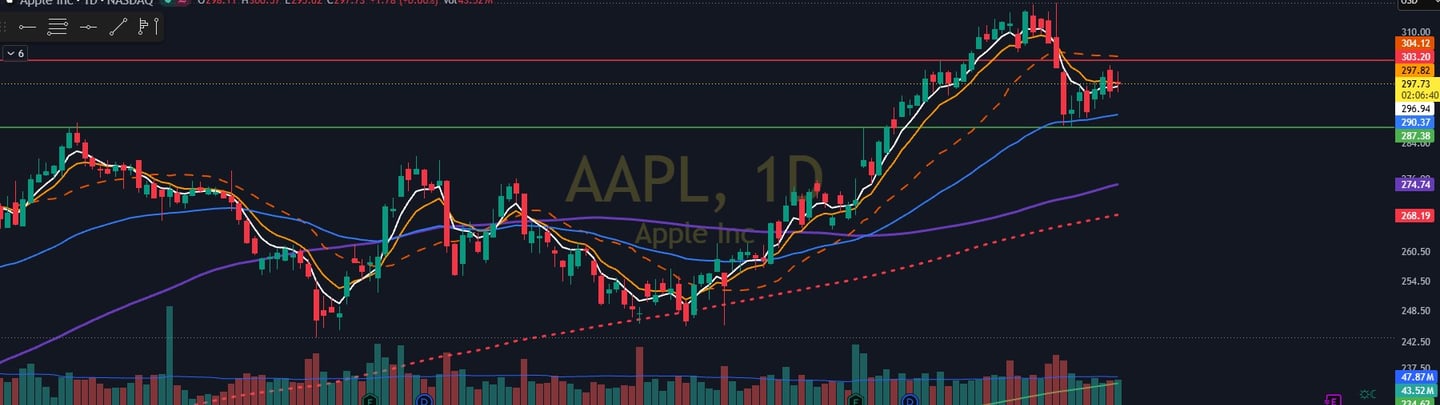
With the fundamental pressure of the AI memory shortage heating up behind the scenes, the technical chart for Apple ($AAPL) is coiled tight. For short-term options and day traders, macro narratives only matter when they align with explicit price action.
The battlefield is drawn around a razor-thin pivot zone. Here is your exact intra-week execution blueprint to handle whichever direction the market chooses to break.
🟢 The Bullish Setup: Holding the Line:
If institutional buyers decide to absorb the supply chain news and step in to defend the tech giant, we are looking for absolute stability over our key psychological floor.
⚡ Key Trigger Level: Stay and hold cleanly above $297.80
🎯 Target 1: $300.85 — Initial resistance and key level to scale out partial profits.
🎯 Target 2: $303.20 — Secondary overhead supply zone.
🎯 Target 3: $304.15 — Major macro target if a full squeeze ignites.
🛑 Risk Management: If the price breaks back under $296.50 on high volume, the bullish thesis is invalidated.
🔴 The Bearish Setup: The Rejection Play:
If the broader market gets spooked by the threat of margin erosion and consumer demand destruction from the $300 price hike, watch for a failure at the top of the range.
⚡ Key Trigger Level: Rejection or clean denial at $297.90
🎯 Target 1: $296.80 — First structural support area where dip-buyers may attempt to step in.
🎯 Target 2: $294.90 — Secondary support block.
🎯 Target 3: $291.70 — Maximum downside target if the selling accelerates down the order book.
🛑 Risk Management: Hard stop if buyers push and hold the price back above $299.10.
💡 Trader's Note on Execution:
Because the pivot level sits right at the edge of the $297-to-$298 range, expect high volatility and chop around the open. Wait for a clean 5-minute or 15-minute candle to confirm a directional close outside of the trigger zones before locking into an options chain or equity position. Guard your capital and trade the trend, not your bias.