
CLARITY Act at the "1-Yard Line": 4 Stocks to Watch as Crypto Rallie
The CLARITY Act is on the verge of passing the Senate. Here is what the SEC/CFTC regulatory split means for Bitcoin, plus top stocks like $COIN and $HOOD to keep on your watchlist.
MARKET INSIGHTS
CLARITY Act 2026: Why the Crypto Market Just Surged $63 Billion Overnight
What Is the CLARITY Act & Why Is It Driving the Market Right Now?
If you've been anywhere near the crypto markets today, you've likely noticed a massive surge—not just in token prices, but in search volume. Traders, investors, and institutions are all asking the exact same question: What is the CLARITY Act?
The hype is entirely justified. A fundamental shift just occurred in the U.S. regulatory landscape, and the financial markets are moving aggressively to price it in.
The CLARITY Act, Explained in Plain English:
The Digital Asset Market Clarity Act (CLARITY Act) is a landmark piece of U.S. legislation designed to give the crypto industry what it has demanded for years: a crystal-clear boundary between SEC and CFTC oversight.
No more guessing games. No more "is this token a security or a commodity?" limbo. And most importantly, no more enforcement-by-lawsuit strategy that kept institutional capital parked on the sidelines.
Key Objectives of the Bill:
Clean Jurisdiction Split: Delineates exact boundaries between the SEC (securities/investment contracts) and CFTC (spot digital commodities) before projects ever launch.
Predictable Operating Framework: Establishes clear, tailored rules for token issuers, exchanges, custodians, and developers instead of relying on retroactive enforcement.
Modernized Disclosures: Introduces disclosure requirements built specifically for distributed ledger technology rather than force-fitting 1930s securities laws onto 2026 technology.
Balanced Consumer Protection: Protects retail investors without strangling domestic financial technology and Web3 development.
Institutional Legal Certainty: Gives asset managers and fiduciaries the legal backing needed to allocate capital without fear of sudden policy reversals.
While the House already passed its version with strong bipartisan support, momentum in the Senate was stalled—until this week.
The Catalyst: The "1-Yard Line" Statement:
The sudden market spark came directly from Treasury Secretary Scott Bessent, who publicly declared that the CLARITY Act is sitting at the "1-yard line."
In legislative terms, this signals that final negotiations are largely wrapped up and the bill is on the doorstep of a Senate floor vote. The market reacted immediately:
Bitcoin Ripped Higher: Spot prices surged within hours of the Treasury Secretary's comments going public.
$63+ Billion Liquidity Injection: The total digital asset market cap jumped roughly $63 billion in a single 24-hour window—a volume expansion driven by institutional repositioning rather than retail noise.
Record ETF Inflows: Institutional spot ETF inflows extended a multi-day streak, topping $700 million.
Broad-Based Rally: Major altcoins caught strong bids as traders moved to front-run a definitive regulatory regime shift.
In financial markets, a "1-yard line" comment from the Treasury Secretary isn't viewed as empty political rhetoric—it is treated as a high-probability catalyst to be priced in before the vote even occurs.
The August Recess Deadline: Why Time Is Running Out:
The urgency behind today's search spike boils down to one factor: the Senate legislative calendar.
With Congress heading toward its mandatory August recess, lawmakers face a tight window. If the bill doesn't reach a floor vote in the coming weeks, it risks stalling until autumn or getting buried in election-season gridlock.
⏱️ The Ticking Clock:
~18 Legislative Days Remaining: The window to bring the bill to the Senate floor before recess is extremely narrow.
White House Ethics Compromise: Key sticking points—specifically around ethics and conflict-of-interest guardrails for public officials—were reportedly resolved in recent White House negotiations.
68% Senate Vote Probability: Prediction markets bumped the odds of a pre-recess Senate vote up to ~68%, a major jump from previous weeks.
This tight deadline means every policy update, committee comment, or White House signal is directly translating into immediate market volatility.
Unlocking Institutional Capital: Eliminating the Regulatory Risk Premium:
To understand why this legislation is moving entire market caps, you have to look beyond the short-term news cycle.
For years, the primary barrier preventing trillions in institutional capital from entering digital assets wasn't volatility or custody—it was regulatory ambiguity.
Fiduciaries Need Statutory Rules: Pension funds and endowments cannot legally invest in assets where regulatory status can be retroactively overturned by regulatory agencies.
Compliance Controls the Gate: Tier-1 banks and institutional brokers require explicit statutory definitions before approving client access or balance sheet exposure.
Audit Standard Normalization: Corporate treasuries require concrete accounting guidelines before holding digital assets on balance sheets.
The CLARITY Act removes the regulatory risk premium that has suppressed institutional participation since 2019. When that legal hazard is eliminated, institutional capital gates don't just open—they flood. That is why today's news is a true market inflection point.
SEC vs. CFTC Rules & The Key Compromises
Everyone wants the headline: who regulates what? And the answer — finally — is written into actual legislation instead of being litigated through enforcement actions one project at a time.
Let's break down the three biggest regulatory shifts inside the CLARITY Act that traders and investors are searching for right now.
The Jurisdiction Split: SEC Takes Securities, CFTC Takes Digital Commodities:
This is the structural change that the entire crypto industry has been demanding for years. And the CLARITY Act delivers it in remarkably plain terms.
The SEC keeps authority over:
- Investment contract tokens — digital assets that function as securities, meaning the buyer is relying on the efforts of a promoter or third party to generate profit
- Tokenized securities — traditional financial instruments (stocks, bonds, fund interests) issued on a blockchain, which remain SEC-regulated regardless of the technology used to create or trade them
- Disclosure obligations for token issuers — projects that issue investment-contract tokens must register or qualify for an exemption, just like traditional securities offerings
The CFTC takes authority over:
- Spot digital commodity markets — Bitcoin, Ethereum, and most other cryptocurrencies that function as commodities rather than securities fall under CFTC jurisdiction
- Digital commodity exchanges and brokers — trading platforms, custodians, and intermediaries handling digital commodities register with the CFTC instead of operating in a regulatory gray zone
- Retail commodity transactions — the CFTC gains direct oversight of spot market transactions, which it previously lacked. Before this bill, the CFTC only regulated crypto derivatives (futures and options), not the spot markets where most trading actually happens
Why this matters for the market:
- Projects can now determine their regulatory pathway before launching — not after receiving a Wells notice
- The SEC can no longer retroactively declare a token a security after years of trading as a commodity, which was the enforcement-by-lawsuit strategy that suppressed innovation since 2019
- Major tokens like Bitcoin and Ethereum are explicitly classified as digital commodities — removing the existential legal risk that hung over them through multiple SEC chairmanship changes
- Exchanges get a path to full CFTC registration instead of operating under patchwork state-level money transmitter licenses
The simplicity of this split is exactly what makes it powerful. Clear lines mean fewer lawsuits, faster product launches, and — critically for institutional capital — a compliance framework that legal departments can actually sign off on.
The Yield Debate: Stablecoin Holding Yields vs. Transaction Rewards:
This is where things get genuinely interesting — and where the banking lobby is fighting hardest.
The CLARITY Act builds on the framework established by the GENIUS Act (the stablecoin bill that already became law) and takes it further. The core tension comes down to one question: should stablecoin issuers be allowed to pay yield to holders?
Here's how the bill currently handles it:
- Stablecoin holding yields are restricted — permitted payment stablecoin issuers are prohibited from paying interest or yield directly to token holders. If you hold a stablecoin in your wallet, you don't earn a return just for holding it
- Transaction and payment rewards may still be permitted — rewards tied to active use of a stablecoin in payments or transactions are treated differently. If a stablecoin is used to settle a transaction, the issuer or platform can offer incentives for that active usage
- The distinction matters because it separates passive yield-bearing stablecoins (which banks see as deposit substitutes) from functional payment instruments (which the crypto industry argues are fundamentally different products)
Why the banking lobby is pushing back:
- A coalition of 78 banking groups, led by the American Bankers Association, is urging Senate leaders to tighten the stablecoin yield language even further
- Their core fear is deposit flight — if stablecoins offer yield or rewards, consumers might move money out of traditional bank deposits into crypto-native instruments
- Community banks are especially vocal because their deposit bases fund local lending — mortgages, small business loans, auto financing. If deposits migrate to stablecoin platforms, the local banking model gets squeezed
- The contested provision is Section 404, which banking groups argue still contains loopholes that could let stablecoins effectively function as interest-bearing deposit accounts
The crypto industry's counterargument:
- Stablecoins are payment instruments, not bank accounts — restricting them like deposits conflates two fundamentally different products
- Payment rewards incentivize actual usage and adoption, which benefits the broader financial system
- If the U.S. over-restricts stablecoin yields, innovation and market share will simply move offshore to jurisdictions with more permissive frameworks
This debate isn't fully resolved. The current language represents a compromise — but one that both sides are still trying to push in their favor before the final floor vote.
The Ethics Compromise: How Congressional Trading Rules Became the Final Bargaining Chip:
This is the part of the story that sounds like political fiction but is entirely real.
Here's the situation: the CLARITY Act needs 60 votes in the Senate to overcome a filibuster. Republicans hold a slim majority, which means they need approximately 7 Democratic senators to cross the aisle. And Senate Democrats had one non-negotiable demand: an ethics clause restricting elected officials and senior executive branch personnel from personally profiting from digital assets.
The sticking point:
- The ethics provision would bar the President, members of Congress, and senior executive branch officials from issuing, endorsing, or promoting digital assets
- It would also restrict personal crypto holdings for these officials
- This was politically sensitive because the sitting President reportedly earned approximately $1.4 billion in crypto-related income — making the ethics clause directly relevant to the person who would need to sign the bill into law
- Several Senate Democrats publicly opposed the bill without stronger ethics language, with Senators Murphy, Van Hollen, and Merkley formally coming out against the merged draft
The breakthrough:
- After weeks of stalemate, the White House reportedly agreed to the ethics package — accepting language that would impose conflict-of-interest restrictions on officials, including the President
- This removed the final major obstacle between the bill and a Senate floor vote
- It was the move that shifted the bill from "stalled" to the "1-yard line" language that Treasury Secretary Bessent used to describe its status
Why this compromise matters beyond politics:
- It signals that crypto regulation is being treated as serious legislation — not a rubber stamp for industry-friendly rules
- The ethics clause creates a guardrail that addresses one of the most common criticisms of pro-crypto policy: that lawmakers writing the rules might personally benefit from them
- For institutional investors watching from the sidelines, the ethics provision actually increases confidence — it demonstrates that the framework has genuine bipartisan input and isn't a regulatory giveaway
- It also sets a precedent: future crypto legislation will now carry an expectation that officials involved in shaping digital asset policy should have clear conflict-of-interest boundaries
The ethics compromise is what made everything else possible. Without it, there were no Democratic votes. Without Democratic votes, there was no 60-vote threshold. Without 60 votes, there was no bill. It was the linchpin — and its resolution is the single biggest reason the market is pricing in passage right now.
Market Impact – Analyzing the $63B Liquidity Surge & Price Action
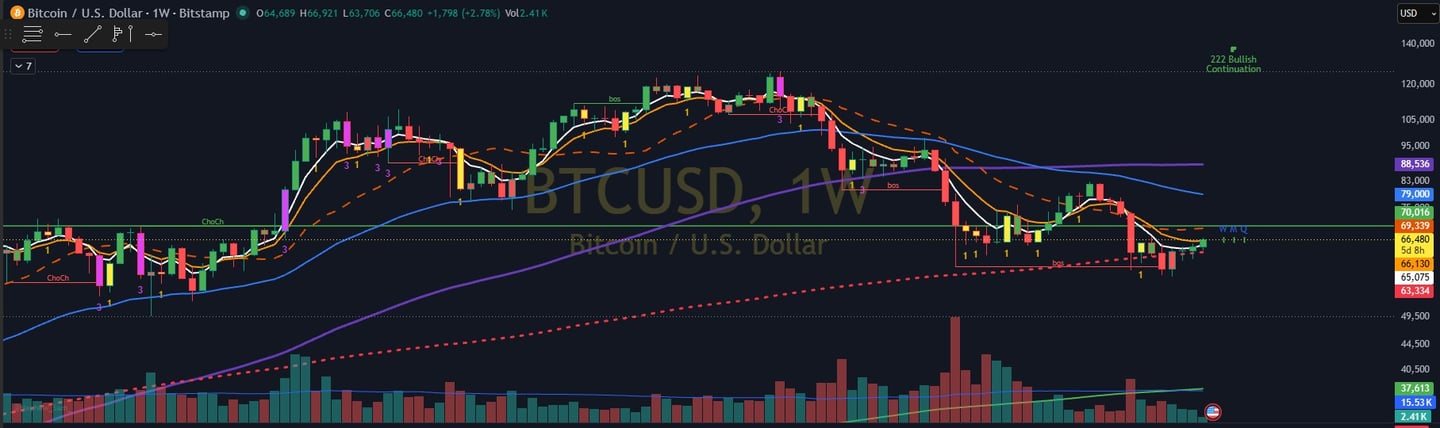
The numbers don't lie. When the White House ethics breakthrough hit the wire, the total crypto market cap jumped roughly $63 billion in 24 hours — a 2.8% surge that pushed total market value to approximately $2.32 trillion. That's not retail money trickling in. That's institutions repositioning, and the price action across major pairs tells the story clearly.
Let's break down what's happening technically and macroeconomically as digital assets price in the probability of statutory approval.
Bitcoin's Reaction & Short-Squeeze Potential:
Bitcoin didn't just tick higher — it ripped. As of the latest session data:
- BTC is trading at $66,577, up +2.14% on the day (+$1,393), with an intraday high of $66,990
- The day opened at $65,213 and never traded below $65,107 — meaning buyers stepped in immediately at the open and never let price revisit the session lows
- Spot volume hit approximately 7,888 BTC on the session, and the last trade crossed at $66,607 — momentum is still pushing into the high of day
- The previous day's close was $65,214, and BTC has now cleared both the prior day's close and prior day's high (**$65,860**) with conviction
Why this matters for squeeze dynamics:
- Bitcoin had been trading in a compressed range between roughly $63,700 and $65,900 for weeks leading into this move. That range accumulated short interest — traders betting on a breakdown that never came
- When price broke above $65,860 (the prior day high) on heavy spot volume, those shorts were instantly underwater. The break above a multi-week range high on a fundamental catalyst is textbook short-squeeze fuel
- The prior day's low sat at $63,692, meaning anyone who shorted anywhere in the $64,000–$65,000 zone over the past two weeks is now facing significant unrealized losses
- If BTC sustains above $66,000 and volume continues, the covering pressure could push price toward the next major resistance — a zone that sits significantly higher
Key Bitcoin levels to watch:
- Immediate support: $65,627 — a major daily level with 4 touches over the past week. If price pulls back and holds here, the breakout structure remains intact
- Secondary support: $64,731 — the heaviest major daily level with 9 touches. This is the line in the sand. A break below here invalidates the bullish breakout thesis
- Prior day close: $65,214 — psychological and structural support. Price holding above this level confirms the move is real, not a spike-and-fade
- Major overhead resistance: $82,818 — the only significant daily resistance above current price. Between $66,990 (today's high) and $82,818, there is a wide gap with no major daily resistance. That's the vacuum that shorts fear
- Period low: $57,718 — the bottom of the entire daily lookback range. Price is now trading well above this, confirming a structural shift from the June lows
DeFi & Altcoin Sentiment: The "Unregistered Security" Overhang Is Lifted:
Here's the thing most mainstream commentators are missing: the CLARITY Act doesn't just affect Bitcoin. It fundamentally changes the risk profile of every altcoin and DeFi token that has been living under the threat of retroactive SEC enforcement.
For years, the "unregistered security" overhang acted like an invisible tax on the entire altcoin market. Projects couldn't list on major U.S. exchanges without fear of a Wells notice. Token issuers faced existential legal risk. DeFi protocols operated in a gray zone where any interaction could be construed as facilitating the sale of unregistered securities.
The CLARITY Act changes that calculus — and the market is pricing it in right now:
- Ethereum is up +1.44% to $1,930, trading in a tight range between $1,900 and $1,954. ETH benefits doubly from this legislation — not only does it gain CFTC commodity clarity, but it also reinforces its position as the settlement layer for DeFi, which now has a defined regulatory path
- Cardano (ADA) surged +2.82% to $0.1745, the strongest gainer of the majors tracked here. ADA has been one of the tokens most frequently labeled a "potential security" by former SEC leadership. Legal clarity removes that existential risk premium
- Solana (SOL) is up +0.27% to $77.99, more muted than the others but still participating. SOL's quieter reaction reflects the fact that it has already been largely accepted as a commodity by market participants — the regulatory clarity is confirmatory rather than transformative for SOL specifically
The broader DeFi implication:
- Protocols like Uniswap, Aave, and Compound have operated under the constant threat that their governance tokens could be deemed unregistered securities. The CLARITY Act's framework for distinguishing investment-contract tokens from digital commodities provides the first real legal pathway for these projects to operate without that overhang
- Tokenized real-world assets — one of the fastest-growing sectors in DeFi — get explicit SEC oversight clarity. This means traditional finance institutions can issue tokenized bonds, equities, and fund interests on-chain with a known regulatory framework, instead of navigating 90-year-old securities law applied retroactively
- Layer-1 and Layer-2 tokens that were the subject of SEC enforcement actions or Wells notices (including ADA, SOL, and others named in previous SEC actions) now have a statutory framework that supersedes the enforcement-first approach
Key Technical Price Levels to Watch During Legislative Votes:
When the Senate moves on the CLARITY Act — whether that's a cloture vote, a floor amendment, or final passage — expect volatility to spike across every major crypto pair. Here are the levels that matter most:
Bitcoin (BTC) — currently $66,577:
- Breakout confirmation: $66,990 (today's intraday high) — a sustained close above here opens the path to the $82,818 vacuum
- Bull/bear line: $64,731 — 9-touch major level. Above here = bullish structure. Below here = breakout failed
- Psychological: $70,000 — round number resistance with no major daily level between current price and this zone. If momentum continues, this is the first natural profit-taking level
- Invalidation: $63,692 (prior day low) — a move below here would signal the rally was a news-driven spike, not a structural shift
Ethereum (ETH) — currently $1,930:
- Immediate resistance: $1,949 — minor daily level, 1 touch. Light resistance that should be cleared on any sustained rally
- Major resistance: $2,467 — the period high. This is the macro target if ETH breaks out of its multi-month range
- Support: $1,915 — minor daily swing low. Holding above here keeps the daily structure bullish
- Major support: $1,711 — 3-touch major level. A pullback to here during vote-day volatility would represent a 11% retracement and a potential buy zone for swing traders
- Prior day close: $1,903 — structural support. Price above here confirms the daily trend
Cardano (ADA) — currently $0.1745:
- Immediate resistance: $0.20 — minor daily level, the round-number psychological barrier. ADA hasn't traded above $0.20 in weeks
- Major resistance: $0.29 — period high. This is the macro ceiling
- Support: $0.16 — major daily level with multiple touches. This is the structural floor
- Prior day close: $0.1698 — price is currently 2.8% above this, confirming the bullish session
Solana (SOL) — currently $77.99:
- Immediate resistance: $79.08 — major daily level with 4 touches. This is the first real overhead. A break above here signals continuation
- Secondary resistance: $83.43 — 3-touch major level. The next ceiling after $79
- Support: $76.18 — minor swing low. First line of defense on pullbacks
- Major support: $78.95 — 6-touch level, the most-tested daily zone. This is the fulcrum — price is trading just below it, which means SOL is at a decision point
- Prior day close: $77.82 — price is holding above this, confirming the session is constructive
How to trade the vote:
- Expect exaggerated moves in both directions on vote day — fakeouts before the actual vote, then a directional surge once the result is clear
- BTC and ETH will lead the move. Altcoins like ADA and SOL will follow but with amplified percentage swings
- The highest-probability setups will come after the initial spike — whether that's a continuation trade on a "yes" vote or a fade on a "no" or delay. Chasing the initial spike is where most traders get hurt
- Watch BTC's $64,731 level as the macro signal. If it holds on any pullback, the structural bull case remains intact regardless of short-term noise
The market is doing something it hasn't done in a long time — it's pricing in the removal of regulatory risk, not just a price catalyst. That's a fundamentally different kind of rally. And if the CLARITY Act clears the Senate, the levels above current price aren't just targets. They're the opening of a new range entirely.
Stocks & Assets to Keep on Watch (Trading Watchlist)
The CLARITY Act isn't just moving crypto prices. It's sending shockwaves through the equities that live and die by crypto market structure — exchanges, brokers, Bitcoin treasuries, and miners. If you're an equity or options trader, these are the sympathy plays that move hardest and fastest when regulatory catalysts hit.
Here's the watchlist, with live prices and technical levels as of today's session.
Coinbase (COIN) — The Primary Beneficiary:
Current Price: $178.51 (+11.23%, +$18.02 on the day)
Coinbase is the single most direct equity beneficiary of the CLARITY Act. Here's why:
- The bill creates a clear CFTC registration pathway for digital commodity exchanges — which is exactly what Coinbase has been begging for since its public listing
- With CFTC oversight comes the ability to operate as a fully registered, federally regulated exchange instead of navigating 50 different state-level money transmitter licenses
- Domestic trading volume expands as institutional participants — previously blocked by regulatory ambiguity — enter the market through compliant infrastructure
- Coinbase's custody business becomes exponentially more valuable when institutional clients have legal certainty about asset classification
Today's price action:
- Opened at $167.89, ripped to an intraday high of $181.49, and is holding near highs at $178.51
- Volume surged to 7.33 million shares — well above the previous day's 5.72 million
- The move cleared the prior day high of $164.70 with massive conviction — this is a breakout, not a drift
Key levels to watch:
- Breakout confirmation: $181.49 (today's intraday high) — a daily close above here opens the path to $189.56
- Major overhead resistance: $189.56 — 4-touch daily level from 14 weeks ago. This is the first real ceiling
- Secondary resistance: $222.35 — the period high. If COIN clears $189.56, this is the macro target
- Immediate support: $169.17 — 3-touch major daily level. If price pulls back, this is the first line of defense
- Structural support: $163.13 — 4-touch major level. The bull/bear line. Below here, the breakout thesis weakens
- Prior day close: $160.43 — psychological and structural support. Price is currently trading $18 above this
Robinhood (HOOD) — Retail Volume Surge Play:
Current Price: $107.09 (+7.75%, +$7.69 on the day)
Robinhood benefits from the CLARITY Act through a different channel than Coinbase — it's the retail on-ramp that stands to gain the most from expanded asset listings:
- With regulatory clarity on what constitutes a digital commodity vs. a security, Robinhood can list tokens it previously delisted or never offered due to SEC enforcement risk
- The GENIUS Act already opened stablecoin trading pathways; the CLARITY Act expands that to the broader altcoin market
- Retail trading volume typically surges during regulatory breakthroughs as the "fear of a ban" narrative collapses and retail participants re-enter the market
- Robinhood's crypto revenue is a meaningful percentage of total transaction revenue, meaning crypto volume expansion flows directly to the bottom line
Today's price action:
- Opened at $102.82 and ran straight to an intraday high of $108.21 — never traded below the open
- Volume hit 10.38 million shares, more than half the previous day's full-session volume
- Price cleared the prior day high of $102.60 immediately and never looked back
Key levels to watch:
- Breakout confirmation: $108.21 (today's high) — a close above here targets $112.50
- Minor resistance: $112.50 — 1-touch daily level from 4 weeks ago
- Major resistance: $120.05 — the period high. This is the macro ceiling for this move
- Immediate support: $108.81 — 4-touch major daily level. Interesting: price is trading just below this level, meaning HOOD is at a decision point — break above $108.81 and it becomes support, or reject here and it's overhead
- Prior day close: $99.28 — structural support. Price is holding $7.81 above this
MicroStrategy (MSTR) — High-Beta Bitcoin Treasury:
Current Price: $101.52 (+3.83%, +$3.75 on the day)
MicroStrategy is the purest Bitcoin proxy in public markets. The company holds over 200,000 BTC on its balance sheet, meaning its stock price moves as a leveraged bet on Bitcoin spot price:
- When BTC breaks out — like today's move through $66,000 — MSTR amplifies that move
- The CLARITY Act reduces the regulatory risk premium on Bitcoin itself, which directly benefits MSTR's treasury strategy
- If BTC continues toward the $82,818 resistance zone identified in Section 3, MSTR could see another 10–15% upside from current levels
- Options on MSTR are deeply liquid, making it a favorite for traders who want Bitcoin exposure through traditional equity options
Today's price action:
- Opened at $101.31, hit an intraday high of $104.60, and is holding at $101.52
- The gap between the intraday high ($104.60) and current price ($101.52) suggests some profit-taking at resistance — which is expected given MSTR's volatility profile
- Volume reached 10.51 million shares, a significant uptick
Key levels to watch:
- Immediate overhead: $101.95 — minor daily resistance, 1 touch. Price is testing this level right now
- Secondary resistance: $104.78 — 2-touch daily level. Today's high of $104.60 came within $0.18 of this level before pulling back
- Major resistance: $197.00 — the period high. This is the macro target but represents a massive 94% move from current price. Only relevant if BTC enters a sustained bull trend
- Support: $90.02 — 2-touch minor daily level. First downside cushion
- Prior day close: $97.82 — price is holding $3.70 above this, confirming the session is constructive
- Prior day high: $100.92 — MSTR is trading above this, confirming the breakout
Crypto Miners — CLSK, MARA, RIOT:
The mining sector is where you see the most explosive sympathy moves. These stocks are high-beta plays on Bitcoin price and on the regulatory framework that governs mined assets.
CleanSpark (CLSK):
Current Price: $15.57 (+8.25%, +$1.19 on the day)
- CleanSpark is one of the most efficiently run U.S.-based Bitcoin miners, with a focus on low-cost energy and scalable operations
- The CLARITY Act's explicit classification of Bitcoin as a digital commodity removes any ambiguity about whether mined BTC is a "security" — which was never realistic but was a legal overhang nonetheless
- Institutional custody support becomes more accessible for miners when the regulatory framework is clear, potentially opening new financing and hedging pathways
Today's action: Opened at $14.80, ran to $15.69 intraday. Volume exploded to 17.15 million shares
Key levels:
- Overhead resistance: $15.10 — 1-touch level from 5 days ago. Price has already cleared this today, turning it into support
- Major resistance: $17.25 — 3-touch daily level from 6 weeks ago. This is the next real ceiling
- Period high: $19.17 — the macro target if momentum continues
- Support: $12.40 — 3-touch major daily level. Below this, the structure breaks
- Prior day close: $14.42 — price is holding $1.15 above this
Marathon Digital (MARA):
Current Price: $12.575 (+8.10%, +$0.945 on the day)
- Marathon is the largest publicly traded Bitcoin miner by hash rate and BTC holdings
- The company has been aggressively expanding its mining capacity and treasury position, making it one of the most sensitive stocks to BTC price moves
- Clear commodity classification under the CLARITY Act means MARA's mined BTC inventory has unambiguous legal status — which matters for balance sheet valuation and institutional investment
Today's action: Opened at $11.94, ran to $12.61 intraday. Volume hit 30.44 million shares — the highest of the three miners
Key levels:
- Immediate overhead: $12.95 — 4-touch major daily level. Price is approaching this now. A break above signals continuation
- Secondary resistance: $13.80 — 3-touch major level
- Major resistance: $14.41 — 4-touch level. The heaviest overhead resistance
- Macro ceiling: $14.87 — 4-touch level. If MARA clears $14.41, this is the next target
- Support: $11.59 — 2-touch minor level. First cushion on pullbacks
- Prior day close: $11.67 — price is holding $0.91 above this
Riot Platforms (RIOT):
Current Price: $21.38 (+7.54%, +$1.50 on the day)
- Riot operates one of the largest Bitcoin mining facilities in North America, with a focus on Texas-based operations
- The company has been expanding its hash rate and power capacity, positioning itself as a scale player in U.S.-based mining
- Like MARA and CLSK, Riot benefits directly from BTC price appreciation and from the removal of regulatory ambiguity around mined digital commodities
Today's action: Opened at $20.30, ran to $21.55 intraday. Volume reached 7.90 million shares
Key levels:
- Immediate overhead: $23.66 — 4-touch major daily level. This is the first significant ceiling above current price.
- Secondary resistance: $25.56 — 1-touch minor level.
- Major resistance: $28.94 — 3-touch major level. The macro target on a sustained rally.
- Period high: $30.32 — the ceiling of the entire lookback range.
- Support: $19.07 — 4-touch major level (currently below price, was prior resistance). If price pulls back, this is the structural floor.
- Prior day close: $19.90 — price is holding $1.48 above this.
How to Approach This Watchlist:
- COIN and HOOD are the infrastructure plays — they benefit from volume expansion and regulatory clarity regardless of which direction BTC moves short-term. They're the most "investable" of the group for longer-dated options
- MSTR is the highest-beta Bitcoin proxy — it will move the most in both directions. Use it for short-term options plays around legislative catalysts
- CLSK, MARA, and RIOT are the mining sector — they tend to move together but with different betas. MARA has the highest volume and liquidity today, making it the best vehicle for options traders. CLSK has the strongest percentage move today (+8.25%), suggesting it may have the most short interest to squeeze
- Watch for correlation breakdowns — if BTC rips but these equities don't follow, something is off. The sympathy link should hold during a catalyst-driven move. If it breaks, it signals the market is pricing in a different outcome than the headlines suggest
- Options strategy consideration — these stocks will have elevated implied volatility going into a Senate vote. That means long options are expensive. Consider spreads (debit call spreads, put credit spreads) rather than naked longs to manage vol crush risk if the vote doesn't happen on schedule
The CLARITY Act creates a rare moment where regulatory legislation directly drives equity price action. These six tickers are the cleanest sympathy vehicles in the market — and today's volume confirms that institutional money is already repositioning.
Frequently Asked Questions About the CLARITY Act
What is the CLARITY Act in simple terms?
The CLARITY Act — officially called the Digital Asset Market Clarity Act — is a U.S. bill that creates a clear regulatory framework for cryptocurrencies and digital assets. Its main goal is to draw a clean line between which agency regulates what:
- The SEC regulates digital assets that function as securities (investment contracts, tokenized stocks and bonds)
- The CFTC regulates digital commodities like Bitcoin and Ethereum, including the spot markets and exchanges where they trade
- Token issuers get clear disclosure rules tailored to digital assets instead of 1930s securities law
- Consumers get protection without innovation being strangled by enforcement-by-lawsuit tactics
In plain English: it ends the years-long guessing game about who regulates crypto and replaces it with an actual rulebook.
How does the CLARITY Act split SEC and CFTC jurisdiction over crypto?
The jurisdiction split is the core of the bill, and it's surprisingly straightforward:
- SEC keeps authority over investment-contract tokens — meaning tokens where the buyer is relying on a promoter or third party to generate profit. These must register or qualify for an exemption, just like traditional securities
- SEC also regulates tokenized securities — traditional financial instruments like stocks, bonds, and fund interests issued on a blockchain
- CFTC gains authority over spot digital commodity markets — Bitcoin, Ethereum, and most other cryptocurrencies classified as commodities. This is new — previously the CFTC only regulated crypto derivatives, not the spot markets where most actual trading happens
- Exchanges, custodians, and brokers handling digital commodities register with the CFTC instead of navigating 50 different state-level money transmitter licenses
The practical impact: crypto projects can now determine their regulatory pathway before launching, not after receiving a Wells notice.
Will the CLARITY Act pass the Senate before the August recess?
As of today, prediction markets put the odds of a Senate vote before the August recess at roughly 68%. Here's where things stand:
- The bill has approximately 18 legislative days remaining before the Senate breaks for August recess
- The White House agreed to a critical ethics package — the final major sticking point — which is what shifted the bill to what Treasury Secretary Scott Bessent called the "1-yard line"
- Senate Republicans hold a slim majority and need approximately 7 Democratic votes to clear the 60-vote filibuster threshold
- The ethics clause restricts elected officials and senior executive branch personnel from personally profiting from digital assets — which was politically sensitive but ultimately accepted
- If the vote doesn't happen before recess, the bill loses momentum and faces the political headwinds of an election-adjacent calendar
Nothing is guaranteed until the vote happens. But the math and the momentum are currently in favor of passage.
How much did the crypto market move on the CLARITY Act news?
The market response was immediate and significant. When reports broke that the White House had agreed to the ethics package:
- The total crypto market cap surged roughly $63 billion in 24 hours, climbing 2.8% to approximately $2.32 trillion
- Bitcoin jumped above $66,000, gaining over 2% on the day and clearing a multi-week range
- Ethereum rose 1.4% to approximately $1,930
- Cardano (ADA) was the strongest major gainer, up nearly 3% — it had been one of the tokens most burdened by the "unregistered security" overhang
- ETF inflows extended a five-day streak that topped $700 million
This wasn't a retail-driven pump. The magnitude and breadth of the move pointed to institutional repositioning — capital that had been sitting on the sidelines waiting for regulatory clarity before deploying.
Which stocks benefit the most from the CLARITY Act?
Several publicly traded equities moved sharply on the CLARITY Act catalyst:
- Coinbase (COIN) — the primary direct beneficiary. The bill creates a clear CFTC registration pathway for digital commodity exchanges, which is exactly what Coinbase has needed since going public. COIN gained over 11% on the news
- Robinhood (HOOD) — benefits from the ability to list tokens it previously couldn't offer due to SEC enforcement risk. HOOD rose nearly 8%
- MicroStrategy (MSTR) — the highest-beta Bitcoin proxy in public markets. The company holds over 200,000 BTC, so its stock amplifies Bitcoin's moves in both directions. MSTR gained nearly 4%
- Crypto miners (CLSK, MARA, RIOT) — all three surged between 7.5% and 8.3%. Clear commodity classification removes any lingering legal ambiguity around mined assets and opens new financing pathways
For options traders, these are the cleanest sympathy vehicles for trading legislative catalysts. COIN and HOOD are the infrastructure plays for longer-dated exposure, while MSTR and the miners offer higher beta for short-term trades around vote day.
What are the stablecoin yield restrictions in the CLARITY Act?
The stablecoin provisions in the CLARITY Act are one of the most contested parts of the bill, and they directly build on the framework from the GENIUS Act (the stablecoin law that already passed). Here's how it breaks down:
- Stablecoin holding yields are restricted — permitted payment stablecoin issuers are prohibited from paying interest or yield directly to token holders just for holding the token
- Transaction and payment rewards may still be allowed — incentives tied to active use of a stablecoin in payments or transactions are treated differently from passive yield
- A coalition of 78 banking groups, led by the American Bankers Association, is pushing to tighten this language further, arguing that the current provisions still contain loopholes that could let stablecoins function as interest-bearing deposit substitutes
- The banks' core fear is deposit flight — consumers moving money out of traditional bank deposits into crypto-native instruments
- The crypto industry counters that stablecoins are payment instruments, not bank accounts, and that over-restricting them pushes innovation offshore
This debate isn't fully resolved. The current language represents a compromise — but both sides are still trying to push it in their favor before the final floor vote.