
$SPY Intraday Playbook: How to Scalp the Most Liquid ETF (2026)
Master SPY day trading with proven intraday strategies. Learn opening range breakouts, VWAP bounces, and the best times to scalp SPY for consistent profits.
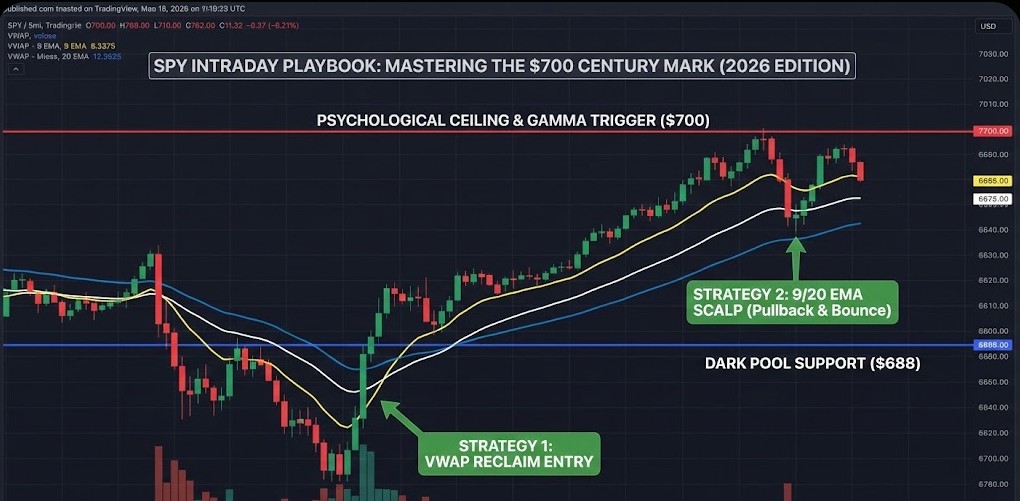
SPY Intraday Playbook: Mastering the $700 Century Mark (2026 Edition)
Introduction: The King of Intraday Liquidity
At Smart Trades Zone, we don't trade the SPY based on "feel." We trade it based on a systematic breakdown of time, volume, and institutional levels. This playbook is your definitive guide to scalping and trend-trading the SPY in the current high-stakes environment.
The SPDR S&P 500 ETF (SPY) remains the most liquid instrument on Earth, with daily volume often exceeding $400 billion. For the day trader, SPY is the "Final Boss." It offers one-penny spreads, near-instant execution, and enough volatility to yield multiple 1-2% moves per day. In January 2026, as the market tests the historic $700 level, the intraday dynamics have shifted. Volatility is no longer just a reaction to news; it is a reaction to "liquidity pockets" and institutional rebalancing.
Phase 1: The Three Pillars of SPY Analysis
To master SPY, you must view the chart through three distinct lenses simultaneously:
1. The Macro Trend: As of late January 2026, the SPY is in a sustained bull market, holding above the 200-day SMA near $610. However, intraday, we are focused on the 5-day EMA as our "Mean Reversion" magnet.
2. The VIX Correlation: The "Fear Index" is currently averaging 15–18. When the [VIX fear index] spikes intraday, SPY entries must be sized 50% smaller. When VIX is compressing, we can be more aggressive with our position sizing.
3. Dark Pool Levels: Major institutional "prints" have been spotted at $688.50 and $695.00. These act as invisible walls of support and resistance that retail traders often ignore until they get run over.
Phase 2: The SPY Intraday Time Zones
The SPY behaves differently depending on the clock. You must master the "Rhythm of the Tape."
- 9:30 AM – 10:15 AM (The Discovery Phase): This is the highest volume period. We look for the "Opening Range Breakout" (ORB). If SPY breaks the 15-minute high with a volume spike, the probability of a trend-day is 70%.
- 10:30 AM – 2:00 PM (The Institutional Grind): Volume drops. This is where "whipsaws" happen. We only trade "Mean Reversion" setups back toward the VWAP during this window.
- 3:00 PM – 4:00 PM (The Power Hour): This is where the real money is moved. As seen in our [Quad Witching Survival Guide], the final 60 minutes are when funds must finalize their daily allocations. In 2026, "0DTE" option hedging makes this hour the most explosive of the day.
Phase 3: The $700 "Century Level" Strategy
Trading at $700 is different than trading at $683. "Big Round Numbers" act as massive psychological magnets.
- The Magnet Effect: Price will often "churn" just below $700 as short-sellers defend the level and long-buyers try to trigger a breakout.
- The Gamma Trigger: There is currently massive "Open Interest" in $700 Call options. If SPY breaks $701.50, market makers will be forced to buy millions of shares to hedge their positions, creating a "Gamma Squeeze" that can rip SPY to $705 in minutes.
- The Fake-out: A common trap is a "wick" above $700 that immediately fails. We wait for a 5-minute candle CLOSE above $700.50 before committing to a long position.
Phase 4: High-Probability Intraday Setups
Strategy 1: The VWAP Reclaim
The VWAP is the "Institutional Anchor." If SPY opens red, drops to $688 (Dark Pool Support), and then crosses back above the VWAP on high relative volume, we enter Long. The target is the Daily High.
Strategy 2: The 9/20 EMA Scalp
On strong trend days, SPY will ride the 9 EMA like a staircase. We wait for a "Pullback to the 20 EMA." If the price touches the 20 EMA and prints a "Hammer" or "Bullish Engulfing" candle, we enter in the direction of the trend.
Strategy 3: The Power Hour "Closing Cross" Play
Between 3:45 PM and 4:00 PM, watch for "MOC" (Market on Close) imbalances. If there is a massive "Buy Imbalance," SPY will often drift higher into the bell regardless of the day's trend.
Phase 5: Risk Management & The "Slippage" Factor
In 2026, the speed of execution is faster than ever.
- The 1% Rule: Never risk more than 1% of your account on a single SPY trade. Utilize our [Position Sizing Mastery] calculator to determine exactly how many shares or contracts to trade based on your specific stop-loss level.
- Limit Orders: While SPY is liquid, "Market Orders" during a VIX spike can result in 10-20 cents of slippage. This might not seem like much, but over 100 trades, it destroys your edge. Always use Limit Orders.
- The "Two-Stop" System: Use a hard stop-loss in the machine for catastrophe protection, and a "manual stop" based on a candle close for your actual exit strategy.
Phase 6: Psychology – Don't Fight the Tape
The biggest mistake SPY traders make is "Predicting the Top." Because the market is at all-time highs near $700, retail traders constantly try to "short the top."
Rule: "Markets can remain irrational longer than you can remain solvent."
If the SPY is making higher highs and higher lows, do not short it. The "Smart Money" is buying. Trade the trend until the trend bends.
Summary: Mastering the 2026 SPY Environment
Trading the SPY intraday is a game of probability and discipline. By focusing on the psychological levels, respecting the time-of-day volume cycles, and using the VWAP as your guide, you are positioning yourself with the institutions.