
How to Trade Quad Witching: Guide for the Witching Hour(2026)
Navigate the quarterly chaos when options and futures expire simultaneously. Learn the volatility patterns, key time windows, and how to profit from extreme intraday swings.
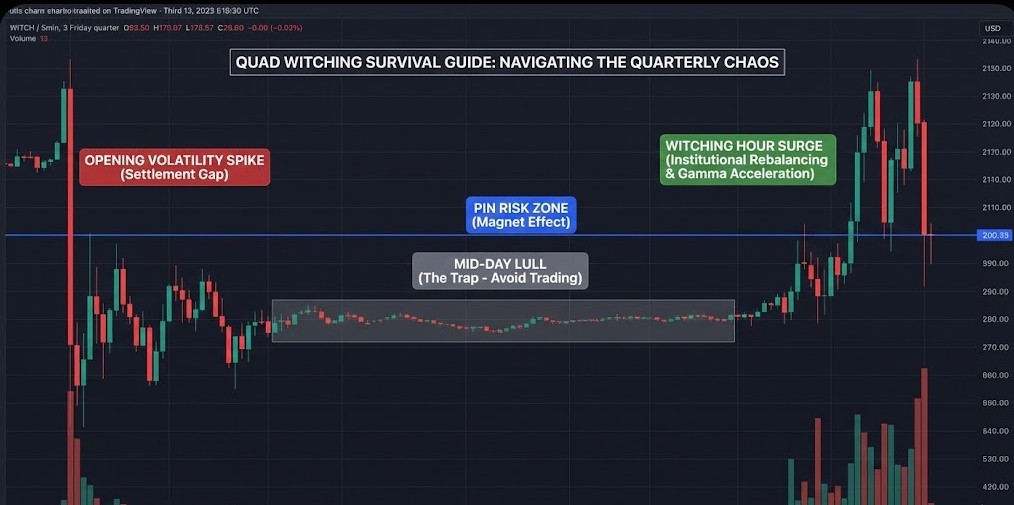
Quad Witching Survival Guide: Navigating the Quarterly Chaos
At Smart Trades Zone, we don't view Quad Witching as a day to fear; we view it as a day of immense opportunity—provided you have the right map. This is the day when institutional "Big Money" is forced to rebalance billions of dollars in positions. This massive exchange of hands creates "forced volatility" and unique price action patterns that do not exist on any other trading day. This playbook is your survival guide to navigating the quarterly chaos and profiting from the highest-volume sessions of the year.
Introduction: The Quarterly Super Bowl
In the professional trading world, four times a year, the market experiences a phenomenon known as "Quadruple Witching". This occurs on the third Friday of March, June, September, and December. It is the simultaneous expiration of four different types of derivative contracts: Stock Index Futures, Stock Index Options, Stock Options, and Options on Stock Index Futures.
Phase 1: The Anatomy of the "Witch" – The Four Pillars
To trade this day successfully, you must understand the mechanical forces at play. Quad Witching isn't driven by news or earnings; it is driven by the calendar.
1. Stock Index Futures: Contracts tied to a specific stock market index, such as the S&P 500.
2. Stock Index Options: Options that give the right to trade an index.
3. Individual Stock Options: The standard options traded on companies like Apple, NVIDIA, or Tesla.
4. Options on Stock Index Futures: Derivative contracts on the index futures themselves.
When these four expire simultaneously, it creates a "liquidity vortex". Institutions, hedge funds, and pension funds aren't just trading for profit on this day; they are trading because they MUST close out or "roll over" their expiring positions into the next quarter. This creates massive blocks of shares being moved that have nothing to do with a stock’s fundamental value, leading to sharp price dislocations.
Phase 2: The Three Windows of Volatility – Timing Your Entry
Quad Witching is not a uniform 6.5-hour event. The action is concentrated into three specific "Power Windows".
Window 1: The Opening Bell (9:30 AM – 10:30 AM EST)
The first 30–60 minutes are dominated by the settlement of index futures and options. Many index derivatives settle based on the opening prices of the underlying stocks, determined by a special opening quotation (SOQ). This leads to massive "imbalance" orders at the open. Expect violent "gap and go" moves or immediate reversals as the market finds its settlement price.
Window 2: The Mid-Day Lull (11:00 AM – 2:30 PM EST)
Counter-intuitively, the middle of the day can be strangely quiet. Most of the early rebalancing is finished, and the "Big Boys" are waiting for the closing cross. This is often a "trap" period where retail traders get bored and over-trade in low-momentum sideways action.
Window 3: The Witching Hour (3:00 PM – 4:00 PM EST)
This is the main event. In the final hour of trading, and specifically the final 15 minutes, billions of shares change hands. This is the "Closing Cross," where institutional orders are executed at the closing price to match their quarterly benchmarks. Expect "Liquidity Spikes" that can move mega-cap stocks 1% or more in seconds. To anticipate the intensity of these spikes, professionals monitor the [VIX fear index] to gauge institutional panic levels in real-time.
Phase 3: The Mechanics – Delta Hedging & Pin Risk
One of the primary drivers of volatility is "Delta Hedging" by market makers. As millions of options contracts approach expiration, market makers must buy or sell the underlying stock to remain "delta neutral".
- Gamma Acceleration: Near expiration, this hedging accelerates dramatically as prices move.
- Pin Risk: This is the fascinating phenomenon where stock prices "gravitate" toward round numbers or heavy strike prices near the close. Market makers often "pin" a stock to a strike price to minimize their payout, creating a magnet effect toward those levels.
Phase 4: High-Probability Survival Strategies
Strategy 1: The "Fade the Extremes" Play
Because Quad Witching volume is often "forced," price can become temporarily disconnected from reality. If a high-quality stock is slammed down in the final 10 minutes on no fundamental news, it is often a "liquidity flush". Smart traders wait for the closing bell and look for a "Mean Reversion" bounce the following Monday when that artificial pressure disappears. Focus on capturing quick moves on high-volume stocks like the [SPY Intraday Playbook] assets using Level 2 order flow to spot aggressive institutional buying or selling.
Strategy 2: Scalping the Witching Hour
Traders adept at short-term techniques can capitalize on the rapid price movements between 3:00 PM and 3:45 PM. Focus on capturing quick moves on high-volume stocks like SPY or QQQ using Level 2 order flow to spot aggressive institutional buying or selling.
Phase 5: Risk Management – The Survival Mandate
Protecting your capital is the #1 priority on Quad Witching.
- Reduce Position Size: Because volatility can exceed normal parameters, you should reduce position sizes by 30-50%. Mastering the math behind [calculated position sizing] is the only way to ensure a single 'witching' spike doesn't blow your account.
- Use Limit Orders ONLY: Never use market orders on Quad Witching. Bid-ask spreads often widen by 15-30%, and a market order can fill you at a disastrous price.
- Widen Your Stops: To avoid being "wicked out" by normal expiration noise, widen your stop-loss distance while maintaining a smaller position size to keep your total dollar risk constant.
Phase 6: The "Monday Hangover" Effect
Historically, the week following Quad Witching tends to show a bearish bias as the bullish positioning built up ahead of expiration is unwound. Stabilization of price discovery typically returns once the market has fully absorbed the expiration effects.
Summary: Mastering the Quarterly Vortex
Quad Witching is a day where the "rules" of technical analysis are tested by the force of institutional necessity. By recognizing the three windows of volatility, understanding the mechanical nature of delta hedging, and sticking to strict limit-order discipline, you move from being a victim of the chaos to being a master of the rebalance. Respect the Witch, but don't fear her.