$VIX Trading Strategy: How to Profit from Volatility Spikes (2026)
Learn how to trade VIX volatility spikes for profit. Master fear index signals, timing strategies, and proven setups for buying dips and selling premium during market uncertainty.
The VIX: Decoding the "Fear Gauge" for Institutional Panic (2026)
Introduction: The Pulse of Panic
At Smart Trades Zone, we don't fear the VIX; we use it as a predictive engine. When the VIX spikes, it tells us that institutions are paying a massive premium for "insurance" (put options), signaling that a market flush is either happening or imminent. This playbook will move you from being a victim of volatility to being a master of it, teaching you to read the "weather" of the market before you ever place a trade.
In the high-velocity markets of 2026, the CBOE Volatility Index (VIX) remains the undisputed "Fear Gauge" of Wall Street. While technically an indicator of the 30-day implied volatility of S&P 500 options, for the day trader, it is a real-time window into institutional panic and expectation. It doesn't track where the market has been; it tracks where the "Big Money" expects it to go in terms of turbulence.
Phase 1: The VIX Math – What the Numbers Actually Mean
To trade the VIX, you must understand its scale and what it implies for daily price movement. The VIX is expressed as an annualized percentage.
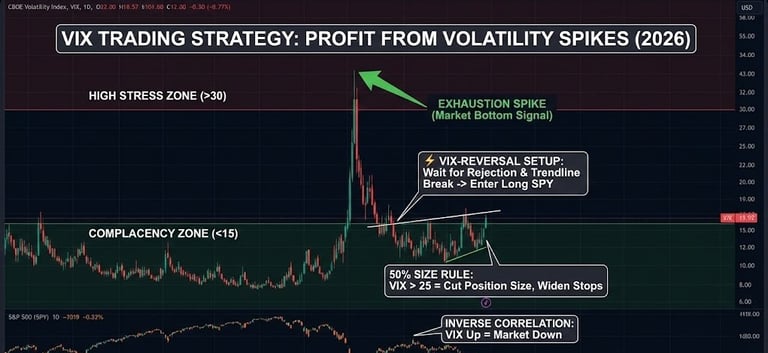
- VIX Below 15 (Complacency): The "Summer Daze." Volatility is low, and markets tend to grind higher in a slow, low-volume "melt-up".
- VIX 15–25 (Normal/Healthy): This is the sweet spot for day traders. There is enough intraday movement for range plays and trend continuation.
- VIX Above 25–30 (High Stress): Institutional panic has arrived. Spreads widen, slippage increases, and standard technical levels are often ignored.
- VIX Above 40 (Black Swan): Extreme financial stress (e.g., 2020 or geopolitical shocks). This is "survival mode" trading where cash is often the best position.
Phase 2: The Inverse Correlation – The Day Trader's Compass
The most powerful aspect of the VIX is its historical -0.70 to -0.90 correlation with the S&P 500.
- The Golden Rule: When VIX goes UP, the market generally goes DOWN.
- The Divergence Signal: This is an elite-level "tell." If the SPY is making a new intraday low, but the VIX is failing to make a new high, it signals "Hidden Strength." This is often a sign that a reversal bottom is forming on the [SPY Intraday Playbook] levels we track daily.
- The Exhaustion Spike: A vertical "blow-off top" in the VIX often coincides with the absolute bottom of a market dump.
Phase 3: The Volatility Risk Premium (VRP)
Implied volatility (what the VIX measures) is almost always higher than the actual realized volatility. Markets are "priced for disaster" more often than disaster actually happens. You can exploit this by recognizing when the VIX has "overpriced" the fear. When the VIX stays elevated but the price action stabilizes, the "Crush" of this premium provides momentum for a relief rally.
Phase 4: The VIX Term Structure – Contango vs. Backwardation
For 2026 traders, looking at the "Spot VIX" (current price) is only half the battle.
- Contango (Normal): Future volatility is more expensive than current volatility. It indicates a stable, upward-trending market.
- Backwardation (The Alarm): When the front-month VIX futures become more expensive than future months, it signals "Immediate Panic." This often occurs during heavy [Trading Earnings Reports] cycles where uncertainty is at its peak.
Phase 5: Execution Strategy – The "VIX-Reversal" Setup
1. Identify the Spike: Wait for the VIX to rip 5–10% above its 20-period moving average on the 5-minute chart.
2. Wait for Rejection: Look for the VIX to print a "Shooting Star" candlestick or an RSI overbought reading (above 70).
3. The Trigger: As soon as the VIX starts to "roll over," we enter LONG positions on SPY. The "Volatility Crush" provides the fuel for a market rally.
Phase 6: Risk Management in High VIX Environments
High volatility (VIX > 25) requires a fundamental shift in how you manage your money.
- The 50% Size Rule: When the VIX is above 25, the "noise" in the market is louder. You must trade with half your normal position size. Use our [Position Sizing Mastery] guide to ensure your dollar-risk stays constant even as you widen your stops.
- Widen the Stops: In a low VIX environment, small stops work. In a high VIX environment, those same stops will get "wicked out" by normal noise.
- Use Limit Orders ONLY: Never use market orders when the VIX is spiking. Spreads can widen instantly, and a market order could fill you at a disastrous price.
Summary: The Weather Channel of the Market
The VIX is the most powerful "context" tool in a day trader's arsenal. It doesn't just tell you what happened; it tells you what the market expects to happen. By mastering the inverse correlation, you stop trading in the dark and start trading with the wind at your back.