
Bear Put Debit Spread vs. Credit Spread: Key Differences Explained
Discover the core differences between a bear put debit spread and a bear call credit spread. Learn to manage risks, calculate payoffs, and choose the right setup.
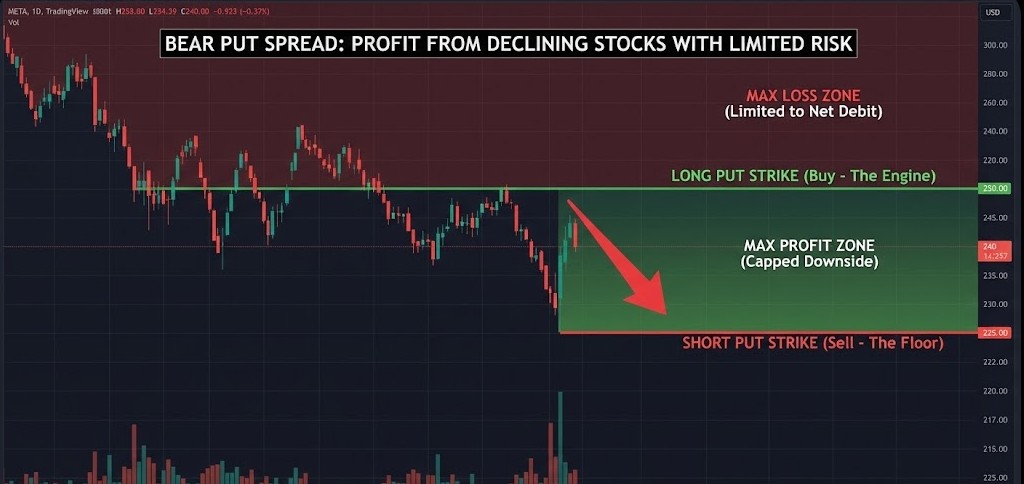
In the world of financial markets, navigating a downtrend effectively requires tools that balance capital efficiency with strict risk management. While many retail market participants simply buy standalone put options when they turn bearish on a stock, professional traders recognize that this straightforward approach exposes them to severe headwinds, namely high premium costs and rapid time decay. To mitigate these structural disadvantages, sophisticated investors deploy the bear put debit spread strategy. This vertical multi-leg setup allows a trader to express a highly precise, cost-controlled bearish outlook on an underlying asset while establishing absolute structural protection from day one.
To understand the core mechanics of how a bear put debit spread operates, one must look at its dual-contract construction. A bear put spread is a type of vertical spread, meaning it involves the simultaneous purchase and sale of options contracts within the exact same underlying asset and sharing the exact same expiration date, but utilizing completely different strike prices. Specifically, the strategy requires two distinct components executed as a single multi-leg package order:
The trader buys one put option featuring a higher strike price, which sits closer to or at the current market value of the stock. This is the long leg of the trade, designed to appreciate aggressively in value as the underlying asset plummets.
Simultaneously, the trader sells one put option featuring a lower strike price, positioned further out-of-the-money. This is the short leg of the trade, acting as a structural hedge.
The interplay between these two contracts is what makes the strategy uniquely powerful. By selling the lower strike put contract to another market participant, you receive an upfront premium credit. While you do not get to keep this credit as pure cash profit, your brokerage platform automatically applies it to offset the steep premium cost of the higher strike put option you purchased. Because the cash outflow required to buy the long put is heavily subsidized by the cash inflow from the short put, the trade is entered for a net debit—hence the name, bear put debit spread. This reduced entry price fundamentally lowers the financial hurdle the stock must cross to reach profitability compared to a single standalone put.
The overarching market forecast for deploying this strategy is explicitly defined as moderately bearish. The ideal scenario for a bear put spread writer is for the underlying asset price to experience a steady, controlled decline, dropping entirely below the lower strike price by the time the expiration clock runs out. If the stock drops beneath both boundaries, both the long put and the short put finish deep in-the-money. This allows the trader to extract the maximum distance between the two strike prices while keeping their initial risk strictly capped at the initial net debit paid to enter the trade.
What is a Bear Put Debit Spread Strategy and How Does It Work?
Constructing a highly profitable bear put spread strategy requires shifting away from guesswork and implementing a strict, mechanical blueprint on the options chain. A vertical spread is only as good as its underlying architecture. To protect your capital from market noise while maximizing your return on investment, you must execute a precise filtering process across asset selection, strike price calibration, and expiration timing.
The foundational step of a professional setup begins with isolating the correct underlying asset. Because a bear put debit spread relies on a clean, downward directional move to reach its maximum profit potential, you must target equities that exhibit clear technical breakdown patterns, downward macroeconomic headwinds, or structural overvaluation. Furthermore, absolute liquidity is mandatory. You must look for high-volume stocks or index ETFs that feature tight bid-ask spreads across their options chains. High liquidity ensures that you can enter and exit the multi-leg position efficiently without losing a significant portion of your capital to slippage, which frequently plagues traders who attempt to trade spreads on low-volume equities.
Once a viable target is identified, you must determine the optimal strike price for the long leg of your spread. The long put option acts as the primary anchor of the trade. To give the position a high statistical probability of success, professional traders generally select a strike price that is at-the-money or slightly out-of-the-money. In technical terms, this means looking for a put contract with a delta value near fifty. Selecting a strike price close to the current market price ensures that the contract will immediately begin accumulating intrinsic value the moment the stock starts to tick downward, providing immediate momentum to your overall position.
The next critical phase is positioning the short leg of the spread, which serves as your financial subsidy. Choosing this lower strike price requires a calculated balancing act between risk and reward. The distance between the long strike and the short strike is known as the spread width. If you select a short strike price that is too close to your long strike, the total cost of the trade will be exceptionally low, but your maximum profit potential will be severely restricted. Conversely, if you place the short strike price deep out-of-the-money, you open the door to a much larger maximum payoff, but you also increase the total upfront cost of the trade and lower the probability that the stock will drop far enough to fully maximize both legs. A highly effective industry standard is to position the short strike at a key technical support level or target a delta value around thirty, creating a healthy spread width that balances a high payout with a realistic price target.
The final component of a masterful setup is selecting the correct expiration date, a process dictated by managing theta, or time decay. One of the primary structural advantages of a bear put debit spread over a standalone put option is its built-in resistance to time decay. Because you have simultaneously bought an option and sold an option, the time decay of the short contract works to actively offset the time decay of your long contract. To exploit this mechanic efficiently, traders typically target an expiration cycle between thirty and forty-five days out. This timeframe captures the acceleration of time decay on the short leg if the stock stalls, while giving the underlying asset ample time to experience its downward break and move completely through your selected strike boundaries before expiration day arrives.
Structuring the Optimal Bear Put Spread Setup: Strikes and Expirations
When a trader establishes a firm bearish conviction on a stock, choosing the right vehicle to express that trade can mean the difference between an equity curve that climbs steadily and one that suffers catastrophic drawdowns. While the bear put debit spread is an exceptional tool for capitalizing on downward momentum, it represents only one side of the vertical spreading coin. To achieve true mastery of a trading hub, an options strategist must weigh the bear put debit spread against its primary structural alternative: the bear call credit spread. Both strategies profit from a declining market, but they utilize entirely opposing mechanics to achieve that goal.
The fundamental dividing line between these two approaches comes down to whether you are paying capital to enter the trade or collecting capital upfront. Understanding how these distinct financial structures influence your risk profiles, probability of success, and volatility exposure is essential for proper portfolio deployment.
Capital Flow and Risk-to-Reward Dynamics: With a bear put debit spread, you are an options buyer at heart. You pay a net debit upfront, and that specific debit represents the absolute maximum amount of capital you can lose if the trade fails. Because you are buying a spread, your maximum reward is capped, but it is often significantly larger than the initial risk capital required to enter. Conversely, when executing a bear call credit spread, you act as the options seller. You sell a call closer to the money and buy a further out-of-the-money call to protect yourself, collecting a net credit upfront. This credit is your maximum potential profit. The primary drawback here is that the risk-to-reward ratio is inverted; you are typically risking a larger amount of collateral to secure a smaller, fixed credit payout.
The Threshold of Directional Tolerance: A debit spread requires a definitive, physical price movement to achieve maximum profitability. If the underlying stock remains completely flat or drifts sideways, both options will experience premium erosion, and the trade will result in a total loss of the debit paid. A credit spread, however, offers a much wider margin for error. Because you are selling premium, you do not need the stock to crash violently to win. The trade will reach maximum profitability if the stock drops, if the stock moves completely sideways, or even if the stock rallies slightly, provided the price remains entirely below your short call strike price at expiration. This makes credit spreads a favorite for high-probability traders who favor consistency over massive individual payouts.
The Impact of Volatility and Time Decay: Implied volatility behaves differently across these setups. Because a bear put debit spread is entered for a net debit, the position retains a slight positive exposure to volatility. If the stock experiences a sudden panic and implied volatility spikes, the overall value of the debit spread can expand, allowing the trader to exit early for a profit before expiration. A bear call credit spread is the exact opposite. It relies heavily on a decline in implied volatility and the steady, unyielding pressure of daily time decay. The credit spread trader wants the market to quiet down and the option premiums to melt away to zero, allowing them to retain the entire initial credit without interference.
Choosing between a debit spread and a credit spread ultimately depends on the specific technical environment and your personal risk tolerance. If a stock is trading at historical highs and appears primed for a sudden, aggressive technical breakdown, buying a bear put debit spread is the superior choice because it allows you to risk a small amount of capital to capture a disproportionately larger profit as the stock slides through your strikes. However, if the stock is already in a slow, grinding downtrend or consolidating under a heavy layer of overhead resistance, writing a bear call credit spread is the optimal play. It allows you to transform the passage of time into direct cash flow, extracting consistent profit from the market even if the stock takes its time moving downward.
Bear Put Debit Spread vs. Credit Spread: Managing Risks and Payoffs
If you want to master more high-velocity market events, check out our other comprehensive trading guides:
➡️VIX Trading Strategy Guide
➡️How to Trade Economic Data
➡️How to Trade Earnings Reports