
Cognitive Biases That Kill Profits: Identify and Eliminate Mental Traps
Discover the cognitive biases destroying your trading profits. Learn to identify confirmation bias, anchoring, disposition effect, and overconfidence that sabotage your trading decisions and account growth.
Cognitive Biases That Kill Profits: Rewiring the Trader's Brain (2026)
Introduction: The Invisible Enemy
At SmartTradesZone, we know that your biggest competitor isn't the guy on the other side of the trade—it’s the hardwired biology inside your own head. While the average trader is a victim of "Anchoring" and "Confirmation Bias," we provide the mental architecture to identify these glitches in real-time and bypass them. Mastering this playbook is about more than just psychology; it’s about rewiring your brain to stop fighting for your ego and start fighting for your equity.
You can have the best technical analysis in the world, the fastest execution software, and a perfect risk management plan. But if you cannot control your own brain, you will lose money. Cognitive biases are mental shortcuts that our brains use to process information quickly. In everyday life, they help us survive. In the stock market, they get us killed.
These invisible mental traps distort reality, causing us to make decisions based on what we "feel" rather than what the chart is actually showing us. At Smart Trades Zone, we believe that identifying these biases is the first step to eliminating them. This playbook exposes the psychological flaws that destroy trading accounts and provides the specific protocols to neutralize them.
Phase 1: Confirmation Bias – The "Echo Chamber" Virus
This is the most common virus in the trading world. Confirmation bias occurs when you form an opinion about a trade (e.g., "The SPY is going to $600 today") and then subconsciously filter out any data that contradicts that belief. You will stare at one bullish indicator on the 5-minute chart while ignoring the massive resistance level on the daily chart.
The Fix: The "Devil's Advocate" Rule
Before you enter any trade, you must verbally state one valid reason why the trade might fail. If you cannot find a bearish argument for your bullish trade, you aren't looking hard enough. You are blinded by bias. We cross-reference our bias with the [Technical Analysis Mastery] guide to ensure our thesis is backed by data, not just desire. Force yourself to look at the chart from the perspective of the person selling you the shares. What do they see that you don't?
Phase 2: Anchoring Bias – The "Price Memory" Trap
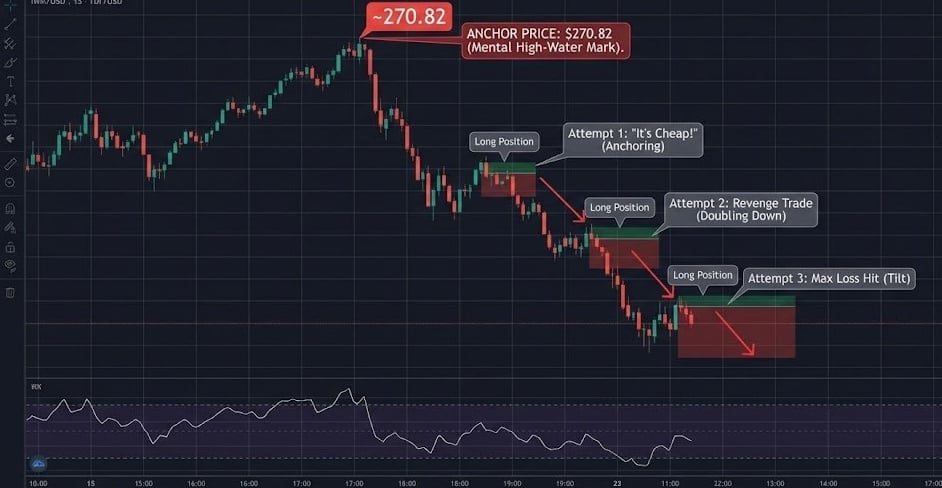
Anchoring happens when you get stuck on a specific price level—usually the price you entered at, or a recent high.
Example: A stock falls from $150 to $130. Your brain anchors to $150, making $130 feel "cheap." You buy it without checking the trend. The stock continues to fall to $100. You refuse to sell because you are still anchored to the idea that it is "worth" $150.
In trading, the market has no memory. The stock does not care what you paid for it. It does not care where it was yesterday. The only thing that matters is the current supply and demand. We use the [Support & Resistance Playbook] to define our levels based on current institutional flow, not historical price points that no longer matter.
Phase 3: The Disposition Effect – Selling Winners, Holding Losers
This is the number one reason retail traders fail to be profitable over the long term. The Disposition Effect is the tendency to sell winning trades too early (to lock in the feeling of success) while holding losing trades too long (to avoid the pain of admitting failure).
Winning feels good, so you snatch the profit immediately, often missing the biggest part of the move. Losing feels bad, so you "hold the bag," hoping it will come back to breakeven so you can exit without "being wrong." This results in a portfolio of small wins and catastrophic losses.
The Fix: The [Risk-Reward Ratio Mastery] Mandate. Never exit a winner until it hits your technical target or a trailing stop is triggered. Never move a stop loss to give a loser "more room."
Phase 4: Sunk Cost Fallacy – Throwing Good Money After Bad
This bias makes you feel that because you have already invested time or money into a trade, you "must" see it through. This leads to the most dangerous behavior in trading: Averaging Down.
The Professional Rule: If you wouldn't buy the stock at its current price as a brand-new trade, you shouldn't be holding it. The money you’ve already lost is a "sunk cost." It’s gone. Your only concern is the next dollar.
Phase 5: The Recency Effect – The "Last Trade" Shadow
The Recency Effect is the tendency to give more weight to recent events than to long-term data. If your last three trades were losers, you will likely hesitate on the fourth trade, even if it is a "Grade A" setup. Conversely, if your last three were winners, you might become reckless.
The Fix: The "Independent Event" Protocol. Treat every trade as a completely new data point. Your past performance has zero impact on the probability of the next trade.
Phase 6: Overconfidence Bias – The "Hot Hand" Fallacy
This usually strikes right after a winning streak. You hit three winners in a row, and your brain tells you that you have "mastered" the market. You start feeling invincible.
- The Symptom: You stop checking your checklist. You increase your position size because you "can't miss."
- The Reality: Your winning streak might just be luck or a favorable market condition. When the market shifts, your overconfidence leads to sloppy execution, and you give back a month's worth of profits in a single afternoon.
The Fix: The "Size Down" Protocol. If you have a massive winning day, cut your position size in half the next day. This protects your profits from your own ego.
Phase 7: Hindsight Bias – The "I Knew It" Illusion
After a move happens, it always looks obvious. "I knew the SPY was going to bounce there!" Hindsight bias makes you think you are better at predicting the market than you actually are. This creates a false sense of security and leads to taking high-risk, low-probability trades because you "just know" what’s going to happen.
The Fix: Journaling the "Why" BEFORE the trade. When you write down your reasons before the move, you can see if you actually "knew it" or if you just got lucky.
Phase 8: Social Proof Bias – The "Twitter" Trap
Seeing thousands of traders on social media talking about a stock creates a psychological urge to join the herd. Humans are social animals; being part of the group feels safe. In trading, the herd is almost always wrong at the extremes.
The Fix: Turn off the noise. Your edge is in your charts and your plan, not in a trending hashtag.
Summary: Trading the Chart, Not the Brain
The market is a mirror. It reflects your own psychology back at you. If you are stubborn, fearful, or greedy, the P&L column will show it immediately. Professional traders are not smarter than you; they are just more self-aware. They have built systems that prevent their cognitive biases from touching the buy button. By recognizing these traps—Confirmation, Anchoring, Disposition, and Overconfidence—you stop trading against yourself and start trading with the market.