
Revenge Trading: Break the Cycle and Protect Your Capital
Learn how to stop revenge trading and break the emotional cycle that destroys accounts. Discover proven strategies to recover from losses without impulsive decisions and trade with discipline.
Revenge Trading: Break the Cycle and Protect Your Capital (2026)
Introduction: The Anatomy of a Meltdown
At SmartTradesZone, we treat Revenge Trading as a biological emergency that requires immediate "Circuit Breaker" intervention. While the retail crowd falls into the "Get-Back" trap, we empower you with mechanical protocols to neutralize the adrenaline spike and protect your bankroll from emotional sabotage. Mastering this playbook ensures that a single losing trade remains a minor business expense rather than becoming a catastrophic account-ender.
Revenge trading is the single fastest way to destroy a trading account. It is not a strategy; it is an emotional response to pain. It happens when you try to force the market to "give back" the money it just took from you. At Smart Trades Zone, we define Revenge Trading (or going on "Tilt") as entering a trade immediately after a loss without a valid technical setup, usually with an increased position size.
While every trader feels the urge to "get even," professional traders have systems to neutralize it. This playbook outlines the exact "Circuit Breaker" protocols we use to protect capital when emotions run high. To win in the long run, you must understand that the market doesn't owe you anything. The money you lost is gone; the only thing that remains is your ability to manage the next trade with cold discipline.
Phase 1: Recognizing the "Tilt" – The 5-Second Audit
You cannot stop revenge trading if you do not recognize it happening in real-time. The "Tilt" state is physiological before it is financial. When you take a significant loss—especially one that breaks your [Stop Loss Strategies]—your body releases cortisol and adrenaline. This triggers a "fight or flight" response. In trading, "fighting" means blindly buying more to recover the loss.
Before you click "Buy" after a loss, run this 5-second Internal Audit. If you experience any of these symptoms, you are on Tilt:
1. Increased Heart Rate: You feel your pulse pounding in your ears.
2. Tunnel Vision: You are staring at the P&L column instead of the chart pattern.
3. The "Get Back" Urge: You catch yourself thinking, "I just need to make that $500 back, and then I'll quit."
4. Anger: You feel physically angry at the market, the news, or your broker.
If you answer YES to any of these, you are biologically incapable of making a rational trading decision. You must stop immediately.
Phase 2: The Logic Gap – Why Doubling Down is Suicide
Revenge traders often fall victim to the "Martingale" fallacy—the idea that if you keep doubling your bet, you will eventually win and cover all losses. While this might work briefly in a casino with infinite capital, in the stock market, it is a mathematical death sentence.
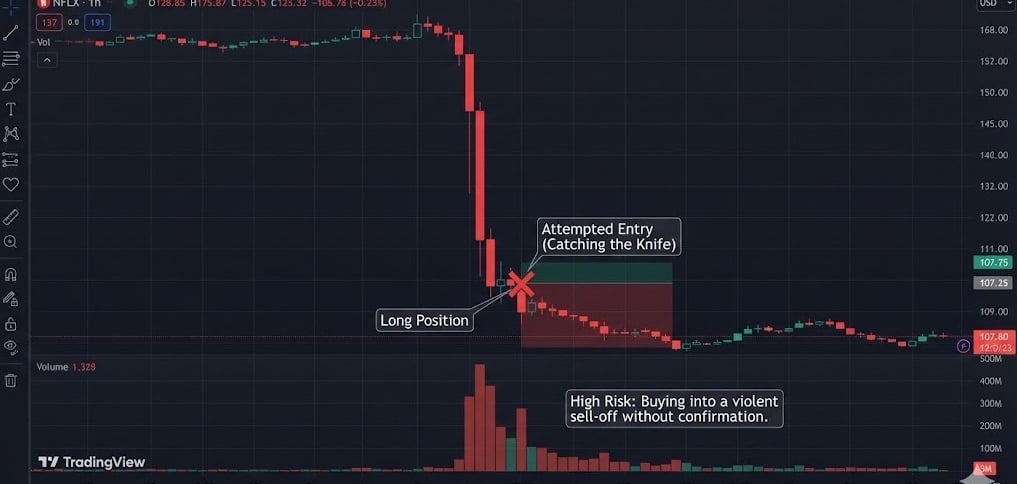
When a stock is crashing, it has momentum. By trying to "catch the falling knife" to make back your loss, you are fighting against the institutional trend. You are providing liquidity to professional sellers who are unloading their shares. The market can remain irrational longer than you can remain solvent. Attempting to pick a bottom during a panic sell-off without a signal from our [Technical Analysis Mastery] is not trading; it is gambling with the odds stacked against you.
Phase 3: The Circuit Breaker Protocol – 3 Non-Negotiable Rules
Willpower is a finite resource. You cannot rely on it to stop revenge trading when you are emotional. You need hard rules that act as mechanical circuit breakers. We use three specific mandates at Smart Trades Zone.
Rule #1: The 15-Minute Lockout
The most dangerous time to trade is the 60 seconds immediately following a loss. This is when the emotional pain is freshest and the impulse to "fix it" is highest.
- The Protocol: After any loss greater than your standard risk unit, you must physically leave your trading desk for 15 minutes.
- The Action: Stand up. Walk away from the screen. Do not look at your phone.
- Why It Works: It takes roughly 15 minutes for the adrenaline spike to subside. By forcing this physical break, you allow your logical brain (the prefrontal cortex) to come back online.
Rule #2: The Daily Max Loss (The Hard Deck)
Every professional trading desk has a "Daily Max Loss" limit. If a trader hits it, they are sent home. You must be your own risk manager.
- The Protocol: Set a hard dollar limit for daily losses. This should be no more than 3% of your total account value.
- The Execution: Use a broker that allows "server-side" risk locks. If you hit this number, the software will automatically reject any new orders until the next day. This removes the "choice" to revenge trade from your hands entirely.
Rule #3: The "Three Strike" Law
Sometimes, your strategy is sound, but the market conditions are simply out of sync with your edge.
- The Protocol: If you take three consecutive losses in a single session, your trading day is over.
- The Logic: Three losses in a row implies that your read on the market is currently incorrect. Continuing to trade in this state usually leads to a "death spiral." Accept the small loss today to preserve your [Bankroll Management System] for tomorrow.
Phase 4: The Recovery Ritual – Rebuilding the Mindset
The day after a "Tilt" session is critical. Your confidence is shaken, and you are prone to hesitation. You must handle the recovery with surgical care.
Step 1: Size Down
For your next 5 trades, reduce your position size by 50%. If you normally risk $200, risk $100. You need to see "green" on the screen to rebuild your neural pathways of success. Smaller size lowers the emotional stakes.
Step 2: Forget the High-Water Mark
Stop looking at your total account balance. Traders often obsess over "getting back to where I was." This is a trap. The money you lost is gone—it is a business expense. Focus entirely on executing the next trade perfectly, regardless of the P&L.
Step 3: The Post-Mortem
Once the market closes, review the trades that caused the meltdown. Was it a bad strategy, or was it bad execution? If you followed your rules and lost, that is just a probability expense. If you broke your rules, identify the trigger. Write it down. Awareness is the first step to permanent prevention.
Phase 5: The "Zen" of the Zero Day
A professional trader knows that sometimes the best trade is no trade. "Sitting on your hands" is a valid position. If you feel the urge to revenge trade, realize that by doing nothing, you are already "winning" against your old, destructive self. You are preserving the most important tool you have: your capital.
Summary: Protect the Fortress
You cannot control the market, and you cannot fully eliminate your emotions. But you can control your environment. By setting hard stops, daily loss limits, and mandatory cool-off periods, you build a fortress around your capital. The goal of trading is not to win every day; it is to survive the bad days so you can thrive on the good ones. Break the cycle of revenge, and you break the cycle of losing.