
Building an Unshakeable Trading Mindset: Mental Toughness for Consistent Wins
Learn how to build an unshakeable trading mindset with mental toughness strategies. Develop resilience, handle losing streaks, maintain emotional control, and think like a professional trader.
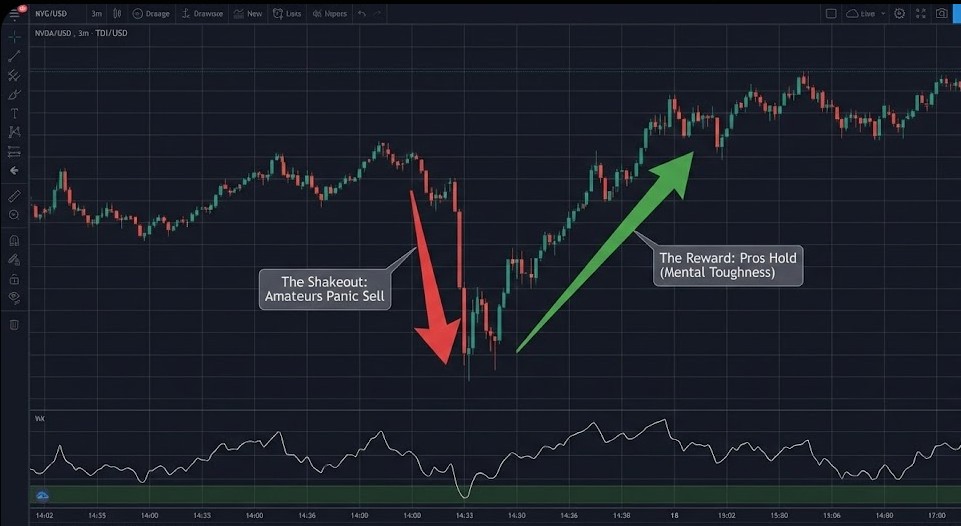
Building an Unshakeable Trading Mindset: Mental Toughness for Consistent Wins (2026)
Introduction: The Driver and the Car
At SmartTradesZone, we know that your strategy is the Ferrari, but your mindset is the driver. You can have a 2026-grade, high-win-rate system, but if the driver panics at every curve, the car will eventually crash. Professional trading psychology isn't about suppressing your emotions through sheer willpower; it’s about re-engineering how your brain processes risk so that fear and greed no longer have a seat at the table. We define an "Unshakeable Mindset" as the ability to execute your trading plan without hesitation, regardless of the immediate outcome. This playbook outlines the mental frameworks required to bridge the gap between knowing what to do and actually doing it.
In trading, your strategy is the car, but your mindset is the driver. You can have a Ferrari of a strategy—a 70% win rate system backed by institutional data—but if the driver panics at every curve, you will crash. Most traders believe "Mental Toughness" means suppressing emotions—gritting your teeth and forcing yourself not to feel fear. This is incorrect. Professional trading psychology isn't about ignoring emotions; it's about re-engineering how your brain processes risk.
Phase 1: The Probability Shift (Thinking in Series)
The primary cause of trading anxiety is judging your success on a "trade-by-trade" basis. This creates a psychological roller coaster.
- Amateur View: "I lost money on this trade; therefore, I made a mistake or the market is rigged."
- Professional View: "I executed my edge. The outcome of this specific trade is a random data point and is statistically irrelevant."
The Casino Framework:
Casinos do not panic when a player wins a jackpot. They don't change the rules of Blackjack because one person had a "hot hand." They know that over a series of 1,000 spins, the house edge guarantees they will profit. To build an unshakeable mindset, you must stop being the Gambler and start being the Casino. You must judge your performance over a block of 20 trades, not one.
Action Step: Group your trades into blocks of 20. Do not assess your profitability until the block is finished. If you followed your [Master Trading Discipline] rules for 20 trades and lost money, tweak the system. If you break your rules and make money, count it as a failure.
Phase 2: The "Drawdown Protocol" – Rebuilding the Armor
Every trader, including the legends, experiences drawdowns. The difference is how they react. Amateurs try to "make it back" quickly, leading to the spiral we cover in [Revenge Trading: Break the Cycle]. Professionals go into defensive mode to protect their "Mental Capital."
When you hit a losing streak, your confidence erodes. To rebuild it, you must implement the "Size Down" rule.
- The Rule: If you lose 10% of your account, you must cut your position size by 50%.
- The Logic: You cannot trade well when you are scared of losing more money. By lowering your size, you lower your emotional attachment to the tick-by-tick movements.
- The Goal: Your goal during a drawdown is not to "make money"; it is to execute perfectly. Once you hit 3 winning trades in a row at half-size, you earn the right to return to full size.
Phase 3: Detachment from the Dollar
If you are staring at your P&L (Profit & Loss) window while in a trade, you are trading with fear. You are watching your mortgage payment or vacation fund fluctuate in real-time, which triggers a biological stress response.
The Protocol: Hide your P&L.
Most professional platforms allow you to hide the "Unrealized P&L" column. You should only be looking at the chart structure and the [Technical Analysis Mastery] levels. Ask yourself: "If I had zero money on the line, would I hold this trade based on the chart?" If the answer is Yes, but you want to sell because you're afraid of the dollar amount, you are trading your P&L, not the market.
Phase 4: The Pre-Market Visualization (Mental Priming)
Mental toughness is a muscle that must be trained before the bell rings. Top athletes use visualization to prepare for high-pressure moments; traders must do the same to handle the chaos of 2026 volatility.
The Exercise: Before the market opens, close your eyes for 2 minutes. Visualize yourself taking a loss.
- Imagine the stock hitting your hard stop loss.
- Imagine the feeling of "losing" the money.
- Imagine yourself calmly accepting the exit and waiting for the next setup.
By "pre-accepting" the loss, you remove the shock factor when it happens. You have already lived it mentally, so you can handle it physically without a spike in cortisol.
Phase 5: Accepting Uncertainty – The End of "Being Right"
The need to be "right" is the primary enemy of profit. In school, 90% is an A. In trading, a 40% win rate can make you a millionaire if you master the [Risk-Reward Ratio Mastery] protocols. You must accept that you cannot predict the future; you can only manage your exposure to it. When you accept that anything can happen on the next tick, you no longer feel "betrayed" by the market when it moves against you.
Phase 6: The "Process-Over-Outcome" Audit
An unshakeable mindset is built on a foundation of integrity. Every time you break a rule, you lose trust in yourself. When you lose trust in yourself, fear takes over.
- The Weekly Audit: Review your trades. If you followed your plan, give yourself an "A," even if the trade was a loss. If you broke your plan but "got lucky," give yourself an "F."
You want to be the trader who can fail the trade but pass the process.
Phase 7: Developing Emotional Neutrality
The ultimate goal of trading psychology is "Equanimity"—a state of emotional neutrality where a win feels the same as a loss. Why? Because both are just part of the job.
- Wins shouldn't make you feel like a "God."
- Losses shouldn't make you feel like a "Failure."
If you celebrate too hard, you are vulnerable to the "Overconfidence Bias." If you mourn too hard, you are vulnerable to "Hesitation." Stay at the baseline.
Phase 8: The "Next 100" Perspective
When you are stressed about a current position, ask yourself: "Will I even remember this trade in 100 trades from now?" The answer is always no. This simple perspective shift shrinks the "giant" problem of a single trade down to its actual size: a tiny grain of sand on the beach of your career.
Summary: Keeping Your Promises
Building an unshakeable mindset does not happen overnight. It is the result of consistently keeping your promises to yourself. Every time you respect your stop loss, you build mental equity. Every time you wait for your setup instead of chasing FOMO, you build discipline. Your goal is to reach a state where you are no longer a "trader," but an "operator." Execute the plan. Manage the risk. Let the math do