
Risk-Reward Ratio Mastery: Only Take Trades With Favorable Odds
Master risk-reward ratios to stack the odds in your favor. Learn how to identify trades where you risk $1 to make $3 or more, and why this metric matters more than win rate.
Risk-Reward Ratio Mastery: The Science of Asymmetric Betting (2026)
Introduction: The Win Rate Trap
90% of amateur traders obsess over their "Win Rate." They want a strategy that makes them right 90% of the time. This is a psychological trap. You can be right 90% of the time, pick up pennies in front of a steamroller, and lose your entire account on one catastrophic "black swan" event. Professional trading is not about the frequency of being right; it is about the "Payout" when you are right versus the "Cost" when you are wrong.
At Smart Trades Zone, we live by a simple mathematical truth: If you risk $1 to make $3, you can be wrong 70% of the time and still be a profitable, professional trader. This playbook outlines the "Asymmetric Betting" strategy that allows you to survive losing streaks and compound wealth with cold, calculated discipline.
Phase 1: The Golden Rule – The "1:3 Mandate"
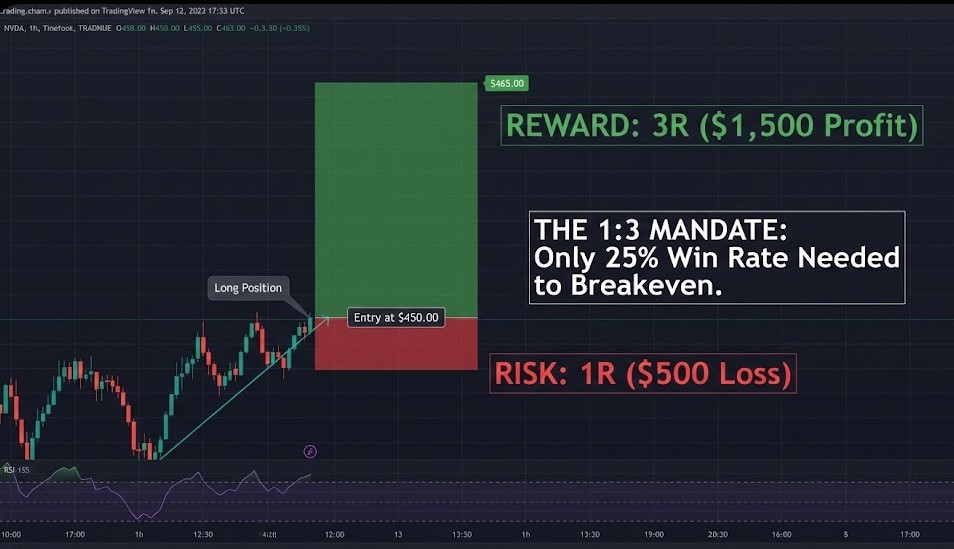
We have a strict mathematical filter for entering any trade. It is called the 1:3 Mandate.
* The Rule: If a trade setup does not offer a realistic, technically-backed potential to make 3 times your risk, YOU DO NOT TAKE THE TRADE.
* The Logic: Trading is a game of probabilities. You will have losing streaks. If you risk $100 to make $100 (1:1 Ratio), you need a 60%+ win rate just to cover commissions and slippage. That is elite-level accuracy that is nearly impossible to sustain over a decade.
* The Shortcut: If you risk $100 to make $300 (1:3 Ratio), you only need a 27% win rate to be profitable. This takes the immense pressure off your shoulders. You don't have to be perfect; you just have to be disciplined enough to wait for the high-reward setups.
Phase 2: The "R-Multiple" Language
To trade like a professional, you must stop counting your profits in dollars. Dollars are emotional; they represent rent, car payments, and ego. Start counting in "R" (Risk Units).
* 1R = Your total risk amount on a trade (calculated via [Position Sizing Mastery]).
* If you lose a trade, you lost -1R.
* If you hit your 3:1 target, you made +3R.
* If you scratch a trade at breakeven, you made 0R.
Why this matters:
If you take 10 trades and lose 7 of them:
- 7 Losses at -1R = -7R
- 3 Wins at +3R = +9R
- Net Result: +2R Profit
You were "wrong" 70% of the time, yet you grew your account. This is how the "Big Boys" on Wall Street stay in business during market crashes.
Phase 3: Technical Barrier Check – Fantasy vs. Reality
A common mistake among retail traders is "Target Grafting"—forcing a 3:1 ratio where the chart doesn't support it.
* The Fantasy R: You buy a stock at $100 with a stop at $99 (Risking $1). You set a target at $103 because you want your "3R."
* The Reality Check: You look at the chart and see a massive, multi-month resistance level at $101.50.
* The Result: The stock is 80% likely to reverse at $101.50. Your "Realistic R" is only 1.5.
* The Protocol: We cross-reference every target with our [Support & Resistance Playbook]. If the next major institutional "wall" is closer than your 3R target, you SKIP the trade. Do not invent targets; let the chart dictate the reward.
Phase 4: Understanding Expectancy
Expectancy is the average amount you can expect to win (or lose) per trade over the long run.
Formula: (Win Rate % x Average Win) - (Loss Rate % x Average Loss) = Expectancy.
If your expectancy is positive, your only job is to execute the trade as many times as possible. If it is negative, no amount of "hoping" will save your account. By focusing on a 1:3 ratio, you mathematically guarantee a positive expectancy even with a sub-50% win rate.
Phase 5: The "Free Roll" Tactic
Once a trade moves in your favor by 1R (you are up the same amount you initially risked), you have achieved a psychological milestone.
- The Strategy: Move your stop loss to Breakeven.
- The Benefit: You now have a "Free Roll." You have zero financial risk in the trade. This psychological freedom allows you to hold for the full 3R target without the "fear of giving it back." This is a core component of our [SPY Intraday Playbook], where we lock in the "risk-free" status as early as possible.
Phase 6: The "Cut at 1R" Discipline
One of the hardest parts of this strategy is the exit. Amateur traders "hope" the stock will turn around and let a -1R loss turn into a -3R catastrophe.
The Mandate: Your stop loss is non-negotiable. If you lose more than -1R on a trade, you have failed as a risk manager. A 3:1 system only works if your losses stay at exactly 1. If your losses are erratic, the math breaks, and the house wins.
Phase 7: The Psychology of the Loser's Streak
The biggest challenge to a 1:3 system is the human ego. Because you only need to be right 30-40% of the time, you will experience strings of 5, 6, or even 7 losses in a row.
- The Retail Reaction: They think the system is broken and start "revenge trading" or increasing their size to "make it back."
- The Professional Reaction: They realize a 7-trade losing streak is statistically normal in an asymmetric system. They keep their size small, stay disciplined, and wait for the one +3R win that wipes out nearly half of those losses in a single move.
Phase 8: Scaling the Payout (The 1:5 Home Run)
As you become more advanced, you can look for "Power Setups"—trades where the risk is tiny (due to a tight consolidation) but the potential is massive (due to a gap or news catalyst). These 1:5 or 1:10 trades are "Account Changers." They are rare, but by sticking to the 1:3 mandate, you keep your capital preserved so you can heavy-up when these "Fat Pitches" arrive.
Summary: Hunters vs. Gatherers
Amateurs are gatherers; they try to pick up every small berry (small wins) and often get eaten by a bear (one big loss). Professionals are hunters. They wait patiently for days, ignoring the small noise, waiting for the one "Big Game" setup that offers a massive reward for a tiny risk. Mastering the Risk-Reward ratio is about having the discipline to say "No" to mediocre trades so you have the capital and the mental clarity to say "Yes" to the home runs. Stop trading for win rate; start trading for payout.