
Covered Call ETFs vs. Traditional Options Trading: Which is Better?
Compare covered call ETFs and funds against traditional hands-on options investing. Discover the hidden risks of NAV erosion, upside caps, and fee drags.
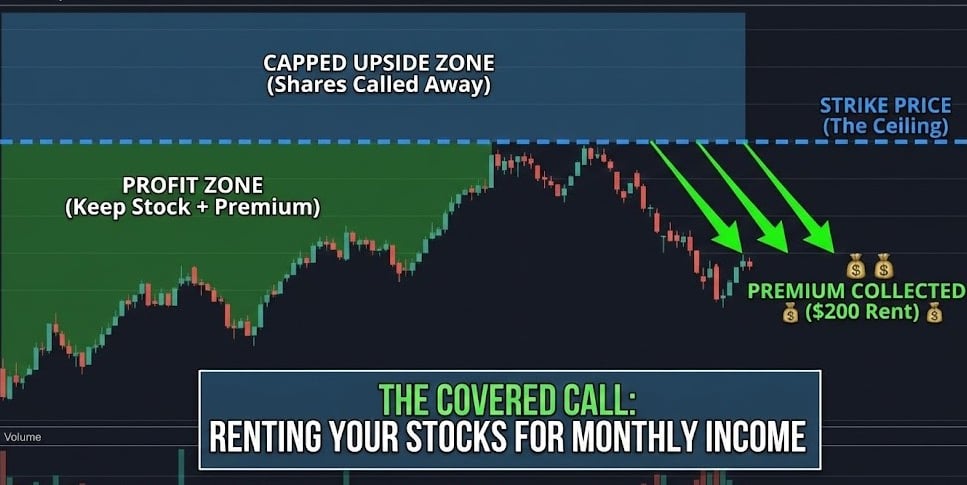
The financial markets are filled with strategies designed to capture the next massive stock breakout, but veteran wealth managers and cash-flow investors recognize that consistent, compounding income often outperforms speculative timing. The covered call option strategy is the absolute cornerstone of conservative options trading, acting as a powerful tool to extract regular cash flow from an equity portfolio. Instead of speculating on rapid price swings, a covered call writer steps into the role of a landlord, utilizing existing stock positions to collect regular, guaranteed premium payments from other market participants.
To master how this strategy functions, a trader must understand its dual-component architecture. A covered call is a multi-leg position requiring a specific balance between equity ownership and options writing. The first component is the underlying asset itself: the trader must own, or simultaneously purchase, at least one hundred shares of an individual stock or exchange-traded fund. The second component is the short option: the trader sells a single call option contract against those exact shares. This specific ratio is critical because one standard options contract represents exactly one hundred shares of the underlying equity.
When a trader executes this strategy, there are two common pathways into the trade. If the investor already owns the underlying shares within their brokerage account—perhaps a long-term position in a tech giant or a blue-chip dividend stock—and decides to write a call option against it to generate yield, the execution is known as an overwrite. Conversely, if the trader does not yet own the equity but executes a single order to buy the one hundred shares of stock and simultaneously sell the call option in a single transaction, the trade is known as a buy-write.
The fundamental reason this strategy is universally classified as a conservative, risk-managed play is the specific definition of the word covered. If an unhedged speculator sells a call option without owning the stock—a highly dangerous setup known as a naked or uncovered call—they face theoretical unlimited financial risk because the stock could rise to infinite heights, forcing them to buy shares at an exorbitant market price to fulfill the contract. In a covered call setup, the risk of the short call is completely neutralized. Because you already own the physical shares, your obligation to deliver stock is fully secured. If the option is exercised by the buyer, you simply hand over the shares you already hold in your account.
The primary objective of deploying a covered call option strategy is immediate income generation, which is achieved through the collection of the options premium. The moment you sell the call option contract, the buyer pays you an upfront cash premium that is deposited directly into your available account balance. This cash belongs to you immediately and unconditionally, providing a vital cushion that lowers your overall cost basis in the underlying stock. The ideal market outlook for a covered call writer is neutral to mildly bullish. The trader wants the stock to remain relatively flat or drift slightly upward during the life of the contract, allowing them to extract consistent time decay from the option premium while preserving their core equity ownership for future income cycles.
What is a Covered Call Option Strategy and How Does It Work?
Successfully executing a covered call option strategy requires transitioning from basic foundational knowledge into a strict, repeatable mechanical framework. Trading this setup for consistent income demands precision in three distinct areas: asset selection, strike price positioning, and expiration timing. If a trader fails to establish clear parameters across these components, they risk collecting small amounts of premium while exposing their core capital to severe downside market moves or prematurely surrendering massive upside gains.
The absolute golden rule of writing covered calls is to only deploy the strategy on high-quality, liquid equities that you are completely comfortable holding for the long term. Because the strategy requires you to lock up one hundred shares of stock per contract, your primary risk remains the outright ownership of the underlying asset. If you write a covered call on a speculative meme stock or a structurally weak company just to chase a hyper-inflated premium, a sudden crash in the stock price will quickly wipe out any income you collected from selling the option. The ideal candidates are robust blue-chip companies, steady dividend payers, or large-cap index ETFs. These assets provide a safe foundation, ensuring that if the market experiences a temporary downturn, you are left holding a resilient asset that you believe will recover over time.
Once a premier asset is secured in your portfolio, the next step is selecting the optimal strike price. For an income-focused investor looking to retain their shares, the standard choice is to sell an out-of-the-money call option. This means selecting a strike price that sits roughly five to ten percent above the current market price of the stock. By positioning the strike price out-of-the-money, you accomplish two critical goals simultaneously: you collect immediate premium income, and you give the underlying stock room to appreciate before it faces the risk of being called away. In terms of options mechanics, professional traders frequently look at the delta of the option contract, often targeting a thirty-delta or lower. This gives the trade a high mathematical probability of expiring worthless, allowing the investor to keep the cash and repeat the process next month.
The final element of the setup involves picking the ideal expiration timeline, a decision completely dictated by managing theta, or time decay. Options are inherently wasting assets, meaning their time value constantly erodes until it hits zero on expiration day. However, this erosion does not happen at a uniform speed; instead, time decay accelerates dramatically in the final thirty to forty-five days of an option's lifespan. By focusing your selling activity exclusively within this thirty-to-fourty-five-day window, you position yourself to capture the steepest part of the time decay curve. This allows you to melt away the buyer's premium at maximum velocity, keeping your capital exposure relatively short while generating recurring monthly income cycles.
Managing an open covered call also requires keeping a close eye on corporate event calendars, specifically ex-dividend dates. If the underlying stock pays a dividend, an options buyer holding the opposing long call may choose to exercise their option early to capture that dividend payment. This is particularly true if the option has moved deep into-the-money and has very little time value left. To prevent an unexpected early assignment that forces the liquidation of your shares before you intend to exit, you must remain highly vigilant as dividend dates approach. Additionally, seasoned traders rarely hold a position all the way to the final closing bell if they can avoid it. If the call option you sold has rapidly decayed to twenty percent or less of its original value, it is often best to execute a buy-to-close order, locking in eighty percent of your maximum profit early and instantly freeing up your capital to establish the next income-generating position.
The Strategic Setup: Writing Covered Calls on Stocks for Income
The modern financial landscape has witnessed a massive explosion in yield-focused products, completely shifting how retail investors approach cash-flow generation. For years, capturing options premium required a hands-on, self-directed approach. Today, the rise of specialized exchange-traded funds has democratized the strategy, allowing anyone to gain exposure to options income with a single click. However, choosing between investing in a pre-packaged covered call ETF and executing traditional stock options manually is one of the most critical decisions an income specialist must make.
To evaluate these paths accurately, a trader must look closely at the structural differences in how managed funds generate their headline yields. Institutional covered call funds operate by aggregating billions of dollars in assets to purchase a broad basket of underlying equities—such as the constituents of the S&P 500 or the Nasdaq-100—and systematically writing call options against those holdings. Many of the most popular funds utilize automated, rigid monthly or weekly roll schedules to collect premium, distributing the cash back to shareholders via monthly dividend payouts.
More aggressive modern variants feature single-stock target income strategies, which write synthetic covered calls against high-beta individual tech giants or cryptocurrency-adjacent equities to capture extreme volatility and generate massive localized yield. While the convenience of these managed funds is undeniable, they introduce clear structural trade-offs when contrasted against active, hands-on portfolio management:
The Problem of Rigid Upside Caps: Because passive income funds must adhere strictly to their automated rules, they often write calls blindly into strong market rallies. When a sector experiences an aggressive upward breakout, the fund's options are immediately tested, capping the capital appreciation of the net asset value. A self-directed investor, by contrast, possesses the tactical agility to adjust their strike selection dynamically, bypass writing calls during explosive breakout patterns, or choose to roll their positions to capture a massive run in the stock price.
Net Asset Value Erosion and Drag: In highly volatile or steadily declining market environments, covered call ETFs frequently suffer from what trading desks refer to as NAV erosion. When the underlying stocks crash, the fund participates fully in the downside. When the market recovers aggressively, the fund's gains are capped by the short options it sold. Over extended periods, this structural imbalance can result in a permanently decaying share price, meaning the high monthly distributions are effectively returning an investor's own capital back to them rather than delivering genuine, organic total returns.
The Burden of Management Fees: Hands-on options trading has become virtually free across major consumer brokerages, allowing independent traders to write contracts with minimal frictional costs. Institutional funds, on the other hand, charge ongoing expense ratios to cover active management, administrative costs, and complex fund structures. Over years of compounding, these management fees act as a constant drag on an investor’s net yield, eating away at the overall cash-flow efficiency of the portfolio.
Ultimately, covered call funds and active stock options investing serve two entirely distinct purposes within a well-rounded trading hub. Managed funds are an exceptional tool for passive investors who want diversified, hands-off income exposure and are willing to sacrifice long-term capital growth in exchange for steady, automated distributions. However, for a sophisticated trader who values precision, active management remains the superior path. Managing your own covered calls allows you to maximize your cash flow based on real-time market sentiment, control your exact cost basis, protect your core shares from unwanted liquidation, and ensure that your portfolio retains its vital long-term compounding power
Covered Call ETFs and Funds vs. Traditional Stock Options Investing
If you want to master more high-velocity market events, check out our other comprehensive trading guides:
➡️VIX Trading Strategy Guide
➡️How to Trade Economic Data
➡️How to Trade Earnings Reports