
How to Trade Earnings Reports: Complete Guide (2026)
Master earnings trading with proven strategies for pre-announcement positioning, during-release risk management, and post-earnings momentum.
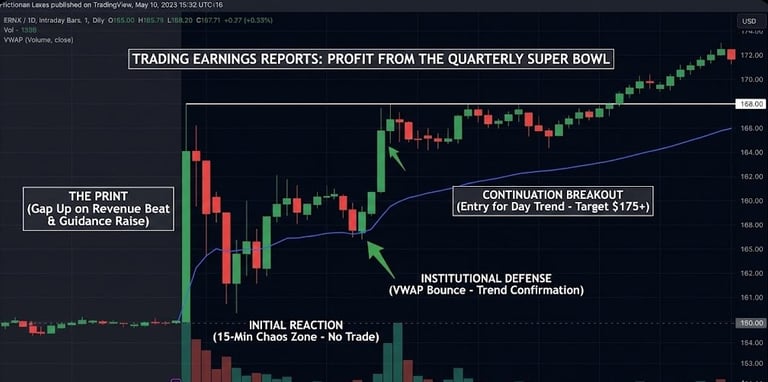
Earnings Season: Mastering the Institutional Reaction Protocol (2026)
Introduction: Beyond the Headline Numbers For many retail traders, earnings season is a game of "guess the beat." They bet on a company "beating expectations" and are shocked when the stock crashes despite a record profit. Professionals know that the numbers themselves are often secondary. What truly matters is the Institutional Reaction to those numbers.
At Smart Trades Zone, we don't trade the "Earnings Beat." We trade the "Reaction Gap." Earnings reports are the only time institutional players are forced to revalue their massive positions all at once. This creates the liquidity and volatility necessary for high-probability day trades. This playbook will move you from guessing outcomes to reacting to price action with precision.
Phase 1: The Pre-Print Preparation (The Before Phase) Success in earnings trading begins weeks before the actual report. You must build a watchlist of stocks with "tradable personalities."
Historical Volatility Check: Some stocks historically "move" 10% on earnings, while others move only 2%. We look for stocks with a history of Post-Earnings Drift (PEAD)—stocks that don't just gap and reverse, but gap and hold a trend for the entire day.
The Analyst Consensus: You need to know the "whisper number"—what the market actually expects vs. the official analyst target.
Implied Move vs. Historical Move: Check the options market to see how much of a move is "priced in." If the market expects a 5% move and the stock gaps 12%, you have an outlier event that often leads to a sustained trend. High-impact earnings often coincide with spikes in the [VIX fear index], which can tell you if the broader market is prepared for a volatile reaction or caught off guard.
Phase 2: Decoding the Holy Trinity of Data When the report hits the tape (usually at 4:05 PM or 7:30 AM EST), ignore the news headlines. Focus on three core metrics:
EPS (Earnings Per Share): The headline profitability.
Revenue (The Top Line): This shows if the company is actually growing its sales or just "cutting costs" to make the EPS look good.
Forward Guidance: This is the most important metric. A company can "beat" on past earnings, but if they "lower guidance" for the next quarter, the stock will almost always be sold aggressively.
Phase 3: The Intraday Execution (The During Phase) We never trade the initial 5 minutes of an earnings reaction. It is a "no-man's land" of wide spreads and algorithm-driven fake-outs. We wait for the Institutional Footprint to establish itself.
The Opening Range Breakout (ORB): We watch the high and low of the first 15–30 minutes of trading..If a stock gaps up on strong revenue and guidance, and then breaks above the 30-minute high, it's a high-probability 'Long' entry. We often compare this relative strength against the [SPY Intraday Playbook] levels to see if the stock is outperforming the broader market.
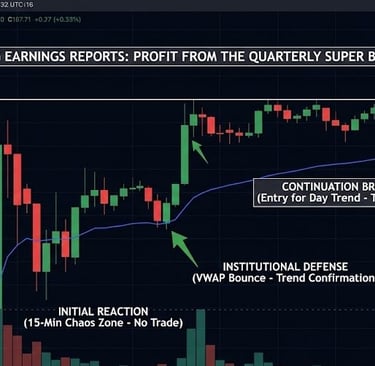
The "Trap" Retest: After a massive gap, a stock will often pull back to its "VWAP" (Volume Weighted Average Price). If buyers defend the VWAP, it confirms that institutions are loading up on the dip.
The Volume Confirmation: A true earnings breakout MUST have massive relative volume (usually 5x to 10x the average). If the stock is moving on low volume, the gap will likely "fade" as the day progresses.
Phase 4: Advanced Post-Print Strategies (The After Phase) The opportunity doesn't end on the day of the report. Many of the best earnings trades happen in the days following the announcement.
The "Fading" Strategy: If a stock gaps up 20% on "weak" revenue and poor guidance (a "short squeeze"), it is a prime candidate for a fade. Professionals look for a "Double Top" near resistance to short the stock back toward the gap.
The "Second Day Play": Institutional funds often take days or weeks to build a full position after a major guidance raise. If a stock closes at the high of the day on its earnings release, we look for a continuation move on "Day 2" as more funds pile in.
Post-Earnings Announcement Drift (PEAD): Research shows that stocks with significant earnings surprises tend to continue moving in that direction for weeks. We use the earnings day high/low as a benchmark for swing trades.
Phase 5: Risk Management & Position Sizing Trading earnings without a plan is a guaranteed way to blow an account. Because volatility is 5x higher than normal, your standard rules must change.
The 1/2 Size Rule: Because the 'Average True Range' (ATR) of the stock is expanded, you should trade with half your normal position size. Utilize our [Position Sizing Mastery] calculator to ensure your risk-per-trade stays within the 1-2% threshold despite the wider stops required for earnings."
The Hard Stop: Never enter an earnings trade without a hard stop-loss in the system. Slippage on earnings can be brutal; a mental stop is a death sentence.
Avoid the "All-In": No matter how "perfect" the report looks, never risk more than 1-2% of your total account on a single earnings trade. The market can remain irrational longer than you can remain solvent.
Phase 6: The Psychology of "Reaction over Prediction" The biggest hurdle for day traders is their own ego. If you spend all night researching a company and decide it's a "Buy," you will likely ignore the price action if the stock starts falling.
Rule: "Trade what you see, not what you think."
If the earnings were great but the stock is red, the stock is wrong, and the market is right. Do not fight the tape. Institutions may be using the "good news" as liquidity to sell out of a massive long-term position.
Summary:
The Disciplined Earnings Trader Earnings season is where traders are made or broken. By focusing on institutional reaction, waiting for volume confirmation, and strictly managing your position size, you can turn these quarterly events into a consistent income engine. Stop trying to predict the report—start mastering the reaction.