
How to Cut Losses in Trading: Master Trading Psychology
Learn how to cut losses in trading quickly and systematically. Master the psychology of exiting bad trades using a mechanical risk management framework.
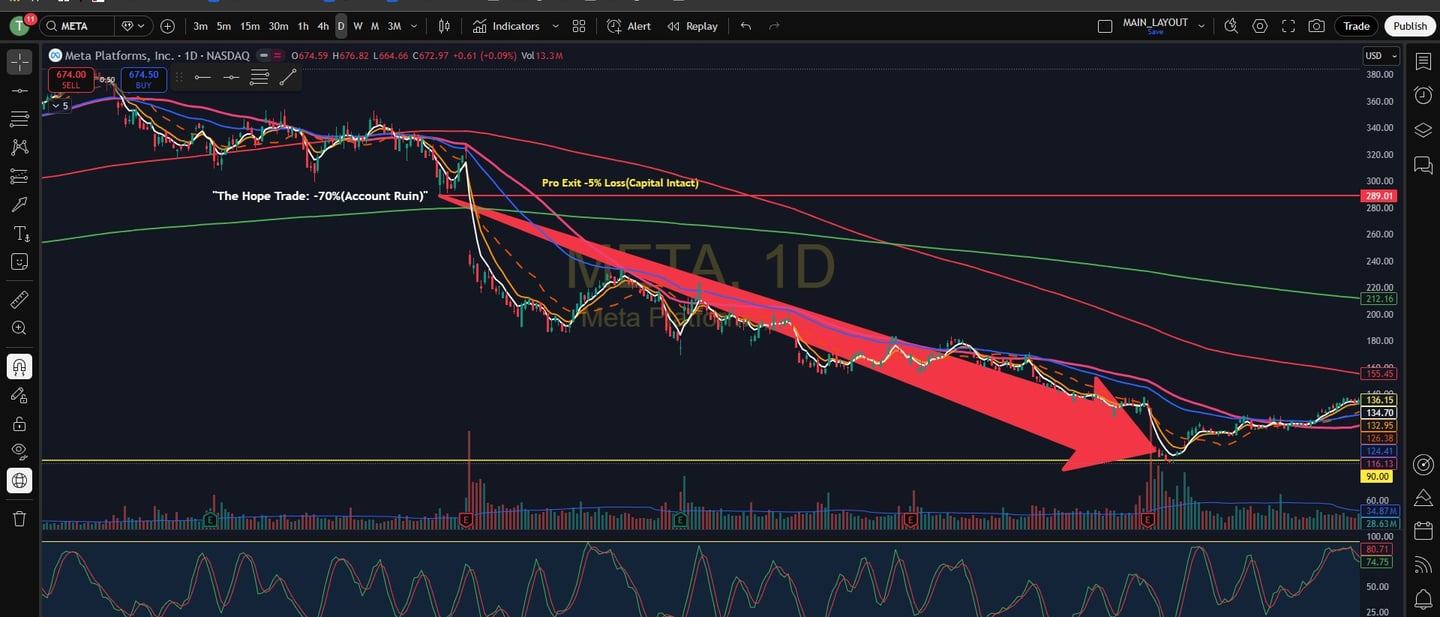
The ultimate differentiator between a consistently profitable market professional and a struggling amateur does not lie in their ability to find winning setups; it rests entirely on how they manage their losing positions. Every participant enters the market with a desire to be right, but the raw reality of the financial landscape is that losses are a mathematical certainty. To master how to cut losses in trading, a trader must shift their focus away from technical patterns and confront the deep psychological biases that naturally prevent humans from accepting when a trade has failed.
The primary cognitive hurdle that a trader faces when a position moves against them is a behavioral phenomenon known as loss aversion. Cognitive psychology and behavioral economics have continuously demonstrated that the pain of a financial loss is psychologically twice as intense as the pleasure derived from an equivalent financial gain. Because humans are naturally wired to avoid pain, the human brain will default to irrational coping mechanisms to dodge the immediate discomfort of realizing a loss. When a stock plummets past a preplanned exit point, an undisciplined trader will stop analyzing objective market data and begin experiencing loss aversion on schedule, allowing emotional narratives to override their original structural risk management criteria.
This emotional friction is heavily fueled by the sunk cost fallacy and the dangerous intrusion of the trading ego. The moment capital is deployed into a position, a dangerous psychological attachment forms. Admitting that a trade is a loser requires admitting a personal mistake, which the human ego perceives as a direct assault on self-worth. To protect the ego, the trader enters a stage of psychological denial. They transform a calculated trade into a hope-driven investment, convincing themselves that the market is wrong, that the asset is sitting at strong support, or that a sudden reversal is just around the corner. By treating a speculative position as a test of their intelligence rather than a statistical numbers game, they transform a minor, manageable setback into a catastrophic, account-killing draw down.
To break this destructive behavioral feedback loop and drastically reduce losses in trading, successful market specialists learn to reframe their relationship with losing. Professional traders completely detach their personal self-esteem from their financial outcomes. They approach the market with deep humility, viewing a small, controlled loss not as a failure, but simply as a necessary, normal cost of doing business. Just as a physical storefront must pay rent, utilities, and inventory expenses to remain operational, an active trader treats small losses as the standard operational overhead required to uncover highly profitable trends. By anticipating the loss before the trade is even executed, the psychological shock is completely neutralized, allowing the trader to take quick, decisive action to preserve their capital for the next high-probability opportunity.
How to Cut Losses in Trading: The Psychology of the Exit
Translating the psychological willingness to accept a loss into real-world account protection requires transitioning into a strict framework of rapid execution. In the active trading arena, speed is not merely a luxury; it is the definitive shield that stands between a minor, temporary pullback and a catastrophic account blow-up. Learning how to cut losses quickly is an operational skill that requires a trader to respect technical invalidation points and execute orders without a single moment of hesitation or second-guessing.
The tactical foundation of rapid risk mitigation begins long before an order is ever submitted to the market. A professional market participant never enters a trade based purely on a vague upward or downward bias. Instead, they define their exact technical invalidation point before risking a single dollar of capital. Technical invalidation represents the specific price level where the original thesis behind the trade is officially proven completely wrong by the market structure. If a trader enters a long position because a stock broke out past a heavy layer of resistance, the invalidation point sits right back below that broken resistance line. If the stock falls back into the old trading range, the breakout has officially failed. By knowing this exact exit boundary in advance, the trader eliminates the dangerous need to make emotional, high-stress decisions in the heat of the moment when a position is actively flashing red.
Once an invalidation point is established, a trader must determine the specific execution mechanism they will utilize to exit the position. The most reliable tool for achieving rapid execution is the hard stop-loss order, which is programmed directly into the brokerage platform. The moment the underlying stock crosses the preselected invalidation price, the platform automatically triggers a market or limit order to liquidate the position immediately, completely bypassing human intervention.
Many amateur traders resist utilizing hard stop-losses, preferring instead to rely on "mental stops." They convince themselves that they will manually exit the trade when the price hits their target level. However, relying on a mental stop is a dangerous trap that opens the door to emotional override. When the price rapidly drops to a mental stop line, the trader’s loss aversion immediately takes control. They hesitate, freeze, or actively move their mental boundary further down, transforming a small, controlled three percent loss into a devastating twenty percent drawdown.
Furthermore, executing exits quickly is absolutely mandatory when trading options due to the compounding nature of option premium pricing. Options are highly leveraged instruments with values derived directly from the underlying stock's movement, time to expiration, and implied volatility. When a stock undergoes a violent, unexpected move against your position, the option premium can collapse exponentially within a matter of minutes. Waiting for a stock to "bounce back" while holding an options contract exposes the position to the compounding destruction of rapid time decay and a sudden contraction of the bid-ask spread. By cutting the loss quickly at the very first sign of structural invalidation, an options trader salvages a substantial portion of the premium value. This salvaged capital can then be immediately reallocated into a fresh, high-probability setup rather than letting it sit in a dying asset that eventually expires completely worthless.
How to Cut Losses Quickly to Protect Your Portfolio
While understanding the psychology of the exit and mastering rapid execution are vital pillars of risk management, the ultimate protection for your trading hub comes from embedding these concepts into a cold, mechanical rules framework. Relying on willpower or emotional discipline in the heat of a market session is an unreliable strategy. Instead, a professional market participant constructs a systematic environment where human discretion is minimized, and trading is treated strictly as an objective numbers game. By automating your risk parameters, you ensure that preserving capital becomes a default behavioral setting rather than a daily emotional battle.
The absolute bedrock of a mechanical rules framework is the rigid application of position sizing based on a fixed risk percentage. A professional trader never enters a trade sizing their position based on how much money they hope to make; they size it based on exactly how much capital they are willing to lose if their stop-loss is triggered. To systematically reduce losses, a trader should commit to never risking more than a fixed, conservative portion of their total account equity on any single trade—typically 1% or 2%. For instance, in a ten-thousand-dollar portfolio, a strict 1% risk rule dictates that the maximum financial damage from any single trade can never exceed one hundred dollars. By anchoring position sizes to this rule, even an unprecedented streak of ten consecutive losses results in a minor, easily recoverable ten percent drawdown, ensuring you always live to fight another day.
The second mechanical pillar involves the strict coordination of predefined risk-to-reward ratios and R-multiples. Before capital is ever exposed to the market, a trader must ensure that the distance from their entry price to their profit target is significantly larger than the distance from their entry price to their technical stop-loss. By maintaining a minimum requirement of a two-to-one or three-to-one reward-to-risk ratio, the mathematical structure of your account shifts dramatically. Under a clean three-to-one framework, you are risking one dollar to capture three dollars in return. This structural edge means your hit rate can drop to a mere thirty-five percent, and your account will still grind steadily upward over time. This cold mathematical reality completely removes the toxic psychological urge to hold onto a bad trade; you no longer need to be right on every trade to be a highly profitable professional.
The final component of an institutional-grade rules framework is the implementation of a post-trade behavioral audit and mandatory trading journal. Every single loss must be documented and meticulously analyzed to determine its root cause. A disciplined trader separates their losing trades into two distinct buckets: standard operational losses and execution errors. A standard operational loss occurs when you follow your rules flawlessly, hit your stop-loss on time, but the market simply moves in a different direction. These losses are celebrated because they prove your system is functioning correctly. An execution error, however, occurs when you hesitate, move your stop-loss mid-trade, or average down into a collapsing asset. By tagging and tracking these execution errors weekly, you expose your specific psychological vulnerabilities, allowing you to systematically refine your mechanical rules until emotional slippage is entirely purged from your trading hub.
How to Reduce Losses in Trading Using a Mechanical Rules Framework
If you want to master more high-velocity market events, check out our other comprehensive trading guides:
➡️VIX Trading Strategy Guide
➡️How to Trade Economic Data
➡️How to Trade Earnings Reports