
How to Position Size for Trading: Forex, Futures, & Stocks
Learn how to calculate position sizing effectively across forex, futures, and stock markets. Master lot sizes, pip values, and futures multipliers to protect your capital.
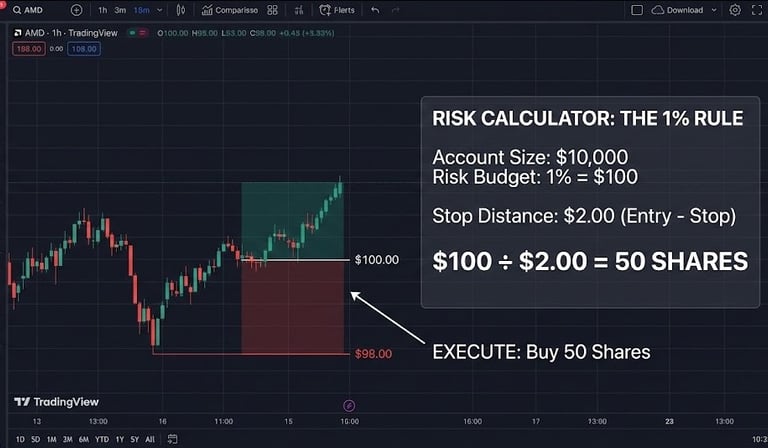
In the competitive arena of financial speculation, retail traders spend a disproportionate amount of time seeking out the ultimate technical indicator, the perfect chart pattern, or an explosive catalyst that promises immediate market gains. Yet, institutional portfolio managers and veteran market specialists recognize that entry accuracy is only a secondary component of a long-term equity curve. The true, foundational pillar of survival and compounding profitability is learning how to position size for trading. Position sizing is the deliberate process of determining exactly how much capital, or how many contracts and shares, should be allocated to a single trade. It serves as the ultimate line of defense that stands between an orderly, systematic pullback and a catastrophic account liquidation.
To understand why learning how to position size is so vital, a trader must first dismantle a pervasive psychological misconception: the confusion between position size and actual trade risk. When an amateur trader allocates five thousand dollars to a specific stock position, they frequently operate under the assumption that they are risking five thousand dollars on that trade. In reality, the total cash allocation represents your purchasing exposure, whereas your actual risk is defined entirely by the distance from your entry price to your mandatory technical stop-loss level. If you fail to separate these two concepts, you will inevitably over-leverage your account, exposing your capital to massive single-day drawdowns when the market experiences unexpected gaps or volatility spikes.
The core objective of implementing a disciplined position sizing framework is the total elimination of the Risk of Ruin. In statistics and probability theory, the risk of ruin represents the mathematical probability that a trader will suffer a string of consecutive losses large enough to completely deplete their trading capital. Because the financial markets operate within a distribution of random outcomes, even a highly optimized trading strategy with a seventy percent win rate will eventually experience a statistical anomaly, such as a streak of seven, eight, or nine consecutive losing trades. If you are arbitrarily choosing your position sizes based on emotion or excitement, a normal streak of bad luck will destroy your account. By contrast, a professional who utilizes a strict, uniform position sizing matrix ensures that each individual loss is completely negligible, allowing the mathematical edge of their system to play out safely over hundreds of execution cycles.
Furthermore, mastering position sizing acts as a powerful psychological stabilizer during live market hours. When a trader allocates an excessively large position size to a trade, their nervous system immediately hijacks their rational decision-making process. The sudden, wild swings in their open profit and loss generate intense states of fear and greed, causing them to micro-manage the trade, exit winners prematurely out of panic, or actively remove their stop-loss orders in a state of emotional denial. When you enforce a strict, mechanical position sizing boundary, the financial stakes of any individual trade are reduced to a comfortable baseline. This total emotional detachment allows you to sit back and observe objective market data, execute your trading rules flawlessly, and treat the entire process as a cold, systematic numbers game.
How to Position Size for Trading: The Core Principles of Risk Mitigation
Transitioning from an abstract appreciation of risk management to the active execution of a live trade requires converting policy into a precise, mathematical reality. Far too many retail participants treat position sizing as an afterthought, arbitrarily choosing a round number of shares or a generic lot size based entirely on a vague intuition or the size of their account balance. To achieve institutional-grade consistency, a trader must adopt a strict calculation process that balances the total equity in their account against the unique structural volatility of the specific asset they are trading. By standardizing this workflow, the exact size of your trade becomes an objective variable completely dictated by market structure.
To calculate the exact footprint of an upcoming trade without relying on guesswork, a structured process must be followed to break down the four essential data points required for every execution. The process begins with identifying your total account liquidation value, which represents the complete baseline of your available capital. Next, the trader applies their predetermined account risk percentage, which typically ranges between one and two percent. Multiplying your total equity by this risk percentage yields your total dollar risk capacity, which represents the absolute maximum financial damage your account is permitted to absorb if the trade hits your stop-loss order. For example, if an account possesses a total balance of fifty thousand dollars and the trader enforces a strict one percent risk parameter, the total dollar risk capacity for that specific trade is exactly five hundred dollars.
Once your total dollar risk capacity is established, the focus shifts entirely to the options chain or stock chart to evaluate the trade risk per unit, which is defined as the physical distance between your entry price and your technical stop-loss level. If a trader prepares to buy a high-quality equity at an entry price of one hundred dollars per share and determines that the technical invalidation point sits at ninety-five dollars per share, the risk distance per unit is exactly five dollars. To determine the final position size, the trader simply divides their total dollar risk capacity by the risk distance per unit. In this specific scenario, dividing the five hundred dollars of permitted account risk by the five-dollar risk distance results in an exact position size of one hundred shares. If the next trade features a tighter technical setup with only a two-dollar risk distance on the same asset, applying the exact same division logic automatically scales the position size up to two hundred and fifty shares, keeping the total account risk perfectly locked at five hundred dollars regardless of the stock's individual price movements.
While calculating these metrics manually is a straightforward process, doing so during high-stress market sessions can introduce dangerous cognitive delays and math errors. To achieve true execution efficiency, modern professionals automate this workflow entirely within their trading hub. Most premier charting platforms and advanced brokerage interfaces feature built-in electronic position sizing tools and custom order entry scripts. By utilizing these integrated resources, a trader can visually drag and drop their entry and stop-loss lines directly on a live chart layout. The background software automatically measures the distance, extracts the current account balance, references the user's programmed risk rules, and updates the order ticket with the exact required share or contract size instantly. Automating this math ensures that you can react to fleeting market setups with absolute speed, completely stripping human emotion and manual calculation lag out of your risk management execution.
How to Calculate Position Size in Trading Automatically
While the core principles of protecting account equity remain identical across the entire financial landscape, a trader must completely adapt their tactical calculation methods when transitioning between different asset classes. Managing risk in a standard stock account is a straightforward exercise in counting shares. However, if you attempt to apply that exact same logic to highly leveraged derivatives markets like foreign exchange or commodity futures, a failure to understand how underlying contract specifications work can result in severe over-exposure and rapid capital destruction. To build a truly versatile trading hub, you must master the unique position sizing mechanics native to each specific asset class.
Understanding how to calculate your true financial exposure requires breaking down the distinct pricing units, leverage rules, and contract sizes that govern equities, currencies, and futures contracts:
Equities (Stocks and ETFs): Direct Share Sizing Position sizing in the stock market is the most transparent and intuitive framework. Because shares are bought and sold in whole units at their face market value, your notional exposure is simply the number of shares multiplied by the current stock price. If your risk rules dictate a five-hundred-dollar maximum risk on a trade and your technical stop-loss is positioned five dollars below your entry, you execute a straightforward division to buy exactly one hundred shares. The absolute simplicity of equities makes them an ideal environment for mastering the psychological discipline of strict risk scaling before moving into leveraged environments.
Foreign Exchange (Forex): Pip Values and Lot Allocations In the currency markets, position sizes are calculated using specialized units known as lots, rather than individual shares. A standard lot represents 100,000 units of the base currency, a mini lot represents 10,000 units, and a micro lot represents 1,000 units. Furthermore, price movements are measured in pips (Percentage in Point), which typically represent the fourth decimal place of a currency pair change (0.0001). To position size effectively in forex, you cannot simply measure a dollar distance; you must calculate the exact dollar value of a single pip for your specific lot size. If a trader risks fifty pips on a trade using a standard lot of EUR/USD, each pip is valued at roughly ten dollars, creating an immediate five-hundred-dollar risk footprint. A forex strategist must constantly dynamically scale their lot allocations up or down based on the localized pip-value metrics of the specific currency pair they are executing.
Futures Markets: Contracts, Multipliers, and Tick Sizes The futures market represents the most complex environment for risk management due to the introduction of structural leverage multipliers and rigid contract specifications. Futures contracts do not move in pennies or pips; instead, they move in minimum increments called ticks, and each underlying index or commodity contract features a fixed monetary value assigned to every tick or full point of movement. For example, in the highly popular E-mini S&P 500 futures contract ($ES), a full point move is worth exactly fifty dollars per contract. If a macro futures trader establishes a position with a ten-point stop-loss distance, a single contract carries a structural risk of five hundred dollars. If that same trader transitions to the Micro E-mini contract ($MES), the multiplier drops to five dollars per point, allowing for much more granular, scaled risk adjustments. To size positions safely in futures, you must memorize the exact point multiplier of the specific contract you are trading, ensuring your contract count aligns perfectly with your macro dollar risk ceiling.
Mastering these cross-market dynamics is what separates a professional portfolio manager from a reckless gambler. When you treat position sizing as a universal mathematical language adapted precisely to the unique structural rules of each asset class, the underlying instrument you are trading becomes entirely irrelevant. Whether you are navigating a fast-moving stock breakout, a highly leveraged currency cross, or a volatile commodity futures trend, your risk parameters remain entirely uniform, perfectly predictable, and structurally insulated against market shocks.
How to Position Size in Forex, Futures, and Equities Effectively
If you want to master more high-velocity market events, check out our other comprehensive trading guides:
➡️VIX Trading Strategy Guide
➡️How to Trade Economic Data
➡️How to Trade Earnings Reports