
How to Trade a Bull Call Spread: Ultimate Guide 2026
Master the bull call spread. Learn how to buy a call spread, understand the difference between call and put spreads, and manage risk.
Mechanics of the Bull Call Spread
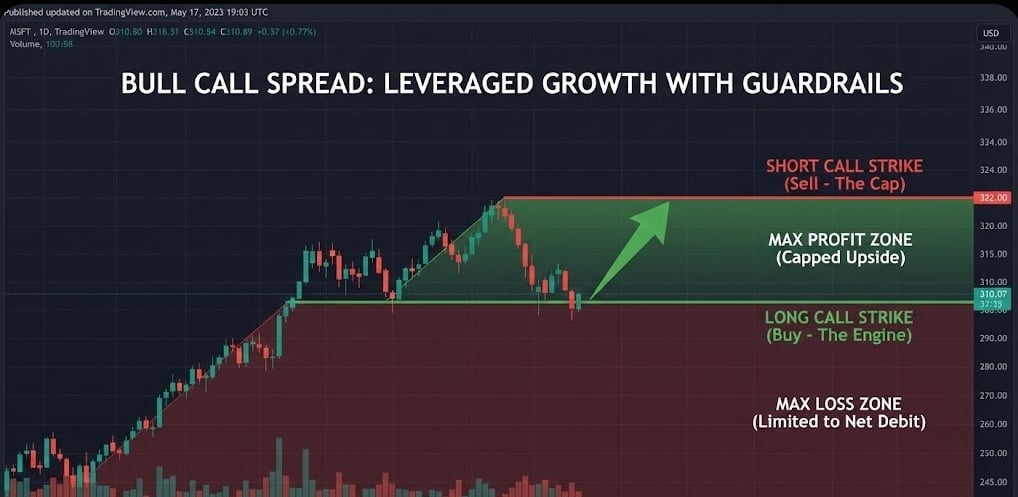
A bull call spread is a foundational vertical spread strategy utilized by options traders to capitalize on an asset’s upward price movement while strictly limiting risk and reducing upfront capital costs. When analyzing how to buy a bull call spread, the strategy is executed by simultaneously purchasing one call option at a specific strike price and selling another call option at a higher strike price. Both contracts must share the exact same underlying asset and expiration date.
This strategy is categorized as a debit spread because the premium collected from selling the higher strike call option offsets a portion of the premium paid to buy the lower strike call option. This structural design drastically reduces your total capital risk compared to purchasing a standalone naked call option, allowing you to maintain an optimized risk-to-reward ratio even in highly volatile market environments.
The Dual-Leg Structural Architecture
To understand the core mechanics, you must break the strategy down into its two components, known as legs. These legs operate in tandem to create a bounded risk profile:
The Long Leg (The Anchor): You purchase a call option with a lower strike price. This leg gives you the legal right to purchase 100 shares of the underlying stock at that specific price. This is your primary engine for profit, generating positive Delta as the stock price climbs.
The Short Leg (The Subsidy): Simultaneously, you sell (write) a call option with a higher strike price. This leg obligates you to sell 100 shares of the stock at that higher price if assigned. By taking on this obligation, you collect an upfront premium from the market. This premium acts as a direct discount on the cost of your long leg.
By capping your maximum upside at the short strike, you strip away the high cost of premium and insulate your capital against devastating volatility drops.
The Mathematical Framework and Core Formulas
To evaluate the mathematical framework of this strategy, traders utilize three core formulas to define their exact profit and loss parameters before entering a live market order:
Max Loss = Net Premium Paid
Max Profit = (Higher Strike - Lower Strike) - Net Premium Paid
Breakeven Point = Lower Strike + Net Premium Paid
The maximum risk is entirely capped at the net premium paid to execute the trade. No matter how low the underlying stock price drops, you can never lose more than this initial debit. The maximum profit is reached if the underlying asset finishes at or above the higher strike price at the exact time of expiration. This deliberate capping of upside potential is the direct trade-off for reducing your total cost of entry and lowering your structural breakeven point.
Real-World Execution Blueprint:
To see these mechanics in action, consider a real-world trading scenario with a hypothetical equity trading at exactly $100 per share:
Long Leg Entry: You buy a $95 strike call option for a premium of $7.00.
Short Leg Entry: Simultaneously, you sell a $105 strike call option for a premium of $2.00.
Net Debit Calculation: Your total cost to enter the trade is $5.00 ($7.00 paid minus $2.00 collected). Because standard options contracts feature a 100-share multiplier, your total capital requirement and maximum risk is exactly $500.
Applying the core formulas to this specific blueprint reveals the exact boundaries of your trade:
Max Loss: $5.00 ($500 total account risk).
Max Profit: ($105 - $95) - $5.00 = $5.00 ($500 maximum profit potential).
Breakeven Point: $95 + $5.00 = $100.
If the stock closes at or below $95 at expiration, both options expire worthless, resulting in the maximum loss of $500. If the stock rallies to $105 or higher, the $95 call is worth $10 of intrinsic value and the $105 call is worth $0 to you as it is assigned, locking in the maximum profit of $500.
Intrinsic vs. Extrinsic Value Dynamics in Spreads:
A primary mechanical advantage of the bull call spread is how it optimizes the interplay between intrinsic and extrinsic value. A standalone naked call consists heavily of extrinsic time value, which decays daily. In a bull call spread, because you are simultaneously long a lower strike and short a higher strike, the net time decay (Theta) of the position is drastically reduced.
The short option’s extrinsic value decays right alongside the long option's extrinsic value. This creates a protective hedge against time erosion, allowing your directional thesis more time to play out without forcing you to fight a rapidly accelerating decay curve.
Mechanics of the Bull Call Spread
Understanding the structural differences between a bull call spread and a bull put spread is critical for aligning your portfolio with current market environments. While both strategies require a directional bullish bias, their execution mechanics, cash flow profiles, and behavioral dynamics regarding time decay and volatility are completely inverted. Choosing the wrong vehicle for your bullish thesis can drastically lower your probability of profit.
Debit vs. Credit Structural Mechanics:
The primary differentiator between these two vertical spreads centers on how capital moves during trade entry, which alters the underlying requirements for a winning trade:
Bull Call Spread (Debit Transaction): You pay money out of your account upfront to secure the position. Because you are a net buyer of options premium, your primary goal is to see the asset price expand aggressively beyond your breakeven threshold. You are effectively paying for the right to capture a specific window of stock growth.
Bull Put Spread (Credit Transaction): This is executed by selling a higher strike put option and simultaneously purchasing a lower strike put option for protection. Instead of paying a premium, you receive a net credit into your account immediately upon execution. The primary goal of a credit spread is not a massive upward rally, but rather for the underlying stock price to simply remain completely above your short strike price through expiration, allowing both contracts to expire worthless.
Concrete Scenario Comparison:
To see how these structural differences impact your account equity, let's look at a comparative example with a hypothetical stock trading at exactly $100 per share.
The Bull Call Spread Alternative: You buy the $95 call and sell the $105 call for a net debit of $5.00.
Max Risk: $5.00 ($500 total)
Max Profit: $5.00 ($500 total)
Breakeven Point: $100
For this trade to reach maximum profit, the stock must rally 5% up to $105 by expiration. If the stock stays perfectly flat at $100, you merely break even.
The Bull Put Spread Alternative: You sell a $95 put and buy a $90 put for a net credit of $1.50.
Max Risk: Width of Strikes ($5.00) - Net Credit ($1.50) = $3.50 ($350 total)
Max Profit: Net Credit = $1.50 ($150 total)
Breakeven Point: Short Put Strike ($95) - Net Credit ($1.50) = $93.50
For this credit trade to reach maximum profit, the stock does not need to rally at all. It can go up, it can stay perfectly flat at $100, or it can even drop up to 5% down to $95. As long as it finishes above $95 at expiration, you keep the entire $150 profit.
Volatility (IV) and Theta Decay Profiles:
The hidden engine driving the performance of these spreads is how they interact with market forces like Implied Volatility (IV) and time decay (Theta).
In a bull call spread, time decay acts as a persistent headwind against your long option leg. Even though the short option leg helps offset this, the net position still loses value every day the stock stays still. Furthermore, a sudden drop in market-wide implied volatility will deflate the value of your contracts, harming your profit timeline. This makes the bull call spread optimal in low-volatility environments where you expect a sharp, sudden upward breakout.
In a bull put spread, time decay acts as your primary ally. Because you are a net seller of options premium, the systematic erosion of time value works in your favor every single day. Additionally, an implied volatility crush accelerates your profits by rapidly deflating the value of the options you sold, allowing you to buy the spread back early for a fraction of the cost. This makes the bull put spread optimal in high-volatility environments where premiums are rich and you expect the stock to stabilize or drift higher.
Probability of Profit vs. Reward-to-Risk Ratios:
When choosing between these two frameworks, you are fundamentally balancing your risk-to-reward ratio against your statistical probability of success:
Bull Call Spreads offer a much higher reward-to-risk ratio (frequently 1:1 or better), but they carry a lower probability of profit because the stock must move upward to clear your breakeven line.
Bull Put Spreads offer a lower reward-to-risk ratio (often risking more than you stand to make), but they carry an incredibly high probability of profit because you can win in three different market directions: if the stock goes up, stays flat, or drops slightly.
Bull Call Spread vs. Bull Put Spread
Successfully executing a vertical call spread requires moving past basic theory and implementing systematic, rules-based criteria for strike selection, trade duration, order entry, and post-entry management. By managing a bull call spread with strict mechanical protocols, you strip emotion out of the equation and maximize your long-term statistical edge.
Optimal Strike Selection and Delta Metrics:
When establishing a bull call spread, you must use options Delta as your guide to select the precise strikes that balance your probability of profit with a strong risk-to-reward ratio. Do not guess which strikes to buy and sell. Instead, follow this exact mathematical blueprint:
The Long Leg (The Anchor): Purchase an at-the-money or slightly in-the-money call option targeting a 50-Delta. A 50-Delta contract ensures that your long leg captures immediate, high-velocity price sensitivity as the underlying stock starts its upward move.
The Short Leg (The Subsidy): Simultaneously sell an out-of-the-money call option targeting a 30-Delta.
By pairing a 50-Delta long call with a 30-Delta short call, your position opens with a Net Delta of 20 (50 Delta minus 30 Delta). This means that at the moment of entry, your vertical spread will gain approximately $20 in value for every $1.00 move upward in the underlying stock. This specific strike architecture ensures you do not overpay for premium while still leaving a highly profitable runway between your two chosen strike prices.
Duration and the Theta Decay Sweet Spot:
Choosing the correct expiration cycle is just as critical as choosing the right strikes. Options contract decay does not move at a steady rate; it behaves like an accelerating curve. To optimize this timeline, your entry target should always be between 30 and 60 Days to Expiration (DTE), with 45 DTE representing the definitive sweet spot.
Entering a trade at 45 DTE provides your directional thesis ample time to play out. During the period from 45 DTE down to 21 DTE, the time decay (Theta) hitting your long option leg remains relatively slow and manageable. Meanwhile, the 30-Delta short option you sold acts as a continuous structural shield, eroding daily and counteracting the decay of your long contract.
Never purchase vertical spreads with fewer than 14 days to expiration as a primary position, as the high-velocity decay will destroy the value of your long leg faster than any minor upward stock movement can recover.
The Mid-Point Limit Order Execution Rule:
Poor trade execution can instantly destroy a spread's built-in mathematical edge. The bid-ask spread on multi-leg options positions can be wide, meaning that if you enter the market incorrectly, you will overpay on entry and undersell on exit.
Never Use Market Orders: Executing a bull call spread with a market order guarantees that the exchange will fill your trade at the worst possible price, costing you an unnecessary premium.
Always Use Limit Orders: When routeing your multi-leg order, calculate the exact mid-point price between the current bid and ask prices of the combined spread. Set your limit order precisely at this mid-point. If the order does not fill immediately, patiently adjust your limit price by a mere $0.01 or $0.02 at a time until you secure a fill, ensuring you preserve every single dollar of potential profit margin.
The Professional Profit-Taking Protocol:
The biggest mistake retail traders make is holding a winning bull call spread all the way until the final closing bell of expiration day to extract every last dollar of profit. This exposes your trading account to extreme Gamma Risk. In the final week before expiration, Gamma peaks, meaning that a minor, sudden downward move in the stock can cause a massive, violent collapse in the value of your options contracts, wiping out weeks of accumulated profits in a matter of minutes.
To completely insulate your portfolio from Gamma risk, implement a strict mechanical profit target:
The 50% to 75% Profit Rule: Manually close your bull call spread as soon as it captures between 50% and 75% of its maximum theoretical profit.
Securing your gains early frees up your trading capital, drastically reduces your time exposed to sudden market reversals, and significantly increases your overall portfolio win rate over time.
Defensive Roll Mechanics for Losing Positions:
When a trade moves directly against your bullish thesis, you do not have to sit idly by and accept a maximum loss. If the underlying stock drops sharply and breaches your lower long strike price, your position's Delta collapses, and the trade loses its upward momentum.
To defend your capital, you can execute a proactive Defensive Roll Protocol before the contract enters its final two weeks of expiration:
Close the Underperforming Position: Simultaneously sell back your long call and buy back your short call, closing out the entire losing spread for whatever remaining premium value it holds.
Reopen in a Further Cycle: Take that remaining capital and immediately open an identical bull call spread in an expiration cycle that is 30 days further out in time.
Adjust Strikes Downward: Shift your new long and short strikes downward to match the stock's new, lower trading range, ensuring your long leg lands back at a 50-Delta.
Executing this roll protocol buys your directional thesis more time to recover, lowers your structural breakeven point on the new position, and prevents an immediate total loss of your initial premium.
Tactical Execution and Risk Mitigation
If you want to master more high-velocity market events, check out our other comprehensive trading guides:
➡️$TSLA Options Trading Strategy Guide
➡️Covered Call ETFs Explained: High Yields, NAV Decay & Risks
➡️How to sell Cash Secured Puts for Consistent Income
➡️Long Straddle Options Trading Strategy