
How to Sell Cash Secured Puts for Consistent Income: The Ultimate Guide
Discover what a cash secured put is and how it works. Learn how to sell cash-secured puts to generate consistent income and buy high-quality stocks at a discount.
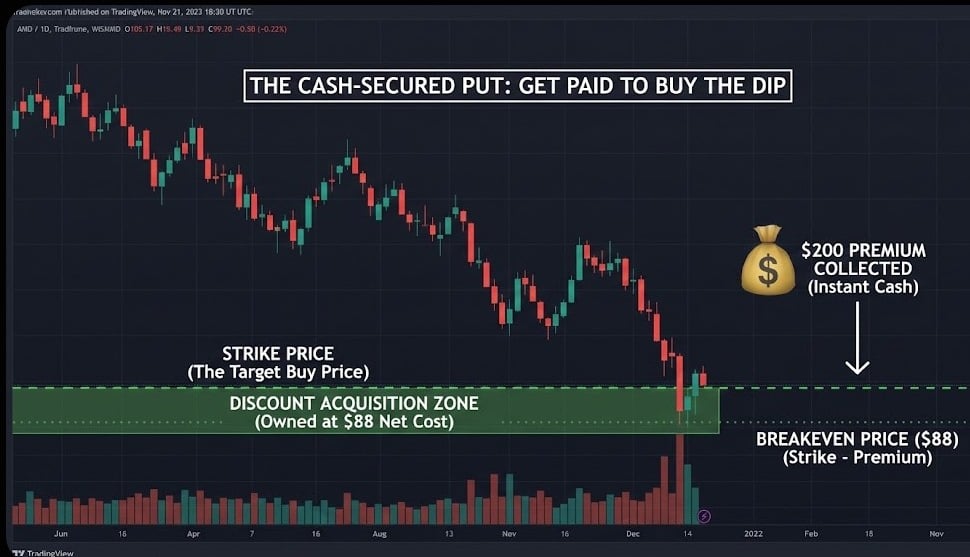
The vast majority of retail options traders enter the financial markets with a buyer's mindset, purchasing call or put options in hopes of capturing rapid, explosive directional moves. However, professional market participants recognize that the odds are structurally stacked in favor of the options seller. The cash secured put is a foundational income-generating strategy that shifts a trader from the role of the gambler to the role of the casino. Instead of paying premiums to buy an option, the seller of a cash-secured put collects upfront income by taking on an obligation to purchase an underlying stock at a predetermined price.
To understand how this mechanism operates, a trader must look at the structural mechanics of a put contract from the perspective of the writer. When you sell a put option, you are selling another market participant the right—but not the obligation—to force you to buy one hundred shares of an underlying equity at a specific strike price on or before a designated expiration date. In exchange for taking on this binding obligation, the buyer pays you an immediate cash premium, which is deposited directly into your brokerage account and is yours to keep regardless of what happens next.
The strategy earns its name from the vital requirement of being cash-secured. To ensure that you can fulfill your contractual obligation if the stock drops significantly, your brokerage platform will immediately lock up a specific amount of cash collateral within your account the moment the trade is executed. The amount of cash required to secure the position is equal to the strike price of the option multiplied by the one hundred shares that the contract governs. Because this cash is segregated and held in reserve, the trade is fully protected against default, making it a safer and highly regulated conservative strategy compared to selling uncovered or naked options on margin.
For income-focused investors, selling a cash-secured put acts as a highly efficient alternative to placing standard limit orders. When a traditional investor wants to acquire a stock at a discount, they typically place a limit order below the current market price and wait. If the stock never drops to that level, the investor walks away with nothing. By selling a cash-secured put at that exact same lower strike price instead, the trader receives immediate cash upfront just for committing to buy the stock at the discount they already desired. If the stock drops, they buy the asset at their target price; if it stays flat or rises, they pocket the premium and repeat the process, turning time decay into a consistent income stream.
What is a Cash Secured Put and How Does It Work?
Successfully executing a cash-secured put strategy requires transitioning from basic definitions into a strict, repeatable mechanical framework. Trading this setup for consistent income demands precision in three distinct areas: asset selection, strike price positioning, and expiration timing. If a trader fails to establish clear parameters across these components, they risk collecting small amounts of premium while exposing their capital to severe downside market moves.
The absolute golden rule of selling cash-secured puts is to only sell puts on high-quality equities that you are completely comfortable owning for the long term. Because the ultimate risk of the strategy is being forced to buy the underlying stock, a trader must never deploy this strategy on speculative penny stocks, highly volatile meme assets, or companies with deteriorating fundamental health. The ideal candidates are blue-chip companies, large-cap index funds, or sector-defining equities with robust balance sheets, steady earnings growth, and strong institutional backing. By focusing exclusively on structurally sound assets, getting forced to buy the shares is not a catastrophic failure; rather, it is a controlled acquisition of a premier asset at a clear discount.
Once an appropriate underlying asset is selected, the trader must utilize the options chain to choose an optimal strike price. This step relies heavily on analyzing delta, the options Greek that measures an option's sensitivity to price changes in the underlying stock, but is also widely utilized by sellers as a rough proxy for the probability of the option expiring in-the-money. To generate consistent income while maintaining a high probability of success, professional traders typically target a delta value between fifteen and thirty. A thirty-delta put, for example, implies that the option has roughly a thirty percent chance of finishing in-the-money at expiration, meaning the seller possesses a seventy percent statistical probability of keeping the entire upfront premium without ever being forced to buy the underlying stock.
The final piece of the trading setup involves selecting the ideal expiration date, a process governed entirely by managing theta, or time decay. The premium value of an options contract does not erode at a perfectly linear rate; instead, time decay accelerates dramatically as the contract moves closer to its expiration date. The sweet spot for maximizing this decay while capturing an attractive premium amount is targeting expiration cycles between thirty and forty-five days out. Entering trades within this specific window allows the seller to capture the sharpest acceleration of the time decay curve. This enables the trader to compound their income rapidly, often allowing them to buy back and close out the position early for a profit well before the actual expiration date arrives.
How to Trade and Sell Cash Secured Puts for Consistent Income
The true test of a professional options trader does not occur when a trade goes precisely as planned; it occurs when the market tests the boundaries of the position. When managing a cash-secured put, there are ultimately two primary market environments that will unfold over the life of the contract, each requiring a distinct strategic response to protect capital and maximize portfolio performance.
The first and most favorable scenario is when the underlying stock price remains entirely above the selected strike price through the expiration date. Because a put option only gains value for the buyer when a stock plunges, an asset that moves upward, sideways, or even experiences a mild decline that stays above your strike price will cause the contract to lose all value. As the expiration clock runs out, the option expires completely worthless. The cash collateral that was locked up by your brokerage platform is instantly released back into your available balance, and the upfront premium you collected is officially realized as a hundred percent net profit. The trader is then completely free to deploy that same cash collateral into a brand-new cycle, compounding their returns week after week.
The second scenario occurs when the underlying stock price drops below your selected strike price, a market event known as assignment. If the stock is trading even a single penny below your strike price at the closing bell on expiration day, the contract will be exercised. Your brokerage platform will automatically utilize the cash collateral held in reserve to purchase one hundred shares of the stock at the agreed-upon strike price. While an uneducated trader might view assignment as a loss, an income specialist understands that their true cost basis in the newly acquired shares is significantly lower than the strike price. Your actual cost basis is calculated by taking the strike price and subtracting the upfront premium you already collected, providing an immediate buffer against the stock's decline.
If assignment does occur, the strategic journey of the capital does not come to an end; instead, it seamlessly transitions into a powerful compounding framework known across trading desks as the Wheel Strategy. Once you are assigned the shares, you pivot from selling puts to selling covered calls against the exact shares you just purchased. You collect fresh income by writing call options at or above your purchase price. If the stock rebounds and the shares are called away, you return entirely to cash and begin the cycle all over again by selling puts. If the market experiences a temporary downtrend, a trader can actively protect their position by rolling the put—a risk management technique where the trader buys back the current option right before expiration and sells a further-dated contract at a lower strike price for a net credit, effectively buying more time while extracting additional income from the market.
The Strategic Setup: Risk Management and Assignment Scenarios
If you want to master more high-velocity market events, check out our other comprehensive trading guides:
➡️$TSLA Options Trading Strategy Guide
➡️Covered Call ETFs Explained: High Yields, NAV Decay & Risks
➡️How to trade a Bull Call Spread: Ultimate Guide
➡️Long Straddle Options Trading Strategy