
$JACK Stock Short Squeeze: Critical Price Levels & Breakout Targets
Track the massive short squeeze setup on Jack in the Box ($JACK). Get the critical must-hold support, upside targets, and the Squeeze Trigger level.
TRENDING STOCKS
The Core Bull Case: Deconstructing the Asset-Light Franchise Business Model
When analyzing the restaurant industry on Wall Street, institutional asset managers and retail options strategists quickly look past reported top-line revenue numbers to focus heavily on structural capital efficiency. For Jack in the Box Inc. ($JACK), the foundation of its long-term investment appeal relies on its deeply embedded asset-light franchise business model. Historically, operating company-owned restaurants meant absorbing the brunt of localized operational friction—including wage inflation, fluctuating commodity costs, real estate maintenance, and heavy capital expenditure burdens. By systematically shifting the majority of its domestic footprint into the hands of independent franchise operators, the corporate entity transformed its earnings profile from a low-margin operational game into a highly predictable, high-margin cash-flow compounding engine.
To evaluate the operational strength of this corporate structure, one must understand how an asset-light system filters recurring revenue into the corporate parent balance sheet. Instead of capturing individual ticket sales at the register, the corporate parent generates predictable, smooth cash inflows through three primary institutional channels:
Franchise Royalty Streams: Operators pay a fixed, continuous percentage of their weekly or monthly gross systemwide sales directly to the parent company, ensuring corporate revenue scales up seamlessly with restaurant traffic.
Real Estate and Lease Control: In a significant portion of its geographic footprint, Jack in the Box actively maintains ownership or master leases over the physical land and building structures. It then subleases these locations back to the franchise operators, capturing a reliable layer of rental spread revenue.
Initial Franchise and Development Fees: When expansion partners sign multi-unit development agreements to break into fresh geographic territories, they pay upfront, non-refundable cash fees to secure regional exclusivity.
The mathematical beauty of this framework lies in the decoupling of margin risk. When labor regulations shift or the market experiences sticky food commodity inflation, the immediate impact on corporate profit boundaries is largely insulated. The operational risk sits squarely with the franchise owner, while the parent company continues to collect top-line royalties on aggregate systemwide sales. This stability is precisely why mature fast-food equities command a premium valuation multiple during broader macroeconomic contractions; their cash-flow conversion rate is exceptionally clean, allowing the underlying firm to prioritize capital allocation toward internal technology advancements, supply-chain modernization, and targeted debt-reduction initiatives.
For a long-term investor or options strategist evaluating $JACK, mastering this corporate distinction changes the entire analytical workflow. Instead of obsessing over individual unit margins, the true yardstick of success becomes systemwide sales expansion, net unit growth, and franchise-level margin health. When the core franchisees operate highly profitable, efficient units, they naturally reinvest their surplus capital back into upgrading existing restaurant drive-thrus and executing regional expansion contracts. This symbiotic relationship ensures that the corporate parent can safely extract massive operational leverage, generating steady free cash flow that can eventually be deployed to maximize long-term equity returns.
Menu Diversity, Late-Night Dominance, and Irreverent Brand Positioning
In the fiercely contested quick-service restaurant sector, standard hamburger concepts frequently run into a structural growth wall due to extreme brand homogenization. When every major competitor offers a nearly identical variation of a value cheeseburger, french fries, and a soft drink, price wars inevitably trigger significant margin compression. To insulate its market share, Jack in the Box Inc. ($JACK) engineered a highly distinctive operational and marketing moat. By treating its menu architecture as a fluid, multi-category platform and establishing absolute ownership over the late-night daypart, the brand successfully separated itself from the standard fast-food category, creating a highly resilient consumer connection.
The first major pillar of this competitive advantage is the deliberate implementation of inter-category menu diversity and all-day product availability. While traditional burger chains enforce rigid operational cutoffs between breakfast and lunch service to streamline kitchen throughput, Jack in the Box operates an entirely open kitchen blueprint. A consumer can purchase a breakfast sandwich, a jumbo burger, sourdough options, or the brand's cult-classic deep-fried tacos at any hour of the day or night. This operational flexibility systematically eliminates the "veto vote"—a common consumer friction point where a group of diners bypasses a restaurant because a single member desires a different food category. Furthermore, the inclusion of non-traditional side items like egg rolls and curly fries acts as a powerful lever for average check expansion, as these high-margin add-ons are easily bundled into standard meal transactions to elevate overall gross ticket value.
The second, and perhaps most financially significant, aspect of the brand's footprint is its absolute dominance of the late-night daypart. In the restaurant industry, the midnight to 4:00 AM window is historically treated as a low-margin operational burden characterized by elevated labor costs and diminished traffic. Jack in the Box systematically transformed this dead zone into a highly profitable, core revenue engine. By optimizing its drive-thru infrastructure and introducing targeted product suites like the "Munchie Meal," the chain captured a highly loyal demographic of late-shift workers, gig-economy drivers, and late-night convenience seekers. Because major competitors frequently shutter their dining rooms or close entirely during these late hours, $JACK faces drastically reduced localized competition during this window, allowing individual units to extract maximum utilization out of fixed real estate costs while generating high-margin cash flow when the rest of the industry is offline.
The final element binding this entire commercial strategy together is an irreverent, counter-culture brand positioning framework. From a marketing perspective, Jack in the Box completely abandoned the generic, family-friendly advertising tropes favored by institutional legacy brands. Instead, the corporation pioneered an edgy, highly self-aware marketing narrative anchored by its fictional, sharp-suited CEO mascot, "Jack." This distinct, humorous brand voice resonates deeply with younger demographics and digital-native consumers who actively reject corporate marketing scripts. By leaning heavily into late-night pop culture and implementing bold social media engagements, the company transforms standard marketing expenditures into active brand equity. This persistent, unconventional positioning ensures that whenever consumers crave high-value, highly customized indulgence food, Jack in the Box remains top-of-mind, maintaining an enduring market footprint that remains insulated from shifting industry trends.
The Turnaround Playbook: Analyzing the "JACK on Track" Operational Overhaul
Every mature retail and restaurant concept eventually reaches a critical inflection point where its legacy infrastructure becomes an operational bottleneck. For a multi-decade quick-service pioneer, sustained growth requires more than clever marketing; it demands a comprehensive structural modernization. Under its structured "JACK on Track" corporate initiative, Jack in the Box Inc. has embarked on an aggressive, multi-layered operational transformation. This playbook focuses heavily on rewriting the brand's growth trajectory by executing an institutional leadership transition, an overhaul of its core digital architecture, and an optimized, tech-forward realignment of its physical real estate asset base.
The immediate catalyst for accelerating this corporate evolution arrived with a decisive executive leadership transition. The Board of Directors appointed industry veteran Mark King—the former highly successful CEO of Taco Bell Corp.—as Executive Chairman and Interim Chief Executive Officer. King’s appointment was engineered specifically to inject aggressive operational speed and disciplined execution into the "JACK on Track" framework. His primary mandate centers on increasing the velocity of the brand's unit expansion, maximizing franchisee-level economic returns, and navigating structural macroeconomic shifts by leveraging extensive global restaurant brand experience.
The absolute backbone of this operational turnaround is a sweeping, systemwide digital transformation designed to address automotive and fragmented legacy software. Historically, the chain operated on an outdated commerce infrastructure that restricted fluid multi-channel menu management and modern data analysis. To eliminate this friction, the corporation deployed a unified commerce Point of Sale (POS) platform across its entire network of over 2,100 restaurants. This technology integration provides major structural improvements:
Omnichannel Order Unification: The new engine seamlessly synchronizes transaction data across physical drive-thrus, in-store digital kiosks, native mobile applications, and third-party delivery marketplaces into a singular processing core.
Kiosk Optimization Metrics: In locations where the modernized kiosk infrastructure has rolled out, restaurants have registered an immediate 16% uptick in average ticket sales compared to traditional counter transactions.
Operational Training Efficiencies: By simplifying the point-of-sale interface, in-store labor onboarding times have plummeted by over 50%, heavily reducing corporate and franchise labor friction.
Targeted Digital Sales Goals: This aggressive digital deployment is structured to push total digital-channel transactions toward an institutional target of 20% of total systemwide sales.
Parallel to this digital modernization is a complete rethinking of the brand's physical footprint through value-engineered real estate formats. A major historic headwind to aggressive franchise expansion was the skyrocketing cost of commercial real estate construction and site development. The corporation countered this barrier by introducing its next-generation, tech-forward "Crave" image prototype. This smaller-footprint, drive-thru-centric building design utilizes strict value engineering to drastically lower initial capital requirements for franchise owners. Early field tests of the Crave prototype in new expansion territories—such as Salt Lake City, Orlando, and Louisville—have significantly outperformed expectations, with new units sustaining robust weekly volumes and achieving immediate digital scale.
To further insulate restaurant-level margins against persistent wage pressure, the brand is actively piloting back-of-house automation systems, including advanced robotic frying and drink-station platforms like Flippy 2 and Sippy. Combined with an intentional menu revitalization strategy that blends high-margin protein wellness innovations with high-nostalgia throwbacks celebrating the brand's 75th anniversary, the "JACK on Track" playbook establishes an incredibly strong, modern operational foundation. For public market investors and macro options strategists, this systemic shift from an old-school fast-food format to a highly automated, data-driven, asset-light franchise vehicle turns $JACK into a compelling structural turnaround play primed for long-term equity compounding.
Tactical Cheat Sheet—Key Short Squeeze Levels to Watch
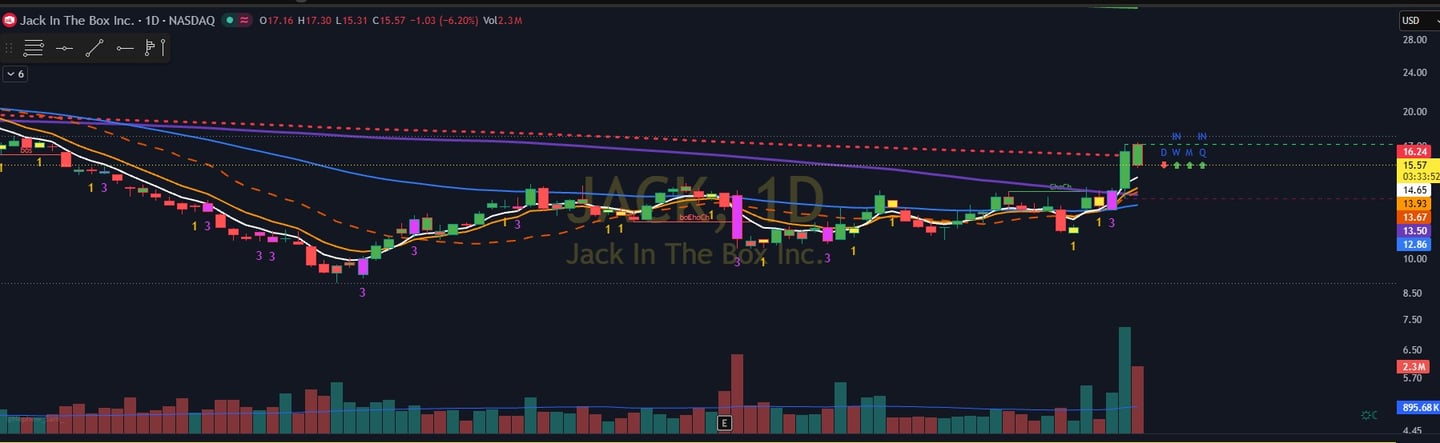
With a massive short interest float sitting above 51% and an incredibly high days-to-cover layer, shorts are officially playing with fire. This technical setup is completely wound up and getting ready to pop. Do not blink on this one—the margin for error for the bears has completely evaporated, and a sudden influx of momentum can spark an explosive cascade of forced institutional buy-ins.
Here is your definitive breakout roadmap and localized levels grid, broken down clearly for your trading hub:
Must-Hold Support ($15.50 Area): This is the absolute line in the sand. If the $15.50 zone holds firmly on a retest, the structural launchpad is locked, and the short-covering rocket is officially cleared for takeoff.
Upside Target 1 ($17.00): This represents the initial overhead liquidity pool. Breaking past this level clears out the immediate high-volume congestion node.
Upside Target 2 ($19.00): An intermediate resistance zone where you can expect minor profit-taking from early longs and defensive wall building by remaining shorts.
Upside Target 3 ($20.00): A massive psychological milestone level. Clearing this threshold shifts macro sentiment heavily and forces trailing stop-losses to trigger across short positions.
Squeeze Trigger (Above $23.00): The definitive breakout ignition point. Sustained daily price action above this level forces mass institutional capitulation, clearing the way for a parabolic run.
Max Extension Target ($26.00): The ultimate macro target for this specific squeeze cycle based on historical structural distribution peaks on the chart.
🛑 Tactical Execution Alert
The Takeoff Condition: If the market gives you a clean retest of the $15.50 zone and it holds on high relative volume, the risk-to-reward ratio becomes heavily asymmetric for buyers. Manage your position sizes mechanically, and keep a close eye on the tape momentum as the price approaches the $23.00 trigger line.
DISCLAIMER: Not financial advice. This is a market commentary piece based on current price action and options flow, and conditions can change quickly.