
Long Straddle Strategy: Profit from Explosive Moves in Any Direction
Master the long straddle options strategy to profit from big price moves regardless of direction. Learn when to use this volatility strategy for earnings plays and major catalysts.
Long Straddle Strategy: The Volatility Hunter (2026)
Introduction: Beyond the Up or Down Guessing Game
At Smart Trades Zone, we call this the "Volatility Hunter" strategy. It is designed for binary events like earnings reports, FDA approvals, or major economic announcements where a massive move is virtually guaranteed, but the direction is a coin flip. In the world of trading, the most common question is, "Where is the stock going?" Up or down? Bull or bear? Retail traders obsess over this directional bias, often getting paralyzed by the fear of being on the wrong side of a major move.
Professional options traders have a different tool in their arsenal for moments of extreme uncertainty: The Long Straddle. This strategy flips the traditional script. Instead of betting on direction, you are betting on magnitude. You don't care if the stock rips to the moon or crashes through the floor—you just need it to explode. This playbook teaches you how to profit from the "Expected Move" without having to guess the winner of the battle.
Phase 1: The Anatomy of a Straddle
A Long Straddle is a debit strategy, meaning you pay cash upfront to enter the trade. Its structure is elegantly simple but mathematically potent. You execute two identical trades simultaneously on the same underlying stock with the same expiration date:
- The Upside Engine: Buy 1 At-The-Money (ATM) Call Option.
- The Downside Engine: Buy 1 At-The-Money (ATM) Put Option.
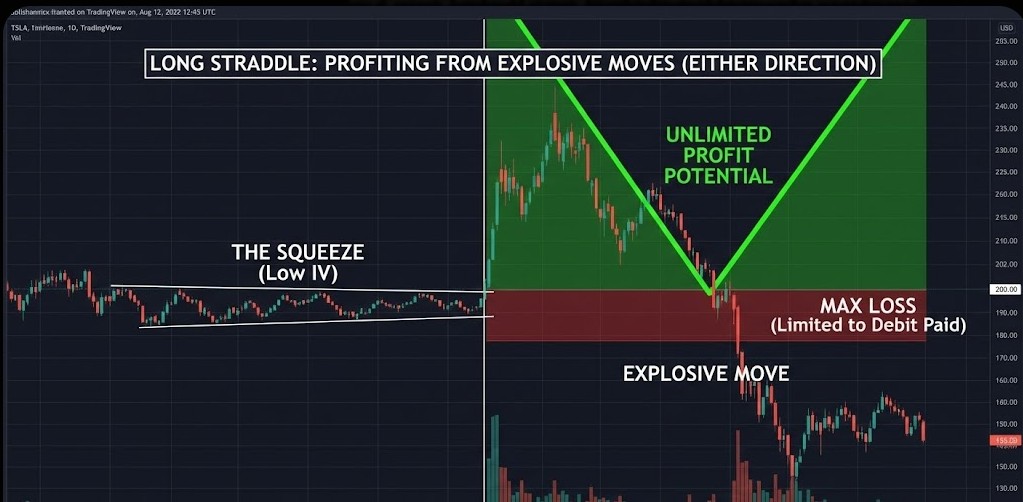
The Logic: By owning both a call (which profits when the stock goes up) and a put (which profits when the stock goes down), you have created a "V-shaped" P&L profile. You are essentially straddling the current price, ready to capture a move in either direction.
- If the stock rallies, your call option’s value explodes, more than offsetting the loss on your put.
- If the stock crashes, your put option’s value explodes, offsetting the loss on your call.
Your only enemy is a stock that does absolutely nothing—staying pinned at your strike price as time decays your value.
Phase 2: The "Why" – Strategic Advantages
Why would you pay double the premium to buy two options instead of just picking a side?
- Directional Agnosticism: The biggest psychological advantage is peace of mind. You don't have to sweat the outcome of a binary event. You have a ticket to the show no matter who wins.
- Unlimited Profit Potential: Unlike spreads which cap your gains, a Long Straddle has theoretically unlimited profit potential on the upside (a stock can go to infinity) and massive potential on the downside (a stock can go to zero).
- Leveraging "IV Run-up": This is a secret pro tactic. You don't just buy a straddle for the price move. You can also profit from a rise in Implied Volatility (IV). Before a known event like earnings, uncertainty builds, and option prices become more expensive across the board. By buying a straddle weeks before the event, you can profit from this IV expansion even if the stock price itself hasn't moved yet. This is why we often consult the [VIX fear index] before entering; we want to buy when the VIX is low and "rent" the options before everyone else piles in.
Phase 3: The Setup – When to Deploy (The Squeeze)
You don't randomly buy straddles. They are expensive and decay quickly. This is a sniper's tool, not a shotgun.
- The Ideal Scenario: Look for a stock that has been consolidating in a tight range ("the squeeze") leading up to a known catalyst date. The market is coiling like a spring, and you are positioning yourself for the release. We cross-reference our [Support & Resistance Playbook] to find these periods of low volatility where price is trapped between two massive institutional walls.
- The "IV Crush" Trap: NEVER buy a straddle the day before earnings. By then, the uncertainty is fully priced in. The moment the news comes out, IV will collapse ("IV Crush"), sucking the value out of your options even if the stock moves.
- The Professional Entry: Buy your straddle 14-21 days before the event. Implied volatility is usually at its lowest, making the options relatively cheap. You then ride the "IV run-up" into the event.
Phase 4: The Math – Breakevens and Probability
Understanding the numbers is crucial. Let’s use a real-world example: Stock XYZ is at $100.
- Buy the $100 Call for $3.00.
- Buy the $100 Put for $3.00.
- Total Cost (Net Debit): $6.00 ($600 total risk per contract pair).
- Max Risk: Your initial cost of $600.
- Upper Breakeven: $106.00 ($100 Strike + $6.00 Cost).
- Lower Breakeven: $94.00 ($100 Strike - $6.00 Cost).
You need the stock to move more than 6% in either direction to be profitable at expiration. This is where "Expected Move" comes in. If the market expects the stock to move 10% on earnings, and your straddle only costs 6%, you have a high-probability "edge" in the trade.
Phase 5: Advanced Strategy – Gamma and Vega
As a straddle trader, you are "Long Gamma" and "Long Vega."
- Gamma: This is the rate of change in your delta. As the stock moves in one direction, the delta of your winning option increases while the losing option shrinks. This means the further the stock moves, the faster you make money.
- Vega: This measures your sensitivity to volatility. If the stock doesn't move but the market gets more "scared," your straddle value increases. This is why buying during low-volatility periods is the cornerstone of the "Volatility Hunter" mindset.
Phase 6: Management – The Exit Strategy
A Long Straddle is a decaying asset. Every day the stock doesn't move, you lose money to Theta (time decay). You must be active and disciplined.
- The Profit Target: Do not be greedy. If the stock makes a violent move and you are up 30-50% on the total trade value, take the profit. Don't wait for a home run and risk a reversal.
- The Pre-Event Exit: If you bought weeks early and have a nice profit just from the IV run-up before the event even happens, consider selling. You've made money without taking the actual binary event risk.
- "Legging Out": If the stock rips higher, your call is a big winner and your put is near-worthless. You can sell the call to lock in the massive gain and keep the cheap put as a "free lottery ticket" in case of a sudden reversal.
Phase 7: Risk Management and Position Sizing
Because straddles involve paying for two options, the "bleed" of time decay is twice as fast as a single directional trade. We utilize [Position Sizing Mastery] to ensure we never over-allocate to these setups. A Long Straddle should typically represent a smaller percentage of your account compared to a Covered Call or a Vertical Spread, as it is a "negative carry" trade (you pay to play).
Summary: The Art of Trading Chaos
The Long Straddle is the ultimate weapon for the uncertain trader. It allows you to stop guessing and start profiting from the market's inevitable explosive moves. It requires the patience to wait for the "Squeeze" and the discipline to exit before the "IV Crush" destroys your premium. In a world obsessed with being right about the direction, the straddle trader thrives by being right about the volatility. Follow the magnitude, ignore the bias, and hunt the volatility.