
Bear Put Spread: Profit from Declining Stocks with Limited Risk
Master the bear put spread to profit from bearish moves while controlling risk and cost. Learn setup, optimal timing, and how to structure this directional options strategy for maximum efficiency.
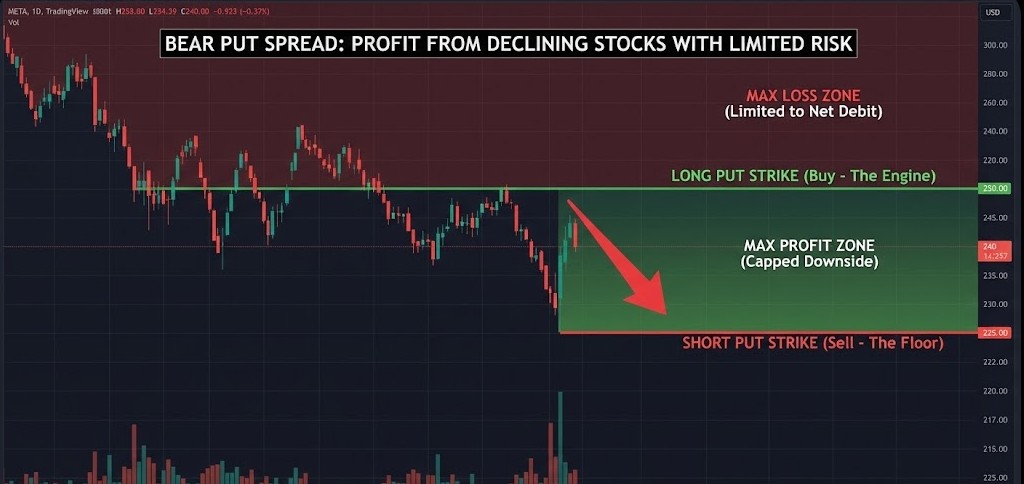
Bear Put Spread: The Gravity Protocol (2026)
Introduction: The Art of the Strategic Short
At SmartTradesZone, we view a falling market not as a threat, but as a mathematical opportunity to deploy the "Gravity Protocol". While retail traders gamble on "lotto" puts that bleed out from time decay, we engineer Bear Put Spreads that use the market’s own mechanics to subsidize our bearish conviction. Mastering this strategy allows you to profit from a stock's descent with capped risk, lower capital requirements, and a professional-grade hedge against the passage of time.
In a bull market, everyone is a genius. But when the tide turns, retail traders often freeze in fear or resort to desperate, high-risk gambles like buying naked, out-of-the-money (OTM) puts. These "lottery ticket" plays are statistically destined for failure because they require the market to crash violently and immediately just to overcome the rapid decay of time.
Professional traders approach a bearish outlook differently. At Smart Trades Zone, we don't just "buy a put"—we engineer a spread. The Bear Put Spread (also known as a Long Put Vertical Spread) is the quintessential tool for the disciplined bear. It provides the high-leverage benefits of a downward move while significantly reducing the cost of entry and the destructive impact of time decay.
Phase 1: Anatomy and Mechanics
The Bear Put Spread is a "Debit Spread," meaning you pay a net cost to enter the position. It is constructed by executing two simultaneous transactions on the same stock with the same expiration date:
* The Engine (Long Put): You buy a Put option with a higher strike price (usually At-The-Money or slightly In-The-Money). This is your primary source of profit.
* The Financing (Short Put): You simultaneously sell a Put option with a lower strike price (Out-Of-The-Money).
The credit you receive from selling the lower strike put acts as a subsidy for the expensive put you purchased. If a naked ITM put costs $8.00 ($800), and you sell an OTM put for $3.50 ($350), your net risk is slashed to $4.50 ($450). You have effectively reduced your maximum possible loss by 43% before the first red candle even prints on the chart.
Phase 2: The Strategic Advantage – Efficiency Over Ego
Amateurs avoid spreads because they "limit the upside." Professionals embrace them because they increase the probability of winning.
* Theta Cushioning: The enemy of every option buyer is Theta (Time Decay). However, in a Bear Put Spread, the put you sold is also losing value every day—and that decay works in your favor. This offset acts as a financial cushion, allowing you to stay in a bearish trade longer if the stock consolidates before eventually breaking down.
* Breakeven Lowering: Because the net cost is lower than a naked put, the stock doesn't have to fall as far to reach profitability. You are essentially "buying the move" at a discount.
* Volatility Resilience: When markets drop, Implied Volatility (IV) usually spikes. While this helps naked puts, an IV "crush" after the move can kill them. Spreads are naturally hedged against volatility swings because you are long one option and short another. This is particularly vital when trading around the [VIX fear index], as sudden drops in volatility won't devastate your position.
Phase 3: The Setup – Technical and Environmental Criteria
Precision is everything. We deploy the Gravity Protocol only when the charts confirm the trend has shifted.
* Technical Breakdown: We look for clear bearish signals using our [Support & Resistance Playbook]. We want to see a breakdown below a multi-month support level, a "Head and Shoulders" pattern completion, or a bearish crossover on the 20/50-day Moving Averages.
* The Overextended Filter: The best candidates for Bear Put Spreads are stocks that are vertically overextended and showing "Divergence" on the RSI (Relative Strength Index). We want to catch the mean reversion.
* Expiration Selection: Target the 30-45 Days to Expiration (DTE) window. This gives the "Bear Case" enough time to play out without forcing you to deal with the extreme volatility of weekly options.
Phase 4: Strike Selection (The Delta Protocol)
Strike selection is where you define your "Profit Corridor."
* The Long Strike (0.55 to 0.60 Delta): This is your anchor. We want this to be slightly In-The-Money (ITM) to ensure the position has immediate "Intrinsic Value" and moves aggressively as the stock drops.
* The Short Strike (0.25 to 0.30 Delta): This is your target. Look for the next major technical support level on the chart—the "floor" where you expect buyers to step back in. Sell your put at or just above this level. There is no mathematical reason to pay for a "downside target" that the chart says is unlikely to be reached.
Phase 5: The Math of the Bear (Risk vs. Reward)
Let’s look at a real-world scenario. XYZ stock is currently trading at $200 and has just broken down.
1. Buy the $200 Put for $9.00.
2. Sell the $185 Put for $3.50.
3. Net Debit (Max Risk): $5.50 ($550 total).
4. Max Profit: (Width of Strikes - Net Debit) = ($15 - $5.50) = $9.50 ($950).
5. Breakeven Price: (Long Strike - Net Debit) = ($200 - $5.50) = $194.50.
The Power of Leverage: To make $950 profit on a short stock position, you would need to short 100 shares ($20,000 in capital) and see the stock drop to $190.50. With the spread, you achieve a similar result with only $550 at risk. This efficiency is why we use this strategy within the [SPY Intraday Playbook] when the higher timeframes turn bearish.
Phase 6: Management and Defense
The trade doesn't end when you click "submit." Professional management is what separates the elite from the liquidated.
* The 50% Rule: We rarely hold until expiration. As a stock approaches your short strike, your "Gamma risk" (the risk of sudden price reversals) increases. Protocol: Close the entire position when you have captured 50-75% of the maximum potential profit.
* The Technical Stop: If the stock rallies and closes back above the support level that triggered our entry, the trade is dead. Kill it immediately. Do not "hope" for a double-top.
* Financial Discipline: If the position loses 50% of its initial value, exit. We protect our capital at all costs so we can trade another day. Use [Position Sizing Mastery] to ensure that a 50% loss on a single spread only impacts our total account by 1%.
Phase 7: Advanced Rolling and Scaling
If the stock crashes through your target strike early, don't just sit there. You can "Roll Down." Close the current spread and open a new Bear Put Spread at lower strikes. This allows you to "bank" your original profit while staying in the move with a lower cost basis. This is how you compound gains in a sustained bear market without increasing your capital at risk.
Phase 8: The Psychology of the Bear
Shorting the market is psychologically taxing. Human nature is inherently "bullish," and market "snap-backs" can be violent. The Bear Put Spread is designed to mitigate this stress. Because you have a "hedged" position, you won't panic during every minor green candle. You have defined your risk, defined your target, and defined your timeframe.
Summary: The Disciplined Bear
The Bear Put Spread is the premier strategy for traders who want to profit from a falling market without gambling their entire account on a single "crash" prediction. By using a second option to finance your entry, you trade away the "infinite" (and statistically improbable) downside profit for a higher probability of success, lower capital requirements, and a built-in shield against the passage of time.
In the world of trading, gravity is your friend—but only if you have the right equipment. Build your spreads, manage your risk, and let the market do the heavy lifting.