
Moving Average Strategies: Complete 2026 Guide
Master moving average strategies in 2026. Discover elite setups for day trading, scalping, swing trading, and forex market execution.
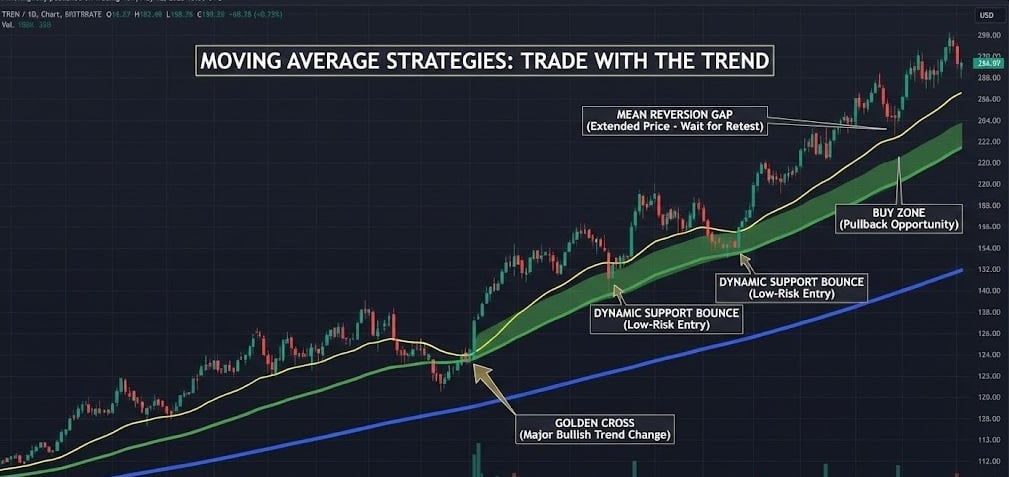
To extract consistent profits from intraday market cycles, a technical trader must utilize indicators that effectively filter out noise while preserving momentum responsiveness. Moving averages are the ultimate trend-following tool, smoothing out erratic price fluctuations to reveal the true directional path of an asset. For day trading and fast-paced scalping setups, the type of moving average you select and how you interpret its reaction to price action dictates your structural edge.
SMA vs. EMA: The Scalper’s Mathematical Choice:
Before deploying capital into an intraday strategy, you must understand the mathematical divergence between the two primary classes of moving averages:
Simple Moving Average (SMA): Calculates the unweighted mean of a specific set of prices over a defined number of periods. Because every candlestick carries equal weight, the SMA reacts slower to abrupt, real-time price turns.
Exponential Moving Average (EMA): Places a greater mathematical weight on the most recent price data points. Because it is front-weighted, the EMA reacts significantly faster to immediate buying or selling spikes.
For scalping and day trading, the EMA is the superior choice. Its rapid responsiveness allows short-term traders to capture the exact inception of high-velocity momentum moves without suffering from the devastating execution lag inherent in simple averages.
The Dynamic Intraday EMA Guide Strategy:
The primary tactical framework for intraday scalping involves loading a dual-EMA cloud consisting of the 9 EMA (the fast line) and the 21 EMA (the slow line) onto a 1-minute or 5-minute chart.
In a powerful, institutional intraday trend, price action will rarely violate these lines. Instead, the asset will use the 9 EMA as a dynamic support floor during a bullish run or a heavy resistance ceiling during a bearish breakdown. A highly effective scalping strategy involves waiting for a shallow pullback into the zone between the 9 and 21 EMAs during an active trend. When a rejection candlestick forms within this pocket, accompanied by a fresh surge in relative volume, it triggers a high-probability entry to play the immediate momentum continuation.
Moving Average Strategies for Day Trading and Scalping
When transitioning from micro-intraday frames to multi-day swing trading and global currency markets, the primary operational challenge shifts from capturing rapid momentum to identifying macro structural trends. The forex market, operating on 24-hour liquidity driven by central bank interest rate differentials, exhibits highly persistent structural trends that make it an ideal playground for higher-period moving average anchors.
Institutional Baseline Anchors: The 50 SMA and 200 SMA:
For swing trading equities and major currency pairs, the daily chart remains the definitive operational matrix. On this macro timeframe, institutional funds ignore short-term exponential averages and focus their algorithmic execution around the 50-day and 200-day Simple Moving Averages.
The 200-Day SMA (The Macro Trend Divider): Serves as the ultimate line in the sand for global market regimes. When a currency pair or stock trades above an ascending 200 SMA, the market is in a structural bull regime, and traders should focus exclusively on long positions. When it trades below, the asset is in a macro bear regime.
The 50-Day SMA (The Structural Pullback Magnet): Represents the primary institutional reloading zone. During a healthy, long-term trend, major funds rarely chase breakouts. Instead, they wait for prices to complete a multi-week corrective pullback down to a flat or rising 50 SMA. When price action stabilizes at this level, it creates a powerful confluence of structural demand, offering swing traders an asymmetric entry point with immense prospective upside.
The Forex Slope Continuation Framework:
Because forex trading involves the relative value of two distinct economies, trends are driven by multi-month macroeconomic cycles. To exploit this via moving averages, successful swing strategies rely on indicator slope rather than simple price crossings.
When the 20-period and 50-period moving averages on a 4-hour or daily forex chart turn completely flat, it signals a trendless, bracketed market where moving average strategies will suffer severe whipsaw losses. However, when the slope of these lines tilts cleanly at a 45-degree angle, it confirms a strong, trending environment. The strategy dictates entering positions solely in the direction of the slope, utilizing minor counter-trend wicks into the moving average line as a mechanical trigger to capture the next multi-hundred-pip macro extension.
Moving Average Strategies for Swing Trading and Forex Trading
The most heavily searched technical concepts on Reddit and trading forums center around moving average crossovers. While standard crossovers like the "Golden Cross" (the 50 SMA crossing above the 200 SMA) or the "Death Cross" (the 50 SMA crossing below the 200 SMA) provide excellent macro regime filters, utilizing them blindly as mechanical execution entry signals is a guaranteed way to bleed capital during sideways market consolidations. Advanced execution requires filtering crossovers using strict price action validation and volume rules.
Eliminating Whipsaws via Volumetric Validation:
A moving average is fundamentally a lagging indicator. When a market enters a choppy, range-bound consolidation phase, the moving average lines will repeatedly cross back and forth, generating a series of false breakout signals. To insulate your portfolio from these choppy traps, you must implement a strict validation rule:
Never enter a trade based solely on the physical crossing of the lines. The crossover must be accompanied by a clean structural breakout of the local price consolidation range, backed by a volume bar that sits at least 150% higher than the 20-period relative volume average. If the averages cross but the underlying price remains trapped inside a horizontal support and resistance bracket on low volume, the signal must be completely discarded as an unvalidated algorithmic head-fake.
The Execution, Stop-Loss, and Trailing Blueprint:
To transform a basic crossover into an elite, asymmetric trading strategy, your risk parameters must be systematically locked based on market structure:
The Tactical Entry: Once a moving average crossover occurs (e.g., a fast 9 EMA crossing a slower 21 EMA), wait for a distinct candlestick to close completely outside the crossover intersection point, confirming institutional momentum.
The Hard Stop-Loss Placement: Position your protective stop-loss immediately behind the most recent structural swing high or swing low formed prior to the crossover event. Alternatively, for a long entry, place the stop right beneath the slower moving average line itself. This ensure that if the crossover instantly fails and reverses, your loss is capped at a minimal, pre-calculated fraction of your account.
The Trailing Max-Win Mechanism: The ultimate strength of an advanced moving average strategy is its ability to keep you positioned in a massive trend for weeks or months. Once the trade moves significantly into profit, discard fixed take-profit targets. Instead, trail your protective stop-loss bar-by-bar immediately behind the slow moving average line. Allow the institutional trend to run uninhibited until a definitive candlestick closes completely on the opposite side of your anchor average, automatically liquidating your position and extracting the absolute maximum percentage of alpha from the market cycle.
If you want to master more high-velocity market events, check out our other comprehensive trading guides:
➡️VIX Trading Strategy Guide
➡️How to Trade Economic Data
➡️How to Trade Earnings Reports