
Why Is $PLTR Trending Today? Full Bull vs. Bear Trading Plan with Key Levels
Why is Palantir ($PLTR) trending today? Break down the sudden market momentum and see our exact Bull vs. Bear trading plan with critical price levels.
TRENDING STOCKS
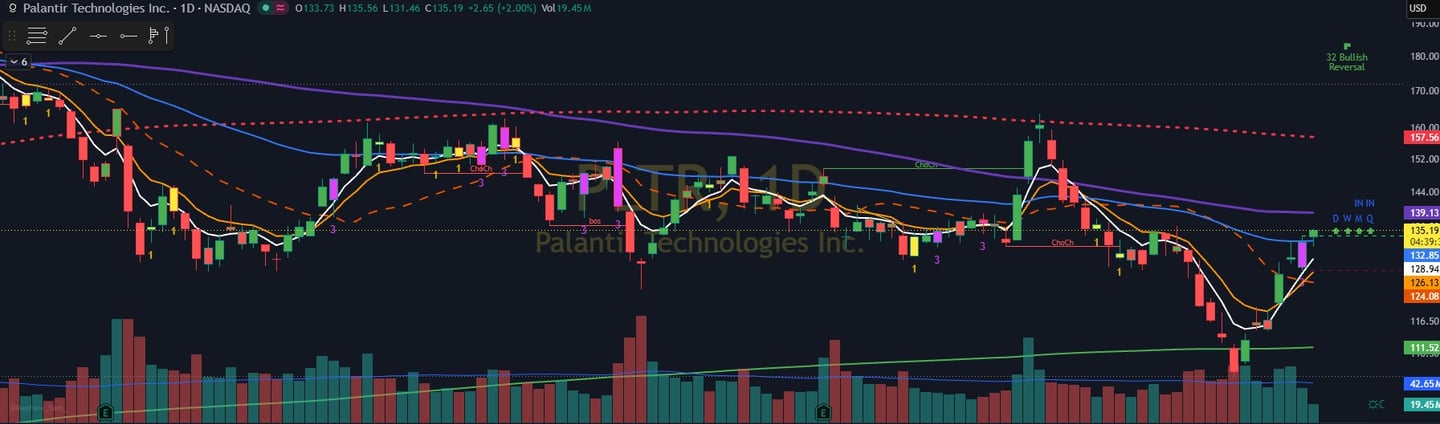
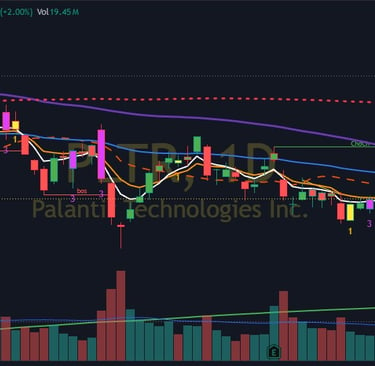
$PLTR: Why the Stock Is Trending: Deconstructing the 6-Day Breakout and Enterprise AI Momentum
Palantir Technologies ($PLTR) is pulling off a textbook reversal, commanding the spotlight on Wall Street with a fierce 6-day breakout that has caught short-sellers off guard. After weathering a choppy first half of the year defined by macro tech corrections and valuation anxiety, institutional buyers have aggressively stepped back in.
This momentum isn't just standard market noise or a brief short squeeze. It is a fundamental rotation back into elite AI infrastructure software, sparked by blockbuster growth metrics and a series of high-profile partnerships that solidify Palantir’s position as the operational brain of the enterprise AI revolution.
The Anatomy of the 6-Day Breakout:
The recent price action marks a definitive shift in market structure. After consolidating and successfully testing long-term support trendlines, $PLTR launched into a consecutive 6-day upward run, clearing major overhead moving averages and signaling that the intermediate downtrend has dissolved.
Traders are watching the Relative Strength Index (RSI), which has moved constructively out of neutral territory into a strong bullish expansion zone. This technical surge was heavily amplified by broad market relief; as hardware giants like Dell and data heavyweights like Snowflake reported robust underlying enterprise demand, investors realized that AI spending is not slowing down—it is migrating rapidly up the stack into software application workflows.
The Fundamental Engine: Unpacking the Hypergrowth Metrics:
While technical breakouts attract day traders, it is the underlying numbers that keep institutional capital locked in. Palantir's recent financial performance has fundamentally redefined what high-scale software profitability looks like.
Triple-Digit Commercial Acceleration: The standout catalyst is the U.S. commercial sector, which exploded with 133% year-over-year revenue growth. This proves that Palantir's Artificial Intelligence Platform (AIP) has achieved true product-market fit in the private sector, moving far beyond its historical reliance on government defense contracts.
The 1,000-Customer Milestone: Palantir officially crossed the 1,000 total customer threshold. This expanding customer base creates a massive, sticky ecosystem ripe for land-and-expand monetization.
Unprecedented Free Cash Flow: The company generated a jaw-dropping 57% adjusted free cash flow margin alongside 85% revenue growth, pushing its full-year revenue guidance toward the $7.66 billion mark.
The Rule of 145: In software economics, the "Rule of 40" (adding revenue growth rate to profit margin) is the gold standard for health. A score above 40 is excellent. Palantir clocked an astonishing Rule of 40 score of 145, combining hypergrowth with near-monopoly profit margins that are exceptionally rare in the technology sector.
Strategic Catalysts Driving the Enterprise AI Moat:
Two massive operational developments are fueling this breakout and securing Palantir’s long-term competitive moat:
1. The Nvidia Sovereign AI Alliance
Palantir recently announced a monumental partnership with Nvidia aimed at advancing sovereign AI deployments for federal and defense agencies. By marrying Palantir’s highly secure, governed operating system with Nvidia’s cutting-edge computing infrastructure and open-source models, the duo is unlocking secure AI execution at scale. This directly insulates Palantir from single-model dependency, giving them a structural advantage as an open platform where enterprises can swap out underlying large language models without disrupting their entire workflow.
2. The On-Premises Push with Dell
The ongoing collaboration with Dell to deliver an on-premises AI operating system is a massive win for highly regulated sectors like healthcare, aerospace, and banking. Companies that cannot risk sending proprietary data to the public cloud can now operationalize AI safely within their own physical data centers.
The Valuation Tug-of-War: Why the Volatility is an Opportunity
Despite the blistering rally, $PLTR remains one of the most fiercely debated stocks on the street. Bears continue to flag its premium valuation multiples—with a trailing price-to-earnings ratio sitting comfortably above 135x and a price-to-sales multiple near 60x. Notably, high-profile short-sellers like Michael Burry of Scion Asset Management have maintained downside exposure via put options, though recent filings indicate he has trimmed those positions significantly while adding long-dated calls to hedge his bets.
This intense tug-of-war between fundamental value purists and growth-at-any-price momentum buyers ensures high trading volume, massive liquidity, and excellent volatility for active traders. For long-term investors, the message from the market is clear: while the stock carries a premium price tag, Palantir is successfully capturing massive financial value at the software layer while others are still trying to figure out how to put AI into production.
$PLTR: The Execution Blueprint: Exact Bull Targets, Bear Risk Levels, and Key Moving Average Triggers
With Palantir trading firmly above its near-term pivot at $135.94, the bulls completely command the tape. In momentum-driven tech setups like this, key psychological and structural levels dictate where institutional algorithms pile in and where they panic.
The entire framework of this trade revolves around one definitive line in the sand: $134.05. As long as $PLTR stays north of this level, buyers have the definitive advantage. The moment it breaks, the momentum shifts to sellers with alarming speed.
The Bull Case: Staying in Control Above the Pivot:
If $PLTR can successfully defend and hold above $134.05 on any intraday retest, the bullish structure remains entirely intact. For absolute confirmation that the next leg higher is underway, buyers want to see the stock reclaim and convincingly hold over $136.10.
Once that immediate barrier is cleared, short-term sellers will likely cover, opening up a clear runway to several key upside targets:
Target 1 ($136.10): The first nearby daily resistance level. Clearing this acts as the primary validation that the breakout has staying power.
Target 2 ($149.64): Major swing resistance. This is a significant structural level where profit-taking might occur, representing a massive reward-to-risk pocket from the pivot line.
Target 3 ($163.70): The higher-timeframe swing high and major extension zone. A march to this level signals a full macro trend continuation.
Bullish Invalidation Rule: The absolute invalidation for any long positions or bullish bias is a definitive loss of $134.05. If the stock drops below this level without an immediate wick back up, the bullish thesis is dead in the water for the short term.
The Bear Case: The Trapdoors to Watch Below Support:
The bears are eagerly waiting for a breakdown below $134.05. If $PLTR cracks this pivot and fails to reclaim it on the subsequent bounce, the technical tape shifts dramatically.
Sellers will aggressively target the gaps and support floors left behind during this rapid 6-day run. If the breakdown triggers, keep a close eye on these downside targets:
Target 1 ($132.54): The prior day's close and first major failure zone. This acts as an immediate downside magnet where buyers will attempt a temporary rescue.
Target 2 ($131.63): The next major daily support shelf. Institutional volume clusters heavily here, making it a critical zone to watch for stabilization.
Target 3 ($126.64): Deeper support and the prior day's low area. Slipping to this level represents a full erasure of recent momentum and a broader retest of the intermediate trend.
Bearish Invalidation Rule: If you are shorting a break of the pivot, your trade is immediately invalidated if the price reclaims and stabilizes back above $134.05.
Execution Strategy: The Active Trading Blueprint
Navigating a high-velocity asset like Palantir requires clear tactical execution rather than emotional guesswork. The rule of thumb for this tape is incredibly straightforward:
When to Long: Look for a sustained hold above $134.05. Wait for the first confirmation trigger—reclaiming and holding $136.10—to build into the position safely, targeting the major overhead swing levels up to $163.70.
When to Short: Look for a clean break below $134.05. If the stock fails to push back above that pivot, look for short exposure or put options targeting $132.54, $131.63, and ultimately $126.64 on a deeper flush.
The bottom line is that as long as Palantir maintains its footing above $134.05, the bulls have the definitive edge. Below that line, momentum shifts to the bears fast, and $132.54 becomes an immediate magnet for the price. Keep your risk tightly managed around the pivot and let the market structure do the heavy lifting.