
Stop Loss Strategies: Protect Capital Without Getting Stopped Out
Master stop loss placement to protect trading capital without premature exits. Learn technical, percentage-based, ATR, and time-based stop loss methods for consistent protection.
Stop Loss Strategies: The Art of the Professional Exit (2026)
Introduction: Your Financial Insurance Policy
At Smart Trades Zone, we view the stop loss as the most important tool in a trader's arsenal. Most retail traders treat a stop loss like an admission of being "wrong." They hate the idea of losing money, so they move their stops, "average down," or remove them entirely, hoping the market will bail them out. This is how accounts are blown.
Professional traders view a stop loss as an insurance policy. It is a pre-defined exit point that invalidates our trade thesis. If the stock hits the stop, the "story" we told ourselves about the trade is no longer true, and we must exit immediately to protect our capital. This playbook will teach you how to place stops that are tight enough to protect your bankroll but wide enough to let your winners breathe.
Phase 1: The Three Pillars of Stop Placement
To trade like an institution, you must move beyond "mental stops" and utilize physical, hard orders based on technical reality.
1. The Technical Stop: This is placed based on structural levels on the chart. If you are long, your stop should be just below a major support level.
2. The Volatility Stop: This uses the ATR (Average True Range) to account for the "noise" of the stock.
3. The Equity Stop: This is the "Hard Stop" based on our [Position Sizing Mastery] guide, ensuring no single trade ever loses more than 1% of the total account.
Phase 2: The Technical Stop (Trading the Zones)
We don't place stops at random round numbers. We place them where the "Smart Money" has historically defended a position.
- Long Trades: Your stop should be placed 5-10 cents below the recent swing low or the bottom of a [Support & Resistance Playbook] zone. This ensures that if the floor breaks, you are out before the "flush" happens.
- Short Trades: Your stop goes just above the recent swing high or the ceiling of a resistance zone.
The Rule: If the price breaks the structure that justified your entry, the reason for the trade is gone. You must be gone too.
Phase 3: The Volatility Stop (The ATR Method)
Some stocks are wild horses (like high-beta tech), and some are slow turtles (like utility stocks). You cannot use a "standard" $1.00 stop for both.
- The Calculation: We use the 14-day ATR. A common professional strategy is to set your stop at 1.5x or 2x the ATR.
- The Benefit: This "Volatility Cushion" prevents you from being "stopped out" by a minor intraday dip that is simply part of the stock’s natural movement. It allows the stock the room it needs to oscillate without triggering a premature exit.
Phase 4: The Trailing Stop (Locking in the Harvest)
As a trade moves in your favor, you must protect your unrealized gains. We never let a "Green" trade turn back into a "Red" trade.
- The 1-Bar Trail: In high-momentum moves, move your stop to the low of the previous candle.
- The EMA Trail: Use the 9 or 21 EMA as your trailing stop. As long as the price stays above the moving average, you stay in the trade. When it closes below, you "Rethink or Exit."
- The Pivot Trail: Move your stop up behind each new "higher low" created during an uptrend. This is the hallmark of the [SPY Intraday Playbook] trend-following strategy.
Phase 5: The Time Stop (The Opportunity Cost Exit)
Time is capital. If you enter a trade expecting a breakout and the stock moves sideways for three days, your capital is "stale."
- The Strategy: If the expected move hasn't materialized within a specific timeframe (e.g., 3-5 bars), you exit the trade at breakeven or a small loss.
- The Logic: The longer a stock stays at your entry point without moving, the higher the probability that the breakout has failed. Professional traders don't wait for the market to prove them wrong; they exit because the market hasn't proven them right.
Phase 6: Managing Gap Risk and Overnight Exposure
The "Hard Stop" in your broker's system only works during market hours. If a stock gaps down 10% overnight due to bad news, your stop loss will be "skipped" and you will be filled at the opening price.
- The Defense: We cross-reference the [VIX fear index]. If market fear is high, we reduce our overnight position sizes.
- The Rule: Never hold more risk through a binary event (like earnings) than you are willing to lose in a gap. If you can't afford a 20% gap down, your position size is too large.
Phase 7: The Breakeven Trap
One of the most common mistakes is moving your stop to "Breakeven" too early.
- The Psychology: Traders do this to feel "safe."
- The Reality: By moving your stop to breakeven before the stock has made a significant move, you are often cutting the trade off just before the "retest" of the entry level.
- The Rule: Only move your stop to breakeven once the stock has reached a 1:1 Risk-Reward ratio. This gives the position enough "room" to retest support without kicking you out of a winning move.
Phase 8: Dealing with "Stop Hunts" and Wicks
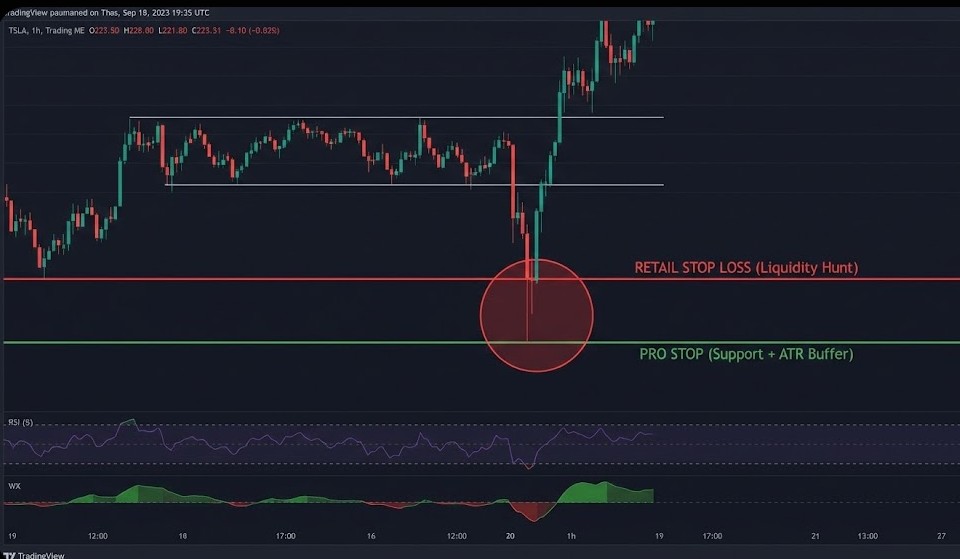
Institutional algorithms are programmed to "hunt" retail stops sitting just below obvious support levels.
- The Fix: Give your stops a "buffer." Rather than placing your stop exactly at the support line, place it a few ticks further away, or wait for a "Closing Candle" confirmation. A "wick" through your level is common; a "body close" below your level is a signal of true failure.
Phase 9: The Emotional Stop Loss
If you find yourself staring at the screen, sweating, and bargaining with the market ("Please just get back to my entry!"), you have already hit your emotional stop loss.
- The Protocol: Close the trade immediately. If the stress is that high, your position size is likely too large for your current psychological level. Trading should be a cold, mechanical process of executing a plan.
Summary: The Art of the Fold
In poker, the best players are the ones who know when to fold a mediocre hand to save their chips for the "Royal Flush." Trading is no different. The stop loss is not a failure; it is a tactical retreat that keeps you in the game. By combining technical levels with volatility adjustments and time-based exits, you ensure that no single mistake—no matter how painful—can end your journey. Respect the stop, protect the bankroll, and trade another day.