
Bankroll Management System: Scale Your Trading Capital Intelligently
Master bankroll management to grow trading capital systematically. Learn percentage rules, drawdown limits, scaling strategies, and capital preservation techniques for long-term success.
Bankroll Management System: The CEO’s Protocol (2026)
Introduction: High Scores vs. Real Cash
In video games, a high score is just pixels on a screen. In trading, a high account balance is also just pixels—until you withdraw it. Many traders turn $5,000 into $50,000, only to give it all back because they never learned Bankroll Management. They treated their account like a casino chip instead of a business operating account.
At Smart Trades Zone, we operate with a CEO Mindset. You are not just the trader (employee); you are the manager of the fund (CEO). The CEO's job isn't to take the trades; it is to ensure the business stays solvent and the shareholders (you) get paid. This playbook outlines the strict protocols for paying yourself, scaling your size, and protecting the business from bankruptcy.
Phase 1: The "50/50 Salary" Protocol
The biggest mistake traders make is "Compounding Forever." They leave every dollar in the account to trade bigger size, thinking they will reach $1 million faster. This is a cognitive trap because one "Black Swan" week can wipe out months of hard work. You must make trading "real" by paying yourself.
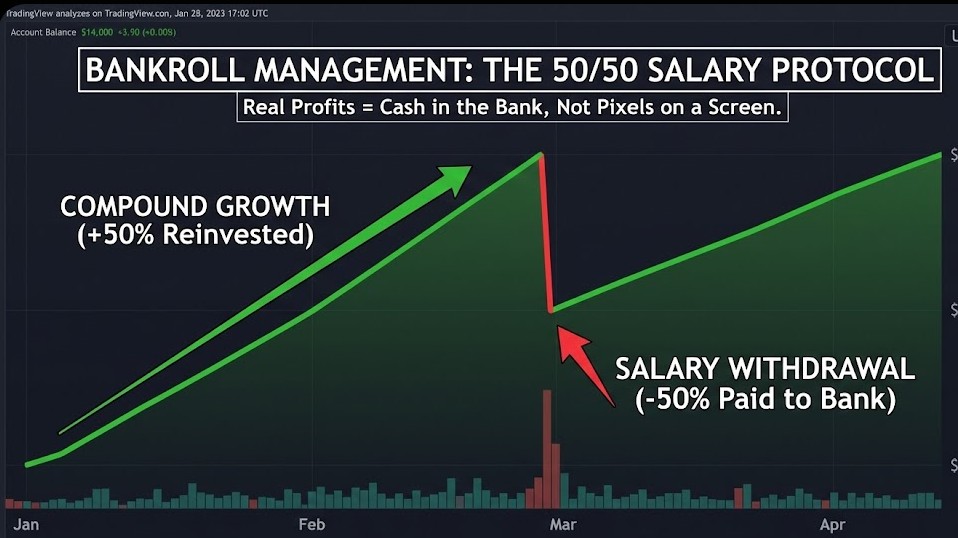
The Protocol: At the end of every profitable month, you perform a 50/50 split.
* 50% of Profits: Stay in the brokerage account to compound and increase position size.
* 50% of Profits: MUST be wired to your personal checking account.
Why this works: This "locks in" your labor. If you make $4,000 this month, put $2,000 in your pocket. Even if you hit a drawdown next month, that $2,000 is physically yours—it’s a car payment, a mortgage, or a vacation. Without withdrawals, trading is just a stressful video game. By taking money out, you reduce the "emotional weight" of the balance in your brokerage account.
Phase 2: The "Earned Right" to Scale
Amateurs double their position size because they "feel confident" after three wins. Professionals increase size only when they have earned the right mathematically. Scaling is not a reward for being "right"; it is a reward for being consistent.
The Step-Ladder Rule:
You may only increase your position size (risk unit) when your account has grown by a set milestone, usually 20%.
* Starting Account: $10,000. Risk per trade: $100 (1%) as per [Position Sizing Mastery].
* Milestone: You profit $2,000. Account is now $12,000.
* New Size: You can now risk $120 per trade.
The Safety Net: If your account drops back below $12,000, you MUST immediately revert to the $100 risk size. You have lost the privilege to trade bigger. Scaling up is a slow ladder; scaling down is a fast elevator. This keeps you from "revenge trading" with larger sizes to make back losses.
Phase 3: The Circuit Breaker (The "Stop-Trading" Rule)
The market doesn't care about your feelings, but your P&L does. Emotional trading happens when you are down big and try to "swing for the fences" to make it back in one trade. The Circuit Breaker prevents this by forcing a cool-down period.
The Hard Limits:
1. Daily Cap: If you lose 3% of your account in a single day, you are locked out. Close the platform. Go outside. You are emotionally compromised and likely "tilting."
2. Weekly Cap: If you lose 6% of your account in a single week, you stop trading until Monday. This is a "generational" rule for survival.
3. Monthly Reset: If you hit your weekly cap twice in a month, you must cut your position size in half for the following month. You are out of sync with the market, and you need to earn back your confidence with small wins.
Phase 4: Managing "House Money" Psychology
When you are on a winning streak, your brain creates a dangerous illusion that you are playing with "House Money"—money that doesn't belong to you. This leads to sloppy entries and oversized bets.
The Smart Trades Reality: There is no such thing as house money. Once the trade is closed, that profit is your capital. Treating it as "free" is the first step toward giving it back. We cross-reference our profit-taking with the [VIX fear index]. If we are in a period of high volatility, we are even more aggressive with our 50/50 withdrawals because "The Market giveth, and the Market taketh away."
Phase 5: Capital Allocation vs. Operational Risk
As your bankroll grows, you must decide how much of it stays in the "Risk Account."
* The Operational Fund: This is the cash you use for day trading and high-leverage plays.
* The Strategic Fund: Once your bankroll hits a certain threshold (e.g., $100k), you should move a portion of it into a lower-volatility "Strategic" account. This is where you deploy the [Covered Call Strategy] or buy long-term index funds.
The goal is to move money from the "War Zone" of active trading to the "Safety Zone" of long-term wealth building.
Phase 6: The Drawdown Survival Guide
Every trader, including the legends, goes through drawdowns. Bankroll management is about ensuring your drawdown is a "paper cut" rather than a "decapitation."
* The 10% Rule: If your account drops 10% from its all-time high, you must reduce your trade frequency.
* The 20% Rule: If your account drops 20% from its all-time high, you must stop trading and return to a demo account or "paper trading" until you can prove 5 consecutive winning days. Your "Edge" has likely shifted, or your psychology is broken.
Phase 7: The "CEO Monthly Review"
On the first of every month, you must sit down and review your "Business."
- What was my win rate?
- What was my average "R" per win?
- Did I follow my circuit breakers?
- Did I withdraw my 50%?
If you can't answer these questions, you aren't a CEO; you're a bystander. This monthly audit is what allows you to identify when you are ready to move from a $100 risk unit to a $1,000 risk unit.
Summary: Protect the Inventory
A restaurant does not bet its entire inventory on one dinner service. A bank does not lend all its cash to one borrower. Your trading account is your inventory. Without it, you are out of business. By withdrawing profits regularly, scaling only through earned performance, and respecting your circuit breakers, you ensure that you will be around to trade for decades, not just days. In the game of trading, the winner is the one who refuses to leave the table. Protect the bankroll, and the bankroll will protect you.