
RSI and MACD Trading Strategy: Complete 2026 Guide
Master RSI and MACD trading strategies in 2026. Learn how to combine momentum indicators, interpret divergences, and build a technical crossover screener.
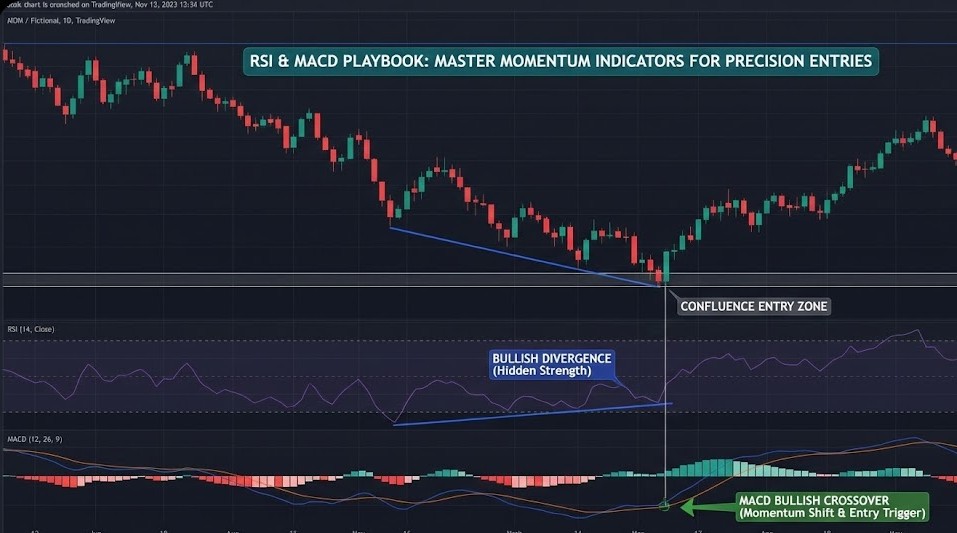
To trade high-probability reversals and structural trend continuations, a technical analyst must utilize tools that complement each other rather than duplicate the same data. Combining the Relative Strength Index (RSI) and the Moving Average Convergence Divergence (MACD) creates a powerful trading engine. Together, they solve the ultimate technical dilemma: identifying both the strength of a price trend and the exact velocity of its underlying momentum.
Decoding the Indicators: Full Form and Mathematical Logic
Understanding how these indicators are constructed prevents you from misinterpreting their visual signals during live market sessions.
RSI (Relative Strength Index): Invented by J. Welles Wilder, the RSI is a pure momentum oscillator bound between a scale of 0 and 100. It measures the speed and change of price movements by comparing the magnitude of a stock's recent gains to its recent losses over a standard 14-period horizon. Traditionally, an RSI reading above 70 indicates an overbought condition, while a reading below 30 signals an oversold condition.
MACD (Moving Average Convergence Divergence): Developed by Gerald Appel, the MACD is a trend-following momentum indicator. It calculates the structural relationship between two exponential moving averages (EMAs)—typically subtracting the 26-period EMA from the 12-period EMA to create the baseline MACD Line. A 9-period EMA of the MACD line, known as the Signal Line, is then plotted on top, accompanied by a histogram that visually measures the distance between the two lines.
The Power of Synergy: Oscillator vs. Trend Follower
The ultimate flaw of the RSI is that it can remain pinned in an extreme overbought or oversold state for weeks during a powerful, institutional trend, leading premature retail contrarians to blow up their accounts. Conversely, the main flaw of the MACD is its lagging nature, as moving averages inherently trail current price action.
By layering them together, you create a powerful confirmation system. The RSI acts as your early warning system, highlighting structural exhaustion, while the MACD acts as your definitive trend filter, preventing you from entering a reversal trade until institutional flow actually turns.
RSI and MACD Indicator Meaning and Core Mechanics
The true operational edge of combining the RSI and MACD in trading manifests when both indicators reach a state of confluence. Instead of trading every single moving average crossover or overbought flash, elite technical analysis relies on matching structural price divergences with mechanical indicator crossovers.
Executing the High-Probability Divergence Setup
Divergence occurs when the underlying price action of a stock decouples from the trajectory of its technical indicators. This mismatch signals that the current trend is hollow and rapidly losing institutional backing.
Bullish Convergence/Divergence: Price prints a lower low on the chart, but the RSI prints a distinct higher low. This indicates that even though sellers pushed the price down, the velocity of the selling pressure is actively drying up.
The MACD Validation Trigger: Never enter a bullish divergence layout purely based on the RSI. To execute the strategy safely, you must wait for the RSI to climb back above 30 while simultaneously catching a bullish MACD crossover (the MACD line crossing cleanly above the Signal Line) below the zero center-line. This multi-layer confirmation guarantees that buying volume has officially entered the order book.
The Trend-Continuation Midline Strategy
Divergences are excellent for catching major macro market turns, but trading crossovers near the midlines offers an exceptional framework for trend continuation during aggressive breakout sessions.
When a stock is in a powerful bullish trend, the RSI will frequently pull back from the overbought territory and find support right at its 50 midline, rather than dropping all the way to 30. If the RSI stabilizes at the 50 line while the MACD histogram completes a shallow wave and prints a fresh bullish crossover above the zero line, it confirms a massive institutional restep. This gives day and swing traders a low-risk entry point to ride the secondary wave of an established breakout, placing their hard stop-loss right beneath the local intraday consolidation anchor.
RSI and MACD Divergence and Crossover Trading Strategies
Manually tracking multiple timeframes to catch simultaneous RSI and MACD confirmations across hundreds of stocks is virtually impossible. To automate your workflow and build a high-quality daily watchlist. You must configure a technical crossover screener using specific, rules-based algorithmic parameters.
Setting Up Your Custom Scanner Rules:
Whether you are using automated scripting logic or standard drag-and-drop screening software, your scan configurations must filter out low-volume noise and focus purely on high-velocity setups. Use these exact parameters to build a highly targeted scanner:
Liquidity Filter: Current Price greater than $10, and 3-month Average Volume greater than 1 million shares. This eliminates erratic, low-float penny stocks that easily manipulate technical indicators.
RSI Screening Condition: RSI (14-period) must have crossed above 30 within the last 3 candlesticks, or the RSI must be steadily increasing between the 45 and 55 zone to capture momentum acceleration.
MACD Screening Confluence: The MACD Line (12, 26) must print a bullish crossover above the Signal Line (9) within the exact same 3-candle window. For reversal setups, specify that this crossover must occur completely below the zero line to maximize the prospective upside.
Sorting and Executing the Screener Output:
When your crossover screener populates its raw daily results, your final optimization step involves sorting the output by Relative Volume (RVOL).
The tickers displaying an active RSI and MACD crossover accompanied by an RVOL score of 2.0 or higher are your absolute priority assets. This statistical volume surge proves that institutional block orders are actively hitting the tape at the exact moment the technical indicators align, resulting in high-velocity, clean continuation moves that are entirely free from erratic retail whipsaws.
If you want to master more high-velocity market events, check out our other comprehensive trading guides:
➡️VIX Trading Strategy Guide
➡️How to Trade Economic Data
➡️How to Trade Earnings Reports