
Stop Loss Hunt Trading Strategy: Beat Market Manipulation
Learn the mechanics behind the stop loss hunt trading strategy. Discover how market makers sweep liquidity and how to protect your entries using structural buffers.
In the fast-moving arena of active market speculation, the difference between an amateur holding a bleeding account and a professional operating a sustainable business model comes down to a single element: execution discipline. Far too many retail participants spend years optimizing their entry signals, completely oblivious to the fact that finding a winning trade is only half the battle. A true market specialist knows that survival is entirely dependent on protecting your downside. Implementing a mechanical stop loss trading strategy serves as the ultimate structural safety net for your trading hub, establishing a cold, legally binding boundary that prevents an ordinary, temporary market pullback from transforming into an account-ending disaster.
The primary hurdle to adopting a strict risk ceiling is a deep-seated behavioral bias known as cognitive denial. When an active position begins moving against a trader, the human brain desperately seeks comfort, causing the individual to abandon objective technical analysis and enter a toxic state of hope. They convince themselves that the stock is just "shaking out weak hands" or that a sudden structural reversal is right around the corner. This dangerous hesitation is exactly how small, manageable losses compound into catastrophic drawdowns. By utilizing a preplanned stop-loss order, you completely strip human discretion and emotional override out of the equation. The order sits passively on the broker's matching engine, ready to execute without hesitation the exact millisecond the market proves your trade thesis wrong.
To deploy an institutional-grade risk strategy, the stop-loss must never be placed at an arbitrary dollar amount or a random percentage drop. Instead, it must be aligned perfectly with a structural invalidation point on your chart. Invalidation represents the exact technical price level where the original reason for entering the trade is officially proven completely dead by the market's layout. Depending on your chosen timeframe and style, this invalidation framework shifts across various operational setups:
Intraday Trading Stop Loss Strategy: When operating within highly volatile intraday windows, short-term day traders place their risk levels immediately outside of immediate-term micro-structures. This includes nesting stops just below the current session's Volume Weighted Average Price (VWAP), past a prominent opening-range breakout line, or underneath a highly defended intraday higher-low node.
Swing Trading Stop Loss Strategy: For multi-day or multi-week holding periods, swing traders require wider spatial padding to absorb normal market noise. They anchor their invalidation lines firmly beneath major daily support boundaries, macro moving averages, or structural pivot lows, ensuring they are only stopped out if the larger-scale trend completely breaks down.
Options Trading Stop Loss Strategy: Because options contracts introduce complex variables like delta-sensitivity and rapid time decay, setting a stop-loss requires tracking the underlying equity asset rather than the premium price alone. An options specialist monitors the precise structural breakdown of the stock chart to trigger an immediate, systematic exit of the derivative contract before the premium experiences exponential destruction.
Ultimately, an elite stop-loss framework operates on the mathematical law of preservation. A professional trader treats a small, controlled loss not as an embarrassing personal failure, but simply as a routine cost of doing business—the standard operational overhead required to uncover highly profitable market trends. By anticipating the maximum loss before the trade is even routed, the psychological sting is completely neutralized. This absolute emotional detachment allows you to protect your core equity curve, retain your mental capital, and keep your purchasing power fully loaded for the next high-probability setup.
The Foundations of a Core Stop Loss Trading Strategy
When an active position enters profitable territory, a trader's mental game undergoes an intense shift. The fear of missing out on a breakout transforms instantly into the fear of giving back open paper profits. This emotional friction forces the vast majority of amateur participants to exit their winning positions prematurely, capping their financial upside and destroying their portfolio's average risk-to-reward metrics over time. To solve this systemic flaw, an advanced trader utilizes a trailing stop loss trading strategy. Unlike a static, fixed risk ceiling that remains anchored to a single price line for the duration of a trade, a trailing stop is a dynamic risk-management instrument designed to actively secure realized gains while granting an explosive trend the necessary breathing room to fulfill its maximum macro potential.
The structural brilliance of a dynamic trail is its mechanical automation. A trailing stop acts as a fluid "if-then" script pre-programmed directly onto your brokerage execution engine. The order specifies a strict trailing distance—designated in either physical cents, currency pips, index points, or exact percentage points—away from the absolute highest price peak achieved by the asset since the trade became active. As the underlying stock or contract climbs to a fresh relative high, the stop-loss order automatically ratchets upward in lockstep, keeping the exact specified distance perfectly preserved. However, the moment the asset tires, exhausts its buying volume, and undergoes a localized pullback, the trailing mechanism immediately locks firmly into place. It refuses to downwardly adjust under any circumstance, establishing an immutable baseline that ensures your won profits are insulated from being completely reabsorbed by a shifting market trend.
To integrate this mechanism into your trading hub without getting repeatedly chopped out by standard market noise, you must move past arbitrary numbers and select a trailing framework matched precisely to current market conditions. Professional strategists rely on a few highly robust, rules-based trailing methodologies:
Volatility-Adjusted Average True Range (ATR) Stops: Instead of assigning a random dollar amount that ignores how fast an asset moves, this method utilizes market volatility to calculate your trailing boundary. A trader measures the current 14-day ATR value of an equity and applies a standardized multiplier—typically 2x or 3x the ATR. For example, if a volatile stock possesses a daily ATR of two dollars, a 3x multiplier creates an automatic trailing distance of six dollars. If the asset’s price expands and its volatility contracts, the ATR naturally shrinks, automatically tightening your trailing boundary to match the stabilizing price action.
Moving Average Trend-Riding Overlays: Highly effective in structural macro momentum markets, this approach utilizes a dynamic technical barrier as your moving exit trigger. A swing trader or options specialist aligns their trailing stop with an exponential moving average—such as the 20-period or 50-period EMA on the daily chart. As long as the closing candles remain firmly positioned above the selected moving average curve, the trend is considered structurally healthy and the position remains completely open. An exit is only triggered mechanically when a candle officially breaks and closes below the moving average line, signaling a legitimate structural regime shift.
Percentage-Based Structural Trailing Parameters: Primarily favored by long-term growth investors and portfolio managers navigating equity breakouts, this framework sets a fixed trailing percentage distance—frequently 5% to 10%—below the highest subsequent peak. If an equity breaks out from a base at fifty dollars and rallies to seventy-five dollars, a 10% trailing stop systematically glides from forty-five dollars all the way up to sixty-seven dollars and fifty cents. This allows you to ride out multi-month institutional accumulation cycles without micromanaging short-term intraday chart fluctuations.
While a trailing stop-loss strategy provides an unparalleled tool for capturing massive, unrestricted trend extensions, a professional operator must fully understand its inherent strategic trade-offs. By definition, a trailing stop requires the market to reverse against your position by a specific distance before an exit can execute. This means you will never sell at the absolute tick top of a move; you are deliberately consenting to give back a predetermined slice of your peak open profits as the necessary tax required to discover if the macro trend will continue expanding.
Furthermore, trailing orders are highly vulnerable to overnight session gaps, sudden corporate halts, and fast-moving, low-liquidity conditions. Because a standard trailing trigger automatically converts into a market order upon activation, a violent downward gap can result in localized execution slippage, causing your actual filled price to land below your expected trail line. Recognizing these structural parameters ensures you size your positions mechanically, choose your trailing margins with absolute discipline, and allow mathematical probability to efficiently optimize your account equity.
Maximizing Gains with a Trailing Stop Loss Trading Strategy
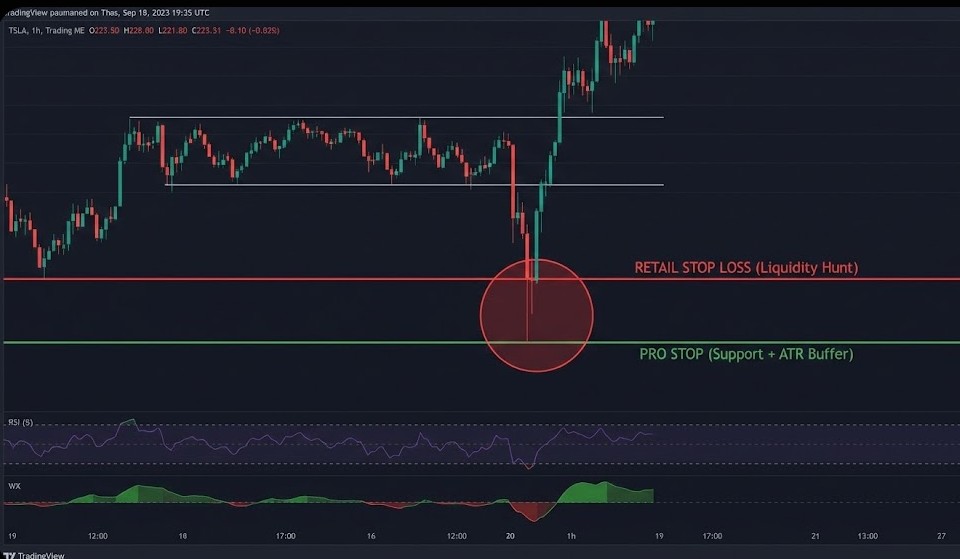
Every active trader has experienced the intense psychological frustration of a flawless stop-out. You spend hours mapping out an immaculate technical setup, execute your entry with absolute discipline, and place your stop-loss precisely where the textbook instructs. Suddenly, a violent, high-volume price wick drops down, pierces your stop-loss order to the exact penny, liquidates your position, and immediately reverses to rocket hundreds of percentage points in your original intended direction. In the aftermath of this execution slippage, it is incredibly easy for an amateur market participant to fall victim to a toxic conspiracy mindset, convincing themselves that their retail brokerage platform is personally tracking their small account or that a malicious market maker is actively rigging the tape against them.
To transition from a frustrated retail speculator into a consistently profitable market specialist, you must completely strip away this victim mentality and analyze the situation through the cold lens of market microstructure. The reality is that institutional operators, hedge funds, and algorithmic market makers are completely indifferent to your individual retail position size. They are not hunting you; they are hunting liquidity pools. Within the framework of auction market theory, price moves continuously to bridge imbalances between supply and demand, naturally gravitating toward the zones containing the densest concentration of resting orders. Because the vast majority of retail participants learn their technical analysis from the exact same mainstream textbooks and public courses, their behavior is hyper-predictable. They routinely stack their stop-market sell orders in the exact same visible locations—immediately beneath a major double bottom, right underneath a clean psychological round number, or a single tick below an obvious daily support floor. To an institutional execution algorithm requiring millions of dollars in opposing order flow to fill a massive block trade, these highly predictable retail clusters represent an oasis of guaranteed execution liquidity.
Understanding how this mechanism functions mechanically completely changes how you build an execution model. When an institutional player needs to accumulate a massive long position without driving the market price up against themselves, they deliberately utilize a concentrated burst of selling pressure to push the asset's spot price directly into the retail stop cluster. The moment the price pierces that support floor, it triggers a massive cascade of automatic stop-market orders. Because a stop-loss on a long position is technically a market order to sell, a violent flood of supply instantly hits the order book. The institution seamlessly steps in as the buyer, absorbing that forced retail liquidation supply at a steep discount with near-zero slippage. Once this liquidity sweep is completed and the opposing supply is entirely exhausted, the market faces a sudden order book imbalance: selling pressure vanishes, institutional buying persists, and the price snaps back aggressively like a rubber band, leaving uneducated retail traders completely left behind on the sidelines.
To effectively survive and capitalize on this institutional environment, a professional must deploy a proactive stop loss hunt trading strategy designed to transform you from the prey into a co-predator trading directly alongside smart money flow. Outsmarting these liquidity raids requires integrating a series of strict, rules-based defense parameters into your daily execution workflow:
The Tactical Implementation of Volatility-Based Padding: To isolate your capital from standard institutional liquidity sweeps, you must completely abandon the habit of placing hard stop-loss orders exactly on visible chart lines. Instead, you should calculate a structural buffer zone utilizing the Average True Range (ATR) indicator. By measuring the underlying asset's true historical volatility over a 14-period baseline, you can programmatically position your invalidation line completely outside the standard hunting parameters. For example, if a stock features an obvious support line at one hundred dollars and its current daily ATR is two dollars, applying a 0.5x ATR padding allows you to position your hard stop-loss at ninety-nine dollars. This technical padding ensures that normal, high-volume institutional sweeps can clear out the obvious retail clusters at one hundred dollars without ever reaching or disrupting your protected capital.
Trading the Reaction via the Sweep-and-Reclaim Blueprint: One of the most powerful mindset shifts a trader can execute is refusing to enter a position before the inevitable liquidity hunt occurs. Instead of aggressively buying the very first test of a major horizontal support level, a disciplined strategist exercises absolute patience and allows the market to break the level first. You sit back and actively monitor the chart layout as the price drives beneath the support floor, waiting for the telltale signs of institutional absorption. If the asset punches through the low, flushes out the retail stops, and then flashes a powerful engulfing candle or a long-wick pin bar that decisively reclaims the broken support floor on expanding relative volume, the trap has officially sprung. This structural pattern—historically referred to as a Wyckoff Spring—serves as your ultimate mechanical entry cue. You execute your long order immediately upon the successful reclaim, nesting your tight invalidation stop comfortably below the absolute bottom of the recent sweep wick, creating a pristine, highly asymmetric risk-to-reward configuration.
Transitioning to Algorithmic, Localized, or Tiered Risk Management: During thin trading environments—such as the early Asian market session, public holidays, or the highly volatile opening minutes of the New York bell—the exchange order books are exceptionally shallow, making it incredibly easy for large operators to intentionally sweep levels. To counter this shallow liquidity risk, sophisticated professionals frequently avoid submitting resting hard stop-loss orders directly onto the public exchange matching engines where they can be mapped via depth of market data. Instead, they run localized algorithmic scripts or custom electronic price alerts on their platform. The automated alert monitors the live tape client-side, and only routes a market or aggressive limit liquidation order to the broker the exact moment a closing candle officially invalidates the technical thesis. Furthermore, if you are scaling into a large position, splitting your total risk capacity into two or three smaller, tiered stop-loss brackets spread across distinct structural layers prevents your entire position from getting wiped out by a single, temporary momentum spike.
By shifting your entire operational paradigm to view stop-loss hunts not as illegal market manipulation, but as the mandatory structural fuel required to drive macro market trends, you unlock true emotional detachment. You stop fighting the natural auction flow of the market and start anticipating exactly where trapped retail liquidity sits. By waiting for the smart money to clear the board before you ever expose a single dollar of capital, you transform your trading hub into a resilient wealth extraction engine, effortlessly flowing with institutional momentum while safely preserving your equity curve for long-term compounding success.
Defeating the Market Makers: Navigating the Stop Loss Hunt Trading Strategy
If you want to master more high-velocity market events, check out our other comprehensive trading guides:
➡️VIX Trading Strategy Guide
➡️How to Trade Economic Data
➡️How to Trade Earnings Reports