
Covered Call Strategy: Generate Monthly Income from Your Stocks
Learn the covered call options strategy to generate consistent monthly income from stocks you own. Step-by-step setup, risk management, and profit calculations included.
Covered Call Strategy: The Landlord’s Guide to Monthly Income (2026)
Introduction: Beyond "Buy and Hold"
At Smart Trades Zone, we treat stock ownership like real estate. Most retail traders buy stocks and "hope" they go up—a strategy purely dependent on capital appreciation. Professional traders know that hope is not a strategy. We treat our portfolios like income-producing assets. We buy stocks and rent them out. This is called "Cash Flow," and the Covered Call is the most fundamental tool for generating it.
The Covered Call allows you to generate a 1-3% monthly dividend on stocks you already own, regardless of whether the market goes up, sideways, or slightly down. In the volatile landscape of 2026, where the market often churns near the $700 level, collecting "rent" is often the difference between a red year and a green one.
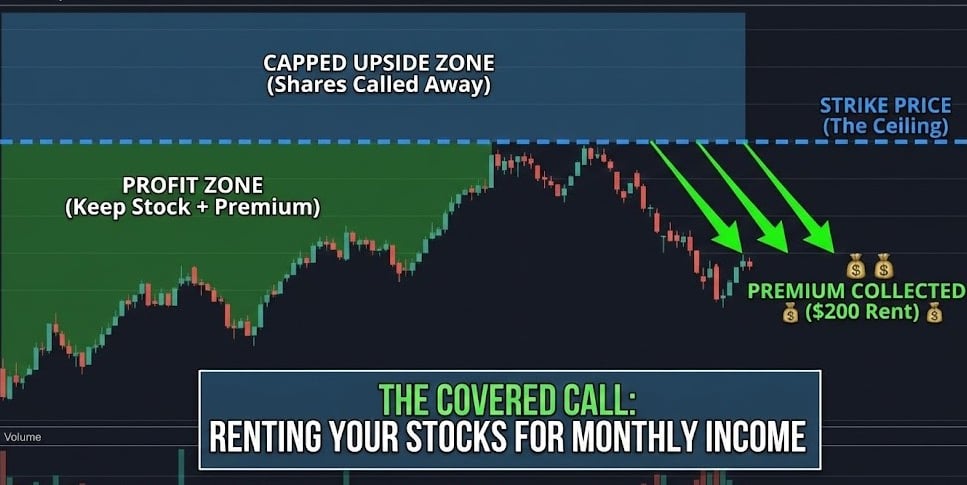
- The Stock = The House. You own the asset.
- The Call Option = The Lease. You agree to let someone else buy your house at a higher price in the future.
- The Premium = The Rent. They pay you cash instantly for this privilege.
Phase 1: The Setup – The "100 Share" Rule
To play this game, you must be a "Landlord." Because one standard option contract represents 100 shares of the underlying stock, you must own shares in multiples of 100 to execute a "covered" trade.
- Requirement: Own at least 100 shares of a high-quality stock or ETF (like SPY).
- The Trade: Sell (Write) 1 Call Option for every 100 shares you own.
- The Strike Price: Pick a price higher than the current market price (Out-of-the-Money).
- The Expiration: Focus on the "Sweet Spot" of 30-45 days out to maximize time decay (Theta).
Phase 2: The Three Professional Outcomes (Win/Win/Win)
Imagine you own 100 shares of a stock at $150. You sell a $160 Call for a $2.00 premium ($200 total income).
- Scenario A: The Sideways/Down Market. The stock stays flat or drops slightly. The option expires worthless. You keep the $200 rent, you still own the stock, and your cost basis is now effectively $148. You simply repeat the process next month.
- Scenario B: The Moderate Rally. The stock rallies to $159. You keep the $9.00/share stock gain AND the $2.00/share rent. This is the ideal outcome where you outperform the market.
- Scenario C: The Vertical Rip. The stock jumps to $170. Your stock is "called away" at $160. You sold your house for a profit ($10.00/share) and kept the rent ($2.00/share). While you missed the move from $160 to $170, you still achieved a Max Profit trade.
Phase 3: The "Delta 30" Rule – Striking the Balance
Selecting the right strike price is an exercise in probability. We use Delta to determine the likelihood of the stock being called away.
- Aggressive Income (The 0.40 Delta): Sells closer to the current price. It offers higher rent but carries a 40% chance your stock will be sold.
- Conservative Income (The 0.20 Delta): Sells further away. Lower rent, but a 80% chance you keep your shares for next month.
- The Institutional Sweet Spot: The 0.30 Delta. This provides a significant premium while giving the stock enough "breathing room" to appreciate. We frequently use this delta when managing positions within the [SPY Intraday Playbook] framework to hedge against intraday volatility.
Phase 4: Understanding Theta and the "Sweet Spot"
Time decay (Theta) is the Covered Call trader’s best friend. Options are "wasting assets." Every day that passes, the value of the option you sold decreases, which is profit for you. Theta decay accelerates significantly within the last 45 days before expiration. By selling 30-45 day "Monthly" options, you are capturing the steepest part of the decay curve, allowing you to collect rent faster than long-term holders.
Phase 5: The Rolling Strategy – Defending Your Position
What happens if the stock rips higher and you don't want to lose your shares? You "Roll" the position.
- The "Roll Up and Out": You buy back your current call (closing the position) and simultaneously sell a new call at a higher strike price and a later expiration date. This allows you to "kick the can down the road," collecting more premium while raising the price at which you are willing to sell your shares.
Phase 6: Volatility and the VIX Connection
The "Rent" you collect is directly tied to the market's fear. When the market is panicking, premiums skyrocket.
- The Strategy: We check the [VIX fear index] before selling calls. If the VIX is high, we can sell calls much further away from the current price and still collect the same amount of rent. This "Volatility Harvest" is how professionals stay profitable during market corrections.
Phase 7: The Dividend Collar (Advanced)
If you own a dividend-paying stock, the Covered Call is even more powerful. You collect the quarterly dividend from the company AND the monthly rent from the option buyer. This "Double Dipping" strategy is how pension funds and massive endowments generate consistent returns that outperform the S&P 500.
Phase 8: When NOT to Sell Covered Calls
1. Before Major Catalysts: Avoid selling calls 24-48 hours before an earnings report. High volatility can cause the stock to gap up 20%, leaving you trapped with a capped profit.
2. The Vertical Bull Market: In a market that is ripping higher with no pullbacks, don't cap your winners.
3. Extreme Oversold Conditions: If the RSI is below 30, a sharp "snap-back" rally is likely. Wait for the bounce before selling your "lease."
Phase 9: Risk Management and Capital Preservation
The greatest risk in a Covered Call is not the stock going up—it is the stock crashing. The $2.00 rent you collected only protects you for the first $2.00 of a price drop.
- Position Sizing: Never put your entire account into one "Rental Property." Use our [Position Sizing Mastery] guide to ensure that no single stock position represents more than 5-10% of your total portfolio, even if you are collecting high rent.
Summary: Boring is Beautiful
Covered Calls are not about hitting home runs; they are about hitting singles every single month. If you can generate 2% a month in premium, that is a 24% annual return before the stock even moves. By treating your portfolio like a landlord treats an apartment complex, you remove the emotional stress of "guessing" the next move. Stop just holding your stocks. Put them to work. Collect the rent.