
Cut Losses Fast: Master the Psychology of Exiting Bad Trades
Overcome the psychological barriers that keep traders in losing positions. Master the mindset, systems, and discipline needed to exit bad trades quickly and preserve capital.
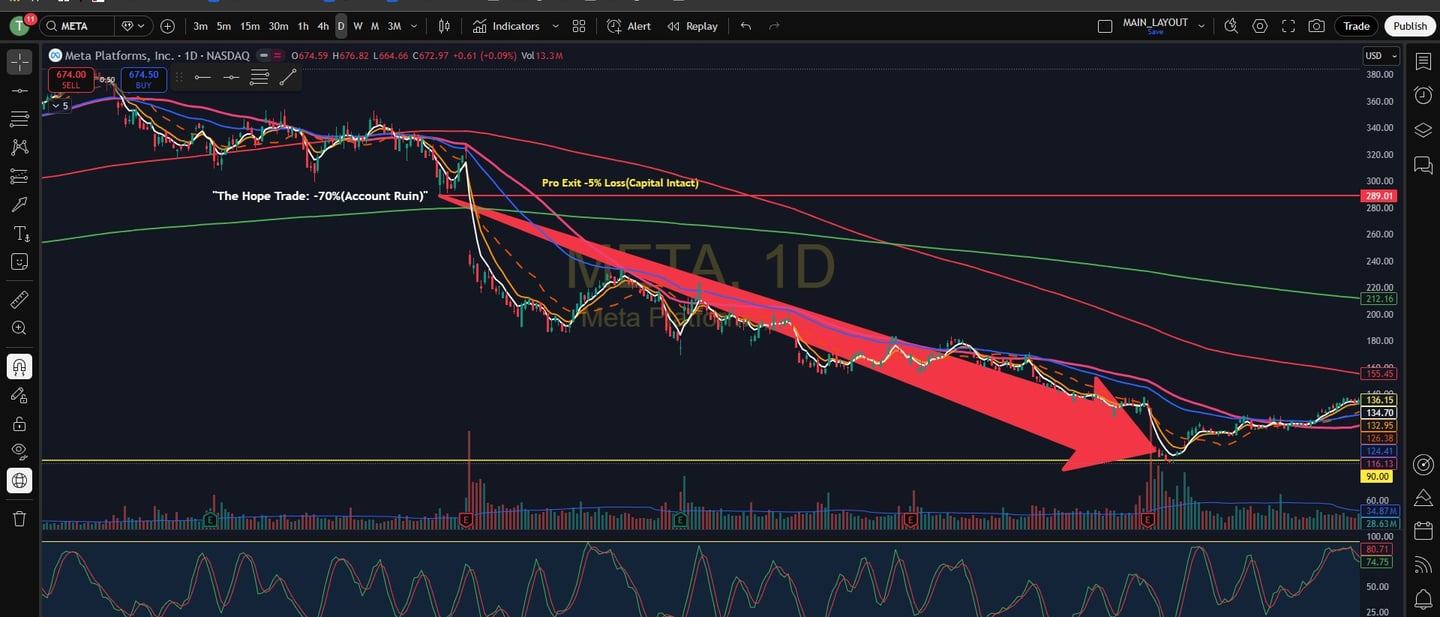
Cut Losses Fast: The Professional’s Survival Protocol (2026)
Introduction: The Psychology of the Fold
In trading, you do not have to be right to be rich. You just have to be safe. The number one reason traders blow up their accounts is not "bad strategy"—it is the inability to accept a loss. They turn a small, manageable expense into a catastrophic disaster because they refuse to admit they were wrong.
At Smart Trades Zone, we view losses differently. We do not view them as "failures" or "bruises to our ego." We view them as Cost of Goods Sold (COGS). Just as a restaurant buys food that sometimes spoils, a trader takes trades that sometimes fail. It is just the cost of doing business. This playbook outlines the psychological and technical protocols to cut losses surgically, without emotion, ensuring you stay in the game long enough for your winners to compound.
Phase 1: The "Invalidation" Mindset
Most amateurs ask: "How much money am I willing to lose?" This is a defensive, fearful question. Professionals ask: "At what price is my thesis wrong?" This is the concept of Invalidation.
* The Concept: You must have a "Reason" for every trade. If that reason disappears, the trade must disappear.
* Scenario: You buy a stock because it broke above a $150 resistance level as identified in our [Support & Resistance Playbook].
* The Reality: The stock falls back to $148.
* The Decision: Your thesis was "Breakout above $150." Since the price is now $148, the breakout has failed. The trade is invalid. You sell immediately. You do not wait for $145 just to "give it a chance." You do not "average down." You exit because the story you told yourself is no longer true.
Phase 2: The "Hope" Protocol – Killing the Virus
Hope is the most dangerous four-letter word in trading. When you are in a losing trade, your brain will invent reasons to stay in. This is "Confirmation Bias"—the brain's way of trying to protect your ego from the pain of being wrong. This is what we call the "Hope Virus."
The Protocol: The moment the word "hope" enters your internal monologue, you must Market Sell immediately.
* If you say: "I hope it bounces at the 200 EMA..." -> SELL.
* If you say: "I’ll just wait for breakeven to get out..." -> SELL.
* If you say: "Maybe the earnings report will save me..." -> SELL.
Your intuition is warning you that you have lost control of the trade and are now at the mercy of the market. In a professional operation, we are never at the mercy of the market. We are the masters of our exits.
Phase 3: The "Time Stop" – Capital as an Employee
Sometimes a trade doesn't hit your stop loss, but it doesn't move in your favor either. It just sits there—dead money. We treat our capital like employees. If an employee isn't working, they are fired. We use a "Time Stop" to free up capital for better opportunities.
* Day Trading: If a trade has not moved in your favor within 3 to 5 candles (e.g., 20 minutes on a 5m chart), cut it. The momentum that triggered your entry has evaporated.
* Swing Trading: If a stock hasn't validated your move within 3 days, cut it.
* The Logic: Dead money is "Opportunity Risk." While your capital is tied up in a stock that is doing nothing, you are missing out on the high-velocity moves happening elsewhere. If the stock isn't doing what you "paid" it to do, fire it and move on.
Phase 4: The "Re-Entry" Rule – Solving FOMO
The fear of cutting a loss often comes from FOMO (Fear Of Missing Out): "What if I sell now and it rips higher immediately after?" This fear keeps traders trapped in sinking ships. We solve this with the Re-Entry Rule.
The Rule: You are allowed to sell now and buy it back 5 minutes later if the setup reforms.
There is no law against re-entering a trade. In fact, professional traders often "ping-pong" in and out of a position as the technical levels shift. By cutting the loss now, you protect your "Mental Capital." You can always buy back in with a clear head. But you cannot re-enter if you are broke because you "held the bag" all the way to zero. Protect the capital first; worry about the re-entry later.
Phase 5: The "Liquidity Trap" and Slippage
In volatile markets, a small loss can turn into a big one because of "Slippage"—the difference between the price you want and the price you get.
The Strategy: This is why we cross-reference the [VIX fear index]. When volatility is high, we cut losses even faster. In a high-VIX environment, liquidity can dry up instantly. If you hesitate for 10 seconds, your 1% loss can become a 5% loss. We use "Market-Out" orders when a level breaks to ensure we are out, regardless of the price.
Phase 6: The Opportunity Cost of Bagholding
Every dollar you have tied up in a losing trade is a dollar that cannot be used for a winning trade.
* The Math: If you are down 50% on a trade, you need that stock to go up 100% just to get back to even.
* The Reality: It is much easier to take a 5% loss today and find a new trade that goes up 10% tomorrow. Bagholding is a choice to let your past mistakes dictate your future potential. We use [Position Sizing Mastery] to ensure our "First Loss" is always small enough that it doesn't damage our ability to take the next trade.
Phase 7: The "Ego-Death" Protocol
To cut losses fast, you must kill your ego. You must reach a point where being "wrong" doesn't hurt.
* Professional Mantra: "I am a risk manager, not a fortune teller."
When you hit your stop, say out loud: "The trade is invalid. I am doing my job by exiting." This verbal confirmation helps rewire your brain to associate cutting losses with "success" (as a risk manager) rather than "failure" (as a trader).
Phase 8: The After-Action Review (AAR)
Once you have cut a loss, the trade isn't over until you've documented it.
- Did I follow my stop?
- Did I hesitate?
- Why did the trade fail?
By documenting the loss immediately, you turn a financial "expense" into a "tuition payment." You paid the market to teach you something. If you don't record the lesson, you paid the tuition but skipped the class.
Summary: Your First Loss is Your Best Loss
There is an old trading saying: "Your first loss is your best loss." It means the loss you take immediately, when the chart first turns against you, is the smallest loss you will ever take. Every second you hesitate, the loss grows—not just in dollars, but in emotional weight. The longer you hold a loser, the harder it becomes to sell.
Cut it fast. Cut it clean. Keep your mental capital intact so you are ready for the next winner. In the world of Smart Trades Zone, we don't pray for a bounce; we plan for the exit.