
Portfolio Diversification Rules: Protect Without Diluting Returns
Master portfolio diversification to protect capital without over-diluting returns. Learn how many positions to hold, sector allocation rules, and correlation management strategies.
Portfolio Diversification Rules: Build an Anti-Fragile Empire (2026)
Introduction: The Myth of Numerical Safety
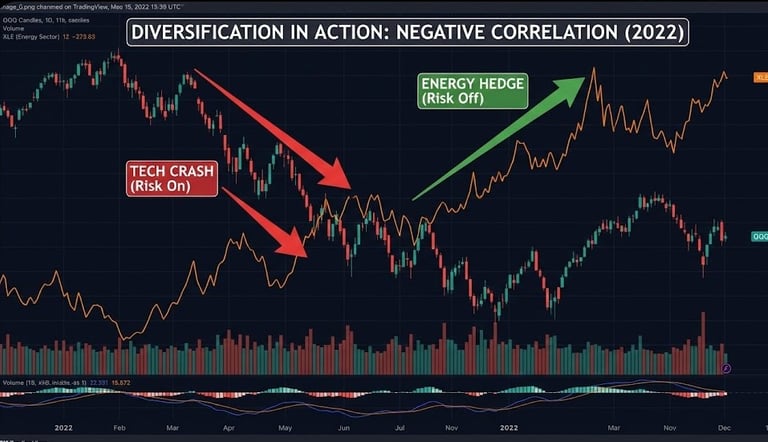
There is a dangerous myth in trading: "To be safe, you should own 20 different stocks." If those 20 stocks are all Tech companies, you are not diversified; you are just complicated. When the Tech sector sells off, your entire portfolio collapses regardless of how many individual tickers you own.
At Smart Trades Zone, we define diversification not by the number of positions, but by the correlation of those positions. Diversification is the art of owning assets that "hate" each other. When one ziggs, the other should zag. This playbook outlines the rules to build a portfolio that is Anti-Fragile—a system that doesn't just survive volatility but thrives because of it.
Rule 1: The "Correlation" Test (Inter-Market Analysis)
Before you add a new trade, you must ask: "Does this move exactly like what I already own?" Most traders fail because they are "Beta-Heavy"—meaning their entire net worth is tied to the direction of the S&P 500.
* The Error: Owning GOOGL, AMZN, and MSFT. While these are different companies, they are the same "theme." They all depend on low interest rates and high consumer spending.
* The Fix: True diversification means mixing asset classes. You want a mix of:
* Growth Assets: (NVDA, TSLA) - These win when the market is optimistic.
* Defensive Assets: (Gold, Long-Term Bonds) - These win when the market is fearful.
* Hard Assets: (Commodities, Real Estate) - These win when inflation is eroding the value of the dollar.
Rule 2: The "Power of 5" Protocol
You do not need 50 stocks to be safe. In fact, "over-diversification" is a slow death for small to mid-sized accounts. Legendary investors have proven that once you own 8-10 uncorrelated assets, the marginal benefit of adding more stocks drops to near zero.
* The Protocol: Limit your active trading portfolio to 5-8 "Best Ideas" across different sectors.
* The Replacement Rule: If you want to buy a 9th stock, you must sell one of the existing 8. This forces you to constantly upgrade the quality of your holdings and prevents "Portfolio Bloat," where you own so much junk you can't track the individual news cycles or technical levels of each position.
Rule 3: Concentration to Get Rich, Diversification to Stay Rich
You must align your diversification strategy with your current stage of wealth.
* The Growth Phase ($5k - $100k): Over-diversification is your enemy. It dilutes your winners. You need Concentration. You should pick 2-3 high-conviction setups—perhaps using the strategies found in our [SPY Intraday Playbook] and watch them like a hawk. You need your winners to "move the needle."
* The Wealth Preservation Phase ($1M+): Your goal shifts to defense. This is where you spread capital across sectors (Real Estate, Crypto, Bonds) to prevent a "zero event."
* Warning: Do not trade like a billionaire hedge fund if you are trying to grow a $5,000 account. You need exposure and "Alpha," not a safety net that caps your upside.
Rule 4: The Sector Rotation Map
Money in the market is like water in a bathtub; it sloshes back and forth between sectors. It rarely leaves the "tub" (the market); it just moves to where the "temperature" is better.
* Risk-On (Hot Economy): Money flows to Technology (XLK) and Consumer Discretionary (XLY).
* Risk-Off (Slowdown): Money flows to Consumer Staples (XLP) and Utilities (XLU).
* Inflationary (Price Hikes): Money flows to Energy (XLE) and Materials (XLB).
By tracking these flows, you can ensure your portfolio isn't fighting the macro current. We cross-reference these rotations with the [VIX fear index]. If the VIX is spiking, we rotate out of high-beta tech and into "Defensive Value" or cash.
Rule 5: Beta-Weighting – Your Portfolio "Speedometer"
If you own 5 different stocks, how do you know how much "risk" you actually have? We use Beta-Weighting to see our total exposure relative to the S&P 500.
* The Concept: If your portfolio has a Beta of 2.0, it means if the SPY drops 1%, your portfolio will likely drop 2%.
* The Goal: During uncertain times, we use [Position Sizing Mastery] to lower our portfolio beta. We want to ensure that if the "market house" burns down, our individual "rooms" are fire-proofed.
Rule 6: The "Designated Survivor" (The Cash Wedge)
Cash is a position. In a crashing market, cash is the best-performing asset because its "purchasing power" increases as asset prices drop.
* The Rule: Always maintain a 10-20% "Dry Powder" (Cash) position.
* The Logic: This isn't just for safety; it's for opportunity. Having cash when everyone else is receiving margin calls allows you to buy "Generational Bottoms" while others are panicking. Cash is the ultimate tool for anti-fragility.
Rule 7: Avoiding the "Cluster" Risk
The most common way traders get wiped out is through "Hidden Correlations." For example, if you own a Bitcoin mining stock, a tech stock, and a crypto-payment processor, you might think you are diversified. You are not. All three are tied to the price of Bitcoin.
* The Audit: Periodically look at your P&L on a red day. If everything you own is down the exact same percentage, you have a "Cluster Risk." You must prune the weakest positions and rotate into a different asset class (like Gold or Energy) to break the correlation.
Rule 8: The Rebalancing Act
Diversification is not a "set and forget" strategy. Over time, your winners will grow to become too large a portion of your portfolio. If you bought NVDA at $100 and it's now $800, it might represent 50% of your account.
* The Action: You must "Harvest" profits from your winners and "Seed" them into under-performing but high-quality sectors. This forces you to Buy Low and Sell High—the fundamental law of wealth.
Summary: The Sleep-Well Portfolio
A perfectly diversified portfolio usually has one asset that is annoying you. If everything you own is going up at the same time, be careful—that means everything can crash at the same time.
True diversification means having a "Designated Survivor"—a portion of your portfolio that thrives when the rest of the world is panic-selling. This is how you survive the "Black Swan" events that wipe out the amateurs. Stop trying to find the one perfect stock; build a team of assets that can win in any weather.