
Cash-Secured Puts: Get Paid to Buy Stocks at Your Target Price
Master cash-secured puts to generate income while waiting to buy stocks at your ideal price. Learn setup, risk management, and how to collect premium with this conservative options strategy.
Cash-Secured Puts: The Professional’s Way to Buy the Dip (2026)
Introduction: Beyond the Limit Order
At Smart Trades Zone, we call this "The Warren Buffett Strategy." It is the art of acquiring high-quality assets at a discount, while generating income while you wait. Most amateur traders use "Limit Orders" to buy a stock at a lower price. They wait for weeks, and if the stock hits their price, they get filled. They get paid nothing for the time their capital was sitting idle.
Professional traders sell Cash-Secured Puts (CSPs). They also place an order to buy at a lower price, but they get paid cash upfront for the privilege. In 2026, where market volatility creates frequent "pockets of liquidity," being the house that sells insurance is a far more profitable venture than being the person buying it.
Phase 1: The Mechanics – Being the Insurance Company
When you buy a Put, you are buying insurance against a crash. When you Sell a Put, you are acting as the insurance company.
* The Agreement: You promise to buy 100 shares of a stock (e.g., AMD) at a specific price (Strike Price) by a specific date.
* The Reward: The buyer pays you a "Premium" (Cash) instantly for taking on this obligation.
* The "Secured" Part: You must have the cash in your brokerage account to buy the shares if the price drops. This is a conservative strategy; we never do this on margin.
Phase 2: The 3 Scenarios (Win / Win / Acquire)
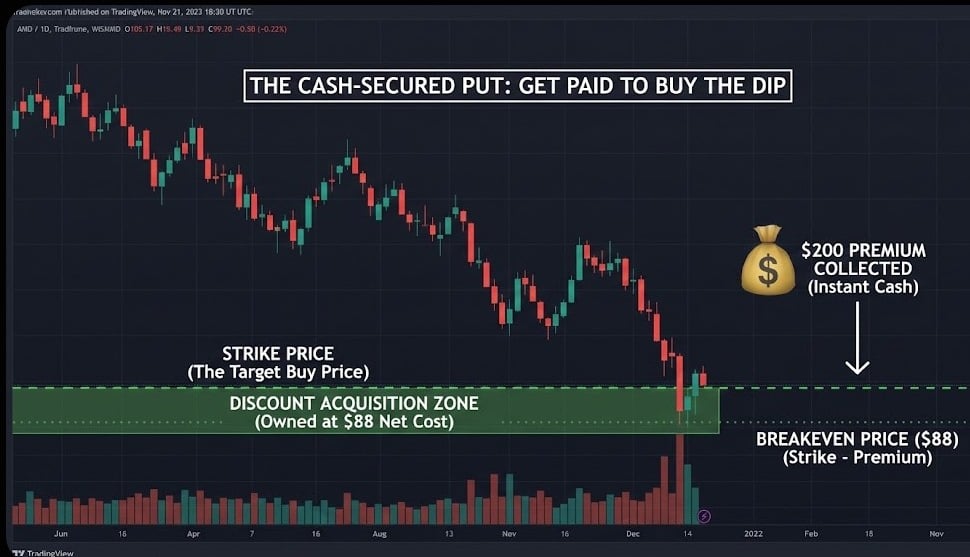
Example: AMD is trading at $100. You want to own it, but only if it drops to $90. You Sell the $90 Put for next month and collect $2.00 ($200) in premium immediately.
1. Scenario A: AMD Rallies (The Income Consolidation): AMD goes to $110. Your Put expires worthless. You keep the $200. You didn't get the stock, but you made a 2% return in 30 days on the cash you were holding anyway. You repeat the trade next month.
2. Scenario B: AMD Stays Flat (The Theta Burn): AMD closes at $95. Your Put expires worthless. You keep the $200. This is pure income generated by time decay.
3. Scenario C: AMD Crashes (The Discount Acquisition): AMD drops to $89. You are "assigned" the shares at $90. While a retail trader might be upset, you are buying the dip you wanted. Because you kept the $2.00 premium, your actual cost basis is $88 ($90 Strike - $2 Premium). You bought the stock cheaper than the guy who used a standard limit order.
Phase 3: The "Delta 30" Selection Process
Just like our [Covered Call Strategy], picking your entry point is a game of probability.
* The Aggressive Entry (0.45 Delta): You sell a put very close to the current price. You get a massive premium, but there is a nearly 50/50 shot you will have to buy the shares.
* The Conservative Collector (0.15 Delta): You sell a put far "out of the money." You get less rent, but you have an 85% probability of keeping your cash and the premium without ever owning the shares.
* The Sweet Spot (0.30 Delta): This is our standard entry. It offers a healthy balance of premium and a reasonable probability of acquiring the stock at a discount.
Phase 4: Monitoring Volatility – The VIX Factor
The amount of premium you collect is entirely dependent on market fear.
* When to Sell: We look for spikes in the [VIX fear index]. When the VIX is high, put premiums are "juiced." You can sell a put much further away from the current price and still collect a high premium.
* The "IV Crush": Once volatility settles down, the value of the put you sold drops rapidly (which is profit for you).
Phase 5: The "Don't Catch a Falling Knife" Rules
The only real risk with this strategy is if the stock crashes massively (e.g., from $100 to $40). You are still obligated to buy at $90.
* Rule 1: NEVER sell puts on a stock you do not want to own for the next 5 years.
* Rule 2: Avoid selling puts on "meme stocks" just for the high premium. High premium = High risk of a permanent crash.
* Rule 3: Always remain cash-secured. If you sell more puts than you have cash for, one bad week in the [SPY Intraday Playbook] levels can result in a margin call.
Phase 6: The Wheel Strategy (The Full Cycle)
Selling Cash-Secured Puts is the engine that starts the "Wheel".
1. Phase 1: Sell Cash-Secured Puts until you are assigned the stock.
2. Phase 2: Once you own the shares, you become a "Landlord" and start selling Covered Calls against them.
3. Phase 3: When the stock eventually rallies above your call strike, the shares are sold at a profit, and you go back to Step 1.
This cycle is how professional income traders generate returns regardless of market direction.
Phase 7: Rolling for a Credit
If the stock drops and you aren't ready to buy it yet, you can "Roll the Put." You buy back your current put and sell a new one for a later date (usually at the same strike or lower). This allows you to collect even more premium while delaying the purchase of the shares.
Phase 8: Risk Management and Capital Allocation
Since this is a cash-heavy strategy, you must be disciplined with your "Buying Power." We use [Position Sizing Mastery] to ensure we aren't putting too much capital into a single sector. If you sell puts on five different semiconductor stocks and the chip sector crashes, your whole account is at risk. Diversification in your "Put Selling" is your primary defense.
Summary: The Patient Hunter
Selling Cash-Secured Puts is the ultimate strategy for the patient investor. You are essentially telling the market: "I will buy this great company, but only at MY price. And you have to pay me while I wait".
By acting as the insurance provider rather than the victim of volatility, you turn time decay into your greatest ally. Stop placing free Limit Orders. Start selling Puts.