
Iron Condor Strategy: Profit from Sideways Markets with Defined Risk
Master the iron condor options strategy to generate income from range-bound stocks. Learn this four-leg neutral strategy with defined risk on both sides and consistent profit potential.
Iron Condor Mastery: Profit When the Market Does Nothing (2026)
Introduction: The Myth of Direction
At SmartTradesZone, we don't believe in the stress of predicting market direction; we believe in the math of probabilities and boundaries. While retail traders gamble on "up or down," we use the Iron Condor to act as the casino, collecting premium from the 70% of the time the market simply chops sideways. By integrating High IV Rank filters with the systematic defenses found in our [SPY Intraday Playbook], we empower you to turn stagnant price action into a consistent monthly income stream.
In the modern market of 2026, 90% of traders wake up asking the same question: "Will the market go up or down today?" They obsess over headlines and indicators, trying to predict the unpredictable. This is a stressful, low-probability game. The top 10% of traders ask a different question: "Where will the market likely NOT go?"
They don't care about direction; they care about boundaries. The Iron Condor is the premier strategy for this mindset. It is designed to profit from the one thing the market does 70% of the time: chop sideways. By "selling the box," you act as the casino, collecting rent from speculators betting on a breakout that never comes. This playbook teaches you how to turn "dead money" into a consistent income stream.
Phase 1: The Anatomy of the Cage
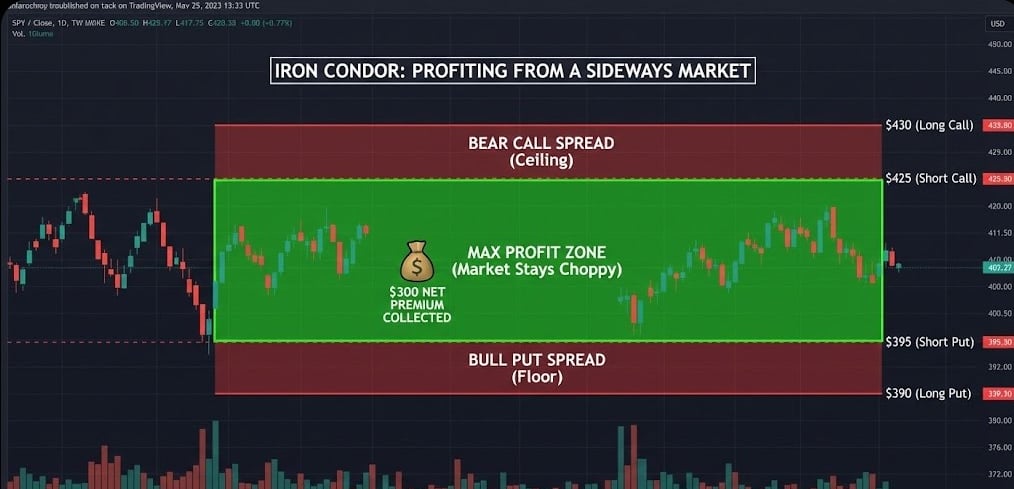
An Iron Condor is a market-neutral strategy built from four different option contracts. It is essentially the simultaneous sale of a Bear Call Spread (The Ceiling) and a Bull Put Spread (The Floor).
* The Ceiling (Short Call Vertical): You sell a Call above the current price and buy a further Out-of-the-Money (OTM) Call for protection. This profits as long as the stock stays below this level.
* The Floor (Short Put Vertical): You sell a Put below the current price and buy a further OTM Put for protection. This profits as long as the stock stays above this level.
* The Sweet Spot: The zone between your Short Call and Short Put is your "Profit Cage." As long as the stock price remains inside this cage at expiration, you keep 100% of the premium collected.
Phase 2: The Selection Criteria (The "High IV" Filter)
You cannot force an Iron Condor onto any stock. You need specific volatility conditions to ensure the "math of the house" is in your favor. The most critical factor is Implied Volatility (IV) Rank.
* The Rule: Only trade Iron Condors when IV Rank is above 30 (preferably above 50).
* The Logic: When IV is high, option premiums are expensive because fear is "priced in." High IV allows you to set your "Ceiling" and "Floor" much further away from the current price while still collecting a fat credit.
* The Mistake: Selling Condors in low IV environments (IV Rank < 20). When volatility is low, premiums are cheap. To make a meaningful profit, you have to place your strikes dangerously close to the price, which often results in getting "run over" by a minor move. We cross-reference the [VIX fear index] to ensure we are selling during a spike in fear, not during a period of market complacency.
Phase 3: Setup & Delta Selection
We use "Delta" as our probability gauge to define the boundaries of our cage.
* The Short Strikes: Target the 0.15 Delta to 0.20 Delta on both sides. This implies the market sees an 80-85% chance that your options will expire worthless.
* The Wing Width: Buy your protection legs (Long Call/Put) $5 or $10 away from your short strikes.
* Wider Wings: Higher risk, but higher credit collected and higher probability of profit.
* Narrower Wings: Lower risk, but lower credit (making it harder to reach breakeven after commissions).
* Recommendation: Use $5 widths for stocks under $200; use $10 widths for major indexes like SPY or QQQ.
Phase 4: Understanding Theta and Time Decay
The Iron Condor is a "Theta-positive" trade. This means every day the stock stays within your cage, the value of the options you sold decreases—which is profit for you. Theta decay is non-linear; it accelerates as you get closer to expiration. We typically enter these trades 45 days out to capture the steepest part of the decay curve without the extreme "Gamma risk" found in the final week of an option's life.
Phase 5: Management & Defense
The "Set and Forget" mentality is a recipe for disaster. Professional traders manage the trade to lock in wins and minimize damage.
Rule 1: The 50% Take-Profit
Never hold until expiration unless the stock is dead center in your range and volatility is crushed. "Gamma Risk" (the risk of rapid price changes) explodes in the final days.
* The Protocol: Place a "Good-Til-Cancelled" (GTC) limit order to buy back the Condor at 50% of the credit received. If you sold the box for $2.00, set an auto-close at $1.00. This increases your win rate significantly and reduces your time in the market.
Rule 2: The Tested Side Defense
If the stock rallies hard and threatens your Call side, your Put side is likely losing value rapidly.
* Roll the Untested Side: Buy back the Put spread for pennies and sell a new, higher Put spread. This collects more credit, which widens your overall breakeven point and reduces the maximum possible loss on the trade. This is a common tactic when the [SPY Intraday Playbook] levels suggest a sustained trend is forming.
Phase 6: The "Cost Basis" Hedge
An Iron Condor isn't just a standalone trade; it can be used to hedge existing long positions. If you own 100 shares of a stock, selling a "wingless" or "wide-winged" Iron Condor can provide enough premium to offset a minor drop in the stock price, similar to how we utilize [Position Sizing Mastery] to manage total account exposure.
Phase 7: The Psychology of Neutrality
Trading Iron Condors requires a rewire of your brain.
* Boredom is Profit: You want the chart to look boring. Big moves, news events, and vertical rips are the enemy.
* Trust the Probabilities: Your P&L will fluctuate wildly. You might be down $50 on Tuesday and up $100 on Thursday simply because of a change in Implied Volatility. You must let the math play out.
* Avoid Earnings: Never hold an Iron Condor through an earnings report. The "Binary Event" can cause a gap that blows right through both your short and long strikes before you can react.
Phase 8: Advanced Strike Adjustment
As you become a master, you will learn to "slant" your condors. If you have a slightly bullish bias, you can sell your Put spread closer to the price (higher delta) and your Call spread further away (lower delta). This allows you to lean into the trend while still profiting if the market goes nowhere.
Summary: The Landlord of the Market
Stop trying to predict the next home run. Be the landlord. With the Iron Condor, you are renting out space above and below the market. Sometimes the tenants get rowdy (volatility), but if you screen for High IV, manage your exits at 50% of max profit, and defend your wings with discipline, you collect the rent checks while directional traders stress over every tick. You aren't betting on the market to move; you're betting on the market to stay human.