
Overcoming Fear and Greed in Trading: Master Your Emotions and Win
Learn proven strategies to overcome fear and greed in trading. Master emotional control, avoid panic selling, stop overtrading, and build the discipline that separates winning traders from losers.
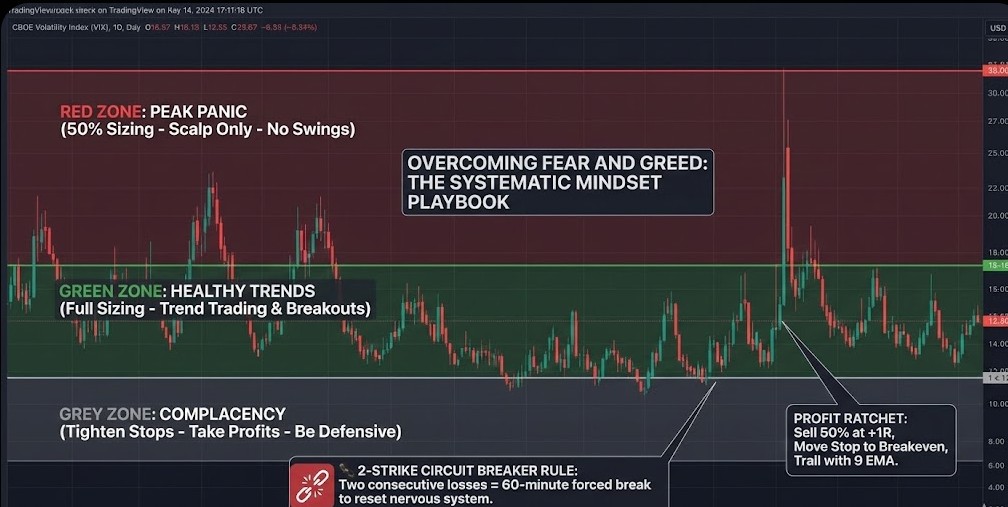
Overcoming Fear and Greed: Mastering the Biological Battle (2026)
Introduction: The Survival Paradox
The human brain was designed for survival on the savannah, not for trading the S&P 500. For our ancestors, fear kept them away from predators, and greed ensured they gathered enough food to survive the winter. These instincts are hardwired into our DNA. However, in the 2026 market, these survival mechanisms become your greatest liabilities.
At Smart Trades Zone, we recognize that trading is 10% strategy and 90% psychology. You can have a "Holy Grail" system, but if you cannot control the chemicals surging through your brain, you will eventually self-destruct. This playbook is your manual for overriding your biological hardwiring and building the mental discipline required to join the top 1% of profitable traders.
Phase 1: The Amygdala Hijack (Understanding Fear)
Fear in trading isn't just a "feeling"—it’s a physical event. When a trade moves against you, your "Amygdala"—the lizard brain—triggers a fight-or-flight response. Your heart rate increases, your vision narrows, and your logical "Prefrontal Cortex" (the part that follows your trading plan) effectively shuts down.
The Manifestations of Fear:
1. Hesitation: You see a perfect setup from the [Support & Resistance Playbook], but you "freeze" and don't take it because you’re afraid of losing.
2. Premature Exit: You exit a winning trade far too early because you’re afraid the market will "take back" your small profit.
3. Moving Stops: You move your stop loss further away because you’re afraid to admit the trade is over, turning a paper cut into a broken bone.
The Fix: We neutralize fear through the [Position Sizing Mastery] protocol. If you are afraid of a trade, your position is too big. Period. When your risk is capped at 1%, the lizard brain stays quiet.
Phase 2: The Dopamine Loop (Understanding Greed)
Greed is the "Dopamine" response. When you win a trade, your brain releases a surge of pleasure-inducing chemicals. You feel invincible. You feel like the market is an ATM. This is the most dangerous moment for a trader.
The Manifestations of Greed:
1. Oversizing: You had three wins, so you double your risk on the fourth trade to "get rich quick."
2. Revenge Trading: After a loss, you immediately jump back in with a larger size to "win back" what belongs to you.
3. Ignoring Targets: You hit your profit target, but you refuse to sell because you think the stock is "going to the moon."
The Fix: We neutralize greed through the [Bankroll Management System]. By withdrawing 50% of profits, you make the money "real" and disconnect your ego from the rising digits on the screen.
Phase 3: The "Next Trade" Mindset
Professional traders view trading as a single, continuous game played over 10,000 trades. Amateurs view every trade as a life-or-death event.
- The Amateur Mindset: "If I lose this trade, I’m a failure."
- The Professional Mindset: "This trade is just one of the next 1,000. The outcome of this specific trade is statistically irrelevant."
When you detach your self-worth from the outcome of a single trade, fear vanishes. You become an operator executing a process, not a gambler hoping for a result.
Phase 4: Developing "Process-Based" Discipline
To overcome emotion, you must stop focusing on the "P&L" (Profit and Loss) and start focusing on "Grade A Execution."
- A "Good Trade" is one where you followed your plan perfectly, even if it resulted in a loss.
- A "Bad Trade" is one where you broke your rules but made money by luck.
In the long run, the trader who makes "Good Trades" builds an empire. The trader who relies on "Bad Trades" eventually gives it all back to the market with interest.
Phase 5: The Pre-Trade Ritual (The Mental Warmup)
Athletes don't run onto the field without warming up. Traders shouldn't open their platform without a mental check.
1. Self-Audit: "Am I angry, tired, or stressed from my personal life?" If yes, do not trade.
2. Risk Review: "If this trade hits my stop, am I okay with losing $X?"
3. Scenario Planning: "What will I do if the stock gaps up? What if it stays flat for two hours?"
By visualizing the "Worst Case Scenario" before it happens, you prevent the Amygdala Hijack. You have already decided what to do, so there is no need to panic.
Phase 6: The Post-Trade Cool Down
After a big win or a big loss, your brain is chemically compromised. You are either "High" on dopamine or "Low" on cortisol.
The Rule: After a 2R win or a 1R loss, step away from the screen for at least 15 minutes. Reset your baseline. If you don't, your next trade will be influenced by the emotions of the previous one. This is how "Winning Streaks" turn into "Giving it all back."
Phase 7: Embracing the Boredom
Retail traders seek "excitement." They want the rush of the gamble. Professional trading is remarkably boring. It is the patient waiting for a specific set of criteria to be met, executing the trade, and then waiting again.
If your heart is pounding while you are in a trade, you aren't trading—you are gambling. We strive for "Equanimity"—the ability to remain calm and composed regardless of whether the market is ripping higher or crashing through the floor.
Phase 8: The Power of the Trading Journal
The only way to see your emotional patterns is to record them. In your journal, you must have a column for "Emotions."
- "I felt anxious during the hold."
- "I felt greedy and didn't take profit."
Over 100 trades, you will see your "Psychological Edge" (or lack thereof). You will realize that your biggest losses didn't come from "market conditions," they came from your own hands breaking the rules.
Summary: The Unshakable Operator
You do not need to "kill" fear and greed; you simply need to move them to the passenger seat while Discipline drives the car. By using strict position sizing, process-based execution, and constant self-auditing, you build a mental fortress that the market cannot penetrate.
Stop trying to predict the market and start mastering yourself. The market is a mirror; it shows you exactly who you are. If you don't like what you see in your P&L, change your mindset. Master your biology, or your biology will master your bank account.