
Bull Call Spread: Profit from Bullish Moves with Limited Risk
Master the bull call spread to capitalize on moderate bullish moves while reducing cost and risk. Learn setup, break-even calculations, and when to use this popular directional options strategy.
Bull Call Spread: Mastering Financed Directional Trading (2026)
Introduction: The Strategic Evolution of the Bull
At Smart Trades Zone, we define this as "Financed Directional Trading." You aren't just betting on a move; you are engineering a trade where the math is tilted in your favor from the moment you click "buy." Most retail traders are stuck in a binary mindset: they are either "long" the stock or they are "gambling" on out-of-the-money (OTM) calls. While buying shares is safe, it is capital-intensive and offers low leverage. Conversely, buying naked calls offers massive leverage but introduces a catastrophic enemy: Theta (Time Decay).
The Bull Call Spread (also known as a Long Call Vertical Spread) represents the strategic middle ground used by professional floor traders and hedge funds. It allows you to maintain bullish exposure with significant leverage, but it does so with a "seatbelt" on. By selling an expensive, further out-of-the-money call to help finance the purchase of your primary call, you effectively lower your cost basis, reduce your breakeven point, and neutralize the daily "bleed" of time decay.
Phase 1: The Anatomy and Mechanics
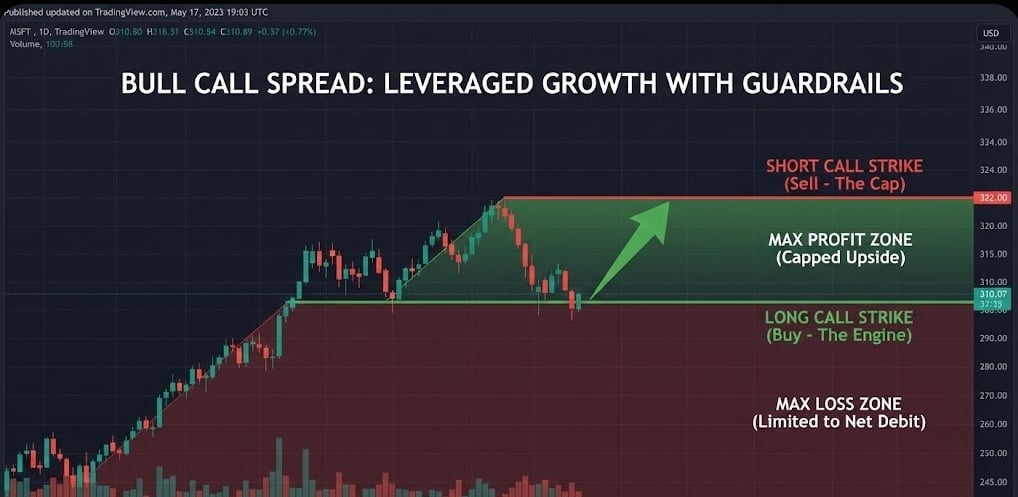
The Bull Call Spread is a "Debit Spread," meaning it requires an initial cash outlay. It consists of two simultaneous transactions on the same underlying security with the exact same expiration date:
- The Engine (Long Call): You purchase a Call option with a strike price close to the current market price (At-The-Money or slightly In-The-Money). This is your primary source of profit.
- The Financing (Short Call): You simultaneously sell a Call option with a higher strike price (Out-Of-The-Money).
The credit you receive from selling the higher strike call is immediately applied to the cost of the lower strike call. If a naked call costs $6.00 ($600), and you sell the higher strike for $2.50 ($250), your total "Net Debit" is now only $3.50 ($350). You have reduced your total risk by 41% before the stock has even moved a penny.
Phase 2: The Strategic Edge – Why Capping Gains is Smart
The biggest psychological hurdle for new traders is the "Capped Profit" aspect. This is the amateur's trap. In reality, stocks rarely move in vertical lines; they move to the next level of technical resistance and consolidate. By selling a call at that resistance level, you are essentially trading a "lottery ticket" chance of an infinite move for the immediate, guaranteed benefit of a lower cost and a higher probability of profit.
- Theta Neutralization: Every day you hold an option, it loses value. However, in a spread, while your long option is losing value, the option you sold is also losing value—and that gain belongs to you. This "Theta offset" is a critical defense when the [VIX fear index] is low and market movements are slow and grinding.
- Volatility Protection: If the market experiences a "volatility crush," a naked call will lose value even if the stock stays flat. In a spread, the volatility change affects both legs, keeping your P&L much more stable.
Phase 3: The Setup – Selection and Entry Criteria
Precision is the difference between a professional and a gambler. We only deploy the Bull Call Spread under specific technical and environmental conditions.
- Technical Catalyst: We look for a "High Conviction" bullish setup. This could be a breakout from a 6-month base or a successful retest of a major moving average.
- Implied Volatility (IV) Filter: Spreads are a "Net Long Vega" trade. We prefer entering when IV is in the lower 50th percentile of its yearly range. You want to buy the "Engine" when it’s cheap.
- Expiration Selection: Target the 30-45 Days to Expiration (DTE) window. This provides enough "runway" for the move to materialize without the extreme price swings seen in weekly options.
Phase 4: Strike Selection (The Delta Protocol)
Strike selection is where the "Business Plan" of the trade is written.
- The Long Strike (The Engine): Target a 0.55 to 0.60 Delta. This ensures your option has high "Intrinsic Value" and will move closely with the stock price.
- The Short Strike (The Ceiling): Target a 0.25 to 0.30 Delta. Look at your chart; find the next major area of supply using our [Support & Resistance Playbook]. Place your short strike right at that level. There is no point in having an "infinite" profit ceiling if the stock has zero chance of breaking through major institutional resistance.
Phase 5: The Math of the Empire (Risk vs. Reward)
Imagine Stock ABC is trading at $150.
- Buy the $150 Call for $7.00.
- Sell the $165 Call for $3.00.
- Net Debit (Total Risk): $4.00 ($400 total).
- Max Profit: (Width of Strikes - Net Debit) = ($15 - $4.00) = $11.00 ($1,100).
- Breakeven: (Long Strike + Net Debit) = ($150 + $4.00) = $154.00.
The Comparison: To make $1,100 on the stock, you would need to buy 100 shares for $15,000 and have it move to $161. With the spread, you achieve the same profit with only $400 at risk. This efficient use of capital is why the spread is a staple of our [SPY Intraday Playbook] when we identify a multi-day trend forming.
Phase 6: Management and Defensive Protocols
A trade is a living organism; it must be managed with cold discipline.
- The 50% Rule: We do not wait for expiration. As the stock approaches your short strike, the risk-to-reward ratio worsens. Close the entire spread when you reach 50-75% of your maximum potential profit.
- The Technical Stop: If the stock breaks the support level that triggered our entry, we exit.
- The Financial Stop: If the spread loses 50% of its initial value, we kill the position. We never let a "bad trade" turn into an account-ender. Using [Position Sizing Mastery] ensures that even a 50% loss on a single spread only impacts our total account by 1%.
Phase 7: Advanced Rolling Strategies
If the stock hits your short strike very early in the cycle, don't just sit there. You can "Roll the Spread." You close the current position for a profit and open a new Bull Call Spread at higher strikes to continue capturing the trend. This allows you to scale your profits while simultaneously taking your initial "seed money" off the table.
Phase 8: The Psychology of the Spread Trader
The Bull Call Spread requires you to kill your greed. You must accept that you will not make "millions" on a single trade if the stock gaps up 50%. Instead, you are choosing a higher win rate and a smoother equity curve. You are trading for a living, not for a jackpot.
Summary: The Professional’s Edge
The Bull Call Spread is the ultimate tool for the disciplined, bullish trader. It eliminates the "lotto ticket" mentality and replaces it with a structured, mathematically sound business plan. You accept a limit on your upside in exchange for a significantly lower cost of entry, a higher probability of success, and a shield against the ravages of time decay. Stop buying "naked" calls and hoping for a miracle. Start building "spreads" and trading with conviction.